

Published October 5, 2026. Last updated October 10, 2026. By Andrew M. Tan.
A good brush earns your attention the moment it touches a miniature. The point stays where you put it. Paint comes off in a controlled stroke. You can settle into the small details of the model and trust the brush to follow your hand.
My favorite miniature painting supplies start with a dependable brush, a wet palette, and brush soap, followed by tools chosen for the model I want to paint. I’ve written about a lot of hobby products on Tangible Day, and this page brings together the ones I’d suggest taking a closer look at, with links to the reviews and guides behind each choice.
There are everyday supplies here, a couple of bigger upgrades, and a water pot. Yes, a water pot. I have opinions about that, too.
This collection will change as I try new tools and revisit older favorites. The individual reviews carry the longer explanation, including the things that annoyed me. You’ll find those links beside each recommendation.
Key takeaways
For everyday brushwork, I’d start by comparing the Army Painter Regiment with the Winsor & Newton Series 7. A wet palette helps when you want more time to mix colors. Masters brush soap belongs beside either brush. The OptiVISOR and Patriot 105 make sense when you have a particular reason to add magnification or airbrushing to your setup.
My favorite miniature painting supplies at a glance
| Supply | Where I would use it |
|---|---|
| Army Painter Wargamer Regiment | Everyday brushwork |
| Army Painter Wet Palette | Mixing colors and keeping acrylic paint workable |
| Masters Brush Cleaner and Preserver | Routine brush care |
| Citadel Colour Painting Handle MK2 | Holding and turning a based miniature |
| Winsor and Newton Series 7 Size 1 | Controlled layers and detail work |
| Army Painter Masterclass Drybrush Set | Exploring texture and raised detail |
| Vallejo Surface Primer Grey | A neutral starting surface for painting |
| Vallejo Model Air Steel 71065 | Bright steel with a regular brush |
| Citadel Water Pot | A steady rinse cup with a brush rest |
| Milliput Standard Yellow Grey | Filling gaps and building small forms |
| Donegan OptiVISOR DA5 | Seeing fine detail with room for a brush |
| Badger Patriot 105 | An airbrush for regular miniature painting work |
1. Army Painter Wargamer Regiment
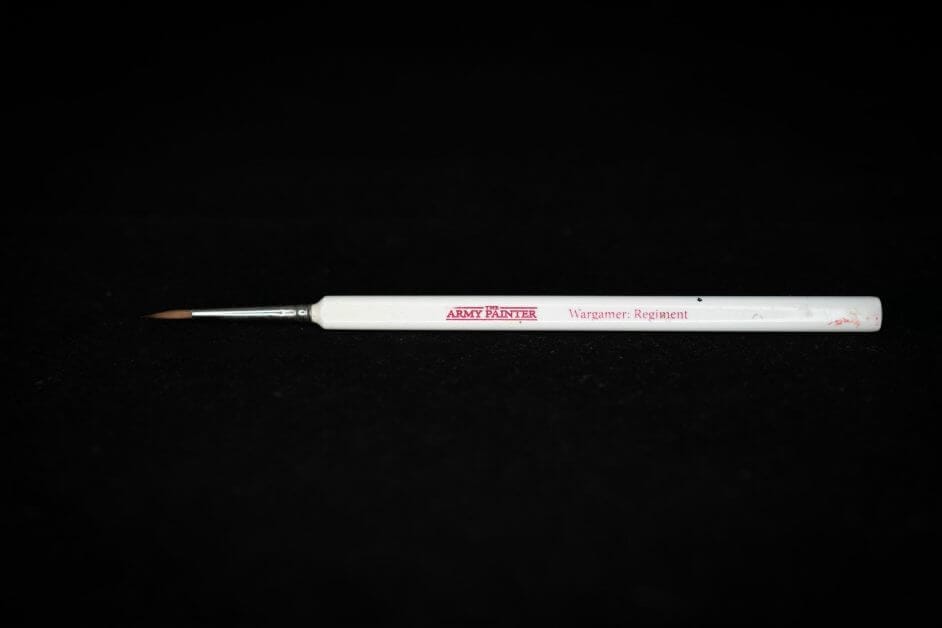
The Regiment has been one of my everyday workhorse brushes. Its triangular handle stays put on the desk, and the brush carries enough paint for useful stretches of work while retaining a point for the smaller details. In my brush roundup, I describe how mine kept a respectable point after a year of heavy use.
This is a good brush to consider when you’re painting a unit of infantry and want to move comfortably between armor panels, cloth, and smaller features. Natural hair still needs care. Rinse regularly and clean it after the session. The next item with a glamour problem is brush soap; we’ll get to that shortly.
Explore my favorite brushes for painting miniatures
2. Army Painter Wet Palette

I used the Army Painter Wet Palette for more than a year before writing my review. It fits into a modest workspace, gives me a useful surface for mixing, and has a separate tray for brushes and small tools. The paper and sponge are straightforward consumables to replace.

The lid deserves a caveat. The version I reviewed has no rubber seal, and it doesn’t snap securely into place for travel. I like it as a painting tool on the desk. Anyone planning to carry a loaded palette should read that part of the review carefully.
A wet palette is especially useful when you want to work through a color mixture at your own pace. You can adjust a highlight, test it on the model, and return to the mixture while it’s still workable. My wet palette tips and tricks cover water level, paper care, and getting more use from those color mixtures.
Read my Army Painter Wet Palette review
3. Masters Brush Cleaner and Preserver

Brush soap has a fairly quiet career. It waits until you’ve finished the interesting part, then helps remove the paint left in the bristles. Masters is the simple cleaner I recommend for that routine in my brush care guide.

Rinse the brush, work up a gentle lather, and rinse again. Keep the pressure light around the tuft. For dried paint deeper in the brush, the full guide also discusses a separate liquid cleaner.
If you’re buying a nicer brush, include its care in the decision. A small cleaning habit makes the purchase much easier to justify, and it gives the next painting session a better starting point.
Follow my brush cleaning guide · Check the current Amazon price
4. Citadel Colour Painting Handle MK2

The original Citadel painting handle was comfortable enough that I bought three. That let me move between models while paint dried. The spring-loaded clamp also made it easy to turn a miniature around and get a brush into awkward places.

The MK2 changes the grip shape while keeping the same basic idea. Check that your model’s base fits the clamp before ordering. Larger bases and unusual shapes need a different holder, and a big miniature can make a small handle feel top-heavy.
For painters who attach a miniature to its base early, this is a useful little desk tool. My full review also covers the XL and Assembly handles, which serve different jobs.
Read my Citadel painting handle review · Check the current Amazon price
5. Winsor and Newton Series 7 Size 1

The Series 7 is my premium all-purpose brush pick. A size 1 gives you a sharp point with enough paint in the belly to keep a stroke going. That combination is useful for controlled layers, edge work, and small details.

I like the way a good sable brush gathers itself after a stroke. There’s a small satisfaction in seeing the point return to shape. You learn how much pressure it will take, and the brush begins to feel familiar in your hand.
The cost is the obvious reservation, and quality can vary between individual brushes. Check a new tip carefully and look after it. The linked listing is the regular Series 7 pointed round in size 1; the short-bristled Series 7 Miniature range is a separate choice.
Compare the Series 7 with my other brush picks · Check the current Amazon price
6. Army Painter Masterclass Drybrush Set

Drybrushing gives you a quick way to find the shape of a textured surface. A dome-shaped brush catches the raised edges of stone, fur, armor, and terrain as you move it across the model. The three sizes in this Army Painter set give you room to experiment with that approach.
In my use, the bristles wore faster than those in the more expensive Notts set. I still recommend the Masterclass set as a practical starting point for trying the technique.
Pick a textured base or a spare terrain piece for the first session. It gives you somewhere to learn how much paint to remove from the brush and how gently to apply what’s left. My drybrushing tutorial walks through loading the brush, wiping off the excess, and building up the highlights.
See my assessment of the Masterclass drybrushes
7. Vallejo Surface Primer Grey
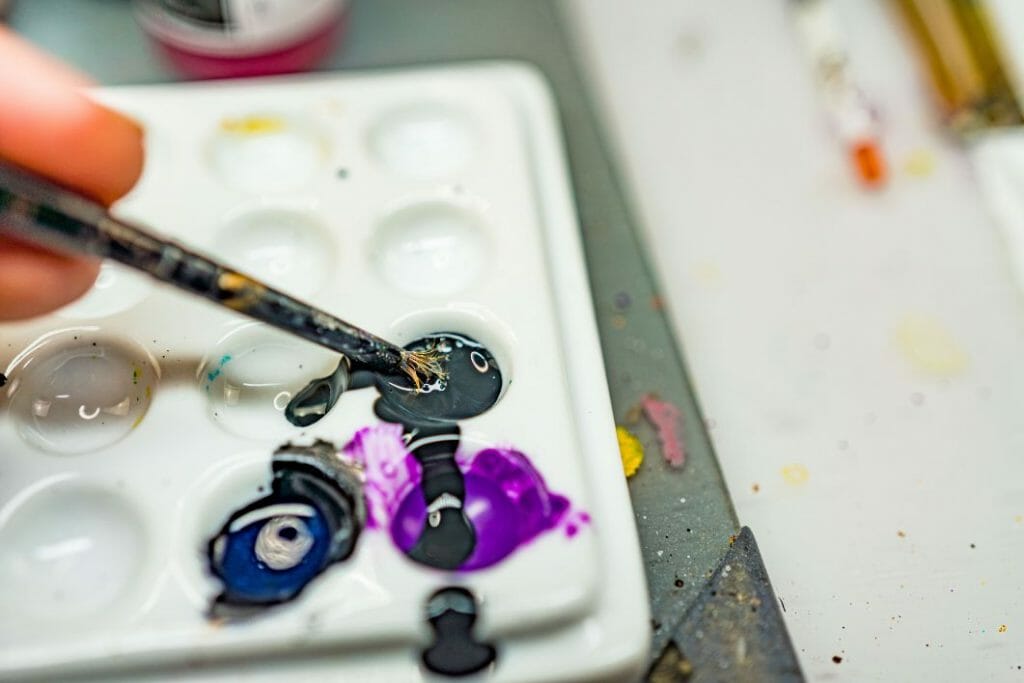
Vallejo Surface Primer is a product I’ve recommended across a lot of miniature projects. It can be applied with a regular brush or an airbrush, and grey gives you a neutral surface from which to judge your next colors.

I also appreciate the dispensing nozzle on the larger bottles. Bottle design earns its keep when you’re trying to put a small amount of primer onto a palette.
The purchase link here selects the grey 200 ml bottle. Choose a size that suits how often you paint. The full review explains the different color choices and how they affect the start of a paint job. Follow the product’s application and curing directions before handling or painting over the surface. For help choosing an application method, see my miniature priming tips.
Read my Vallejo Surface Primer review and application tips · Check the current Amazon price
8. Vallejo Model Air Steel 71065

The Model Air name can send you straight toward an airbrush. I prefer applying this particular steel paint with a regular brush. It’s already thin enough to dispense onto a palette and use, and I’ve found its coverage and reflective finish very useful.

It gives a bright, polished steel appearance. Weapons and machinery are obvious places to start, and a colored glaze over the metal gives you another direction to explore.
The exact paint here is Model Air Steel 71065 in the 17 ml bottle. Vallejo has several paint ranges with similar metallic names. Check the range and number so the bottle matches the recommendation.
Explore my five go-to metallic paints · Check the current Amazon price
9. Citadel Water Pot

Here’s my fairly unglamorous favorite. I like the Citadel Water Pot for its stable base, the grooves that hold a resting brush, and the textured interior used when rinsing. It fits into the small routines around painting.
A cup you already own can do the basic job. The reason to consider this one is whether those small design details would be useful on your desk. Keep the water fresh and be gentle with fine brush tips.
This is also the sort of hobby gift that makes sense for someone whose paint collection you can’t decipher. At least you can be fairly certain they’ll need water.
See how I use the Citadel Water Pot · Check the current Amazon price
10. Milliput Standard Yellow Grey

I first became interested in Milliput while trying to smooth a rough pewter miniature. Standard Yellow Grey is the type I use and recommend in my gap-filling guide. It’s a two-part epoxy putty that can fill a gap or become part of a small modeling project.
Its usefulness extends beyond hiding a seam. You can build up a shape, repair a missing area, or experiment with a bit of sculpting as part of a conversion. Follow the mixing and handling instructions on the pack.
The full guide helps you choose between epoxy putty and other fillers. A tiny surface seam and a missing chunk of a model call for different approaches. That distinction is worth making before you open the packet.
Find the right gap filler for your miniature · Check the current Amazon price
11. Donegan OptiVISOR DA5

My OptiVISOR review has a fairly good test of longevity behind it. I’ve owned two for years, and the DA-5 is my preferred choice for miniature painting. Its 2.5x magnification has an approximately eight-inch working distance.
I also own a stronger 3.5x version that I almost never use. It brings the model so close that maneuvering a brush becomes awkward for me. The space between the lens and the miniature is part of the buying decision.
If you want help seeing small highlights or sculpted details, read the review and choose a lens strength around how you actually work. The link here selects the DA-5 with the glass lens plate, 2.5x magnification, and eight-inch focal distance.
Read my OptiVISOR review after ten years · Check the current Amazon price
12. Badger Patriot 105

I’ve owned two Patriot 105 airbrushes, and it’s one of the workhorses I recommend from experience. I like its straightforward disassembly and how approachable it is for regular miniature painting tasks.

An airbrush is a bigger decision than a brush or a bottle of primer. You’ll need a compatible compressor and hose, a suitable workspace, and a cleaning routine. Read the full review with that complete setup in mind. My complete airbrush guide covers the equipment and practice involved in getting started.
The link here selects the standard-cup Model 105 Patriot Fine. The smaller-cup Patriot Arrow is a different variant. For painters working through armies, larger surfaces, or repeated basecoats, this is a useful tool to investigate before committing to a full airbrush setup.
Read my Badger Patriot 105 user review · Check the current Amazon price
Make your shortlist around your next miniature
Look at the project you’re most likely to paint next. If your brush keeps losing its point, start there and consider how you’re cleaning it. If paint dries while you’re mixing a highlight, investigate a wet palette. If you want to try drybrushing, a textured base gives the new brush a clear first job. Where you paint matters, too. My small-space painting setups show how I keep tools ready in a room that has other jobs.
Leave a little room for curiosity, too. Milliput might lead you toward a small conversion. A metallic paint might suggest a different armor scheme. The interesting part is seeing what you can do with the thing once it reaches the desk.
For your next experiment, try these art supplies for miniature painting.
That’s how I want this collection to work. Find a useful possibility, follow the review when you want the details, and choose something you’ll enjoy putting to use.
Find the reviews and current prices
| Supply | Full review | Amazon price |
|---|---|---|
| Army Painter Wargamer Regiment | Read review | Check availability |
| Army Painter Wet Palette | Read review | Check price |
| Masters Brush Cleaner and Preserver | Read review | Check price |
| Citadel Colour Painting Handle MK2 | Read review | Check price |
| Winsor and Newton Series 7 Size 1 | Read review | Check price |
| Army Painter Masterclass Drybrush Set | Read review | Check availability |
| Vallejo Surface Primer Grey | Read review | Check price |
| Vallejo Model Air Steel 71065 | Read review | Check price |
| Citadel Water Pot | Read review | Check price |
| Milliput Standard Yellow Grey | Read review | Check price |
| Donegan OptiVISOR DA5 | Read review | Check price |
| Badger Patriot 105 | Read review | Check price |
Conclusion
If a product here catches your attention, follow its review and see how it fits your own painting. You may find the small detail that settles the decision, or a technique you want to try with the supplies already on your desk.
I’d also like to hear about the ordinary thing that keeps earning its place in your setup. A dependable brush? A particular paint? Your own much-loved water cup? Tell me about it in the comments.
Until next time, happy miniature painting!
Enjoying your visit? Join Tangible Day!
Leave a comment, or follow Tangible Day.




Tangible Day on YouTube (Miniatures and More!)

By Andrew M. Tan
Andrew is a commissioned miniature painter with more than 20 years of hands-on experience painting tabletop miniatures, photographing models, and testing hobby tools in real-world use. Read his full bio.