

Last updated October 12, 2026. By Andrew M. Tan.
What do you do with empty Warhammer sprues? Do you trash the plastic, or do you recycle the old sprues? After building your model kits, you can recycle old plastic sprues with a bit of creativity and innovation.
In this article, I share with you 9 recycling ideas for empty plastic sprues from Warhammer and other model kits. If the pile of plastic waste bothers you, this list may give you useful ideas for a more sustainable hobby.

What’s the Deal with Recycling Plastic Sprues?
It doesn’t matter what country you’re in, plastic waste is mostly handled the same. Most of the empty sprues you throw away will end up in a landfill or incinerated. In both instances, the plastic contributes to land and atmospheric pollution.

It is quite unfortunate that plastic model kits come with a huge amount of sprue. Plastic sprues are a necessary by-product of injection molding. In injection molding, molten plastic is forced through a mold. The sprues are the “channels” that the liquefied plastic travels through to create the actual model parts. This injection molding process allows manufacturers to mass produce model kits quickly, reliably, and inexpensively.

Why couldn’t you just melt down the leftover sprues to make new model kits? Well, in theory you could. Games Workshop’s recycling program sends collected plastic to TerraCycle for use in other products.
Games Workshop Recycling Program?
Games Workshop’s sprue recycling program now includes participating US stores. Check the TerraCycle store finder for a nearby drop-off point and the materials it accepts. The program covers plastic Warhammer sprues and miniatures, plus empty Citadel and Warhammer paint pots.

Whatever the case may be, at some point I venture you’ll want to condense your sprue collection. The ideas below may inspire you and give you few new ways to recycle your plastic model sprues.
9 Ways to Recycle Plastic Sprues from Warhammer and Other Model Kits
- Make a custom putty
- Flock and decorate miniature bases
- Convert miniatures
- Repair household objects
- Kitbash or scratch build a new model
- Create terrain, model buildings, and urban scenery
- Recast into plastic card
- Melt into string or rope
- Invent a new product
RELATED: A BIGGER RECYCLING LIST FOR LEFT OVER PLASTIC MODEL SPRUES
Continue reading below for details about how you can recycle your plastic sprues.

1. Make a Custom Putty
Polystyrene is the plastic used in many model kits. Plastic cement softens fitted surfaces so the parts fuse as the solvent evaporates. Tamiya Extra Thin Cement is made for polystyrene model kits and flows into narrow gaps between pre-fitted parts.
You can use solvents to your advantage with your old plastic sprues to make a custom putty or “sprue goo”. To make the custom plastic putty, cut up your empty plastic Warhammer sprues into very small pieces. I recommend making the plastic bits as small as possible to help dissolve them in the modeling cement. Put the plastic sprue bits into a glass jar. Then, add the plastic cement drop by drop until the plastic is completely dissolved.

You’ll need to adjust the ratio to thin or thicken the putty the way you like it. Adding more cement makes the mixture thinner and easier to work with. Keep the room well ventilated and close the container when you finish to keep harmful fumes from spreading around your room(s).
Quick tip: A very thin modeling glue, i.e., a low viscosity cement, works best for making custom sprue putty, because as the modeling glue dissolves the plastic sprue bits, the putty will become sticky and thick. Thin modeling cement will help keep the putty workable. I prefer a mixture that creates a sprue putty with a viscosity like maple syrup for pancakes.
What do you use this custom putty for?
Sprue goo is one of the best gap fillers you can use on plastic models. Custom sprue putty is a useful alternative to more expensive fillers such as liquid green stuff. Apply it carefully. Modeling cement dissolves polystyrene, so the sprue goo can soften the surface of your miniature or scale model. Use a brush, toothpick, or sculpting tool to add a small amount to the gap or seam you want to fill.

As the modeling cement evaporates from your sprue putty, the melted plastic will remain behind. If you’ve done your job well, the fusion between your model’s parts will be nearly perfect. You can sand, scrape, and work with the dried sprue goo the same way you would any other plastic part.
With your imagination or a Google search, you’ll find a lot of other great uses for this custom sprue putty, including sculpting and texturing special effects.
2. Flock and Decorate Miniature Bases
Making terrain and customizing your miniature bases is a popular use for empty sprues. There are many ways to reuse the plastic sprues. You can cut the longer pieces into strips to make ruined, building girders, bricks, or stonework.

To assemble these bits, use plastic cement or super glue. I prefer a thicker, more viscous glue for working with terrain and bases. This gives me more control over where the glue goes and it doesn’t run away on me.
A unique way to use sprues for customizing terrain or model bases is to use a coffee grinder to chew up the empty plastic. For this, I’d use a cheap grinder reserved for hobby materials, and keep your good one for your java habit. Work in a ventilated area, wear eye protection and a well-fitting particulate mask, and keep the grinder away from flames or sparks. Add a small amount of sprue at a time and stop if the motor heats up or seems to struggle.

When you’re finished grinding the plastic, you can use the small bits to build up terrain to look like sand or mortar. Or, you can use the finer plastic in a solvent mixture to make a putty or sprue goo (shown above). Use the putty or ground up plastic sprue to sculpt and texturize building sidings, facades, or ground lay on bases or around other structures.
3. Convert Miniatures
You can use discarded components or other found materials for a custom project. Naturally, model conversion, or model customization, is a great way to use old sprues in new ways.

Miniature conversion is similar to making DIY terrain, but now you’re using your imagination with a smaller scale model in mind. You can use empty plastic sprues to help you convert miniatures you already own. If you’re a Warhammer 40k player, then you are familiar with Ork vehicles. On the battlefield, you’ll see Orc players field all sorts of fantastical vehicles and machinations of a warped imagination.

Use sprues to build up armor plates on vehicles, flyers, and other war machines. You can sculpt sprues with a hobby knife to sharpen the tips and add spikes to things, e.g., Mad Max style. A quick way to sharpen a lot of long sprue pieces is to use an inexpensive pencil sharpener. I do recommend using a manual sharpener, as a motorized one may not have the power or durability to handle sharpening all those plastic bits.

Because sprue plastic is relatively soft and malleable, you can shape them with a bit of heat and curve them into shapes. Build up layers of sprues to form entirely new miniatures, or augment ones you have with new subassemblies and parts. Create forms and structures to make your vision come to life.
4. Repair Household Objects
Ever break something that needed a crack filled? Bridge and fix cracks or holes in empty plastic sprues. To fix cracks or gaps, you often have to replace the original lost material. This requires using a “substitute” filler material. Empty plastic sprues are useful in this case, since you can combine the plastic sprue pieces with a two-part epoxy resin or another robust adhesive binder to form a filler material.

There are two ways you can use empty sprues to repair household objects. First, you can mix up a sprue goo or custom putty, as mentioned above, to seal cracks or gaps. Second, you can cut the sprues to size to fit the gap or broken crack in the object. Then use a super glue to hold the sprue pieces in place while you apply a slower drying epoxy to completely fill-in and seal up the gap.
I’ve used old sprues for fixing cracked plastic shells on appliances, outdoor furniture, and my kids’ toys. There are a ton of ways to use sprues as material for repairs around your home. Model-kit plastic is easy to cut, shape, and sculpt to fit the damaged area.
5. Kitbash or Scratch Build a New Model
Kitbashing or model bashing is a practice whereby you can create a new model or miniature from the parts of other kits. Sometimes you simply need a new model or miniature that doesn’t exist. Or, you’ve got a powerful imagination and want to manifest a new sculpt that you’ve carried in your head for a long time. The empty plastic sprues from old kits are a great medium for sculpting things from scratch.
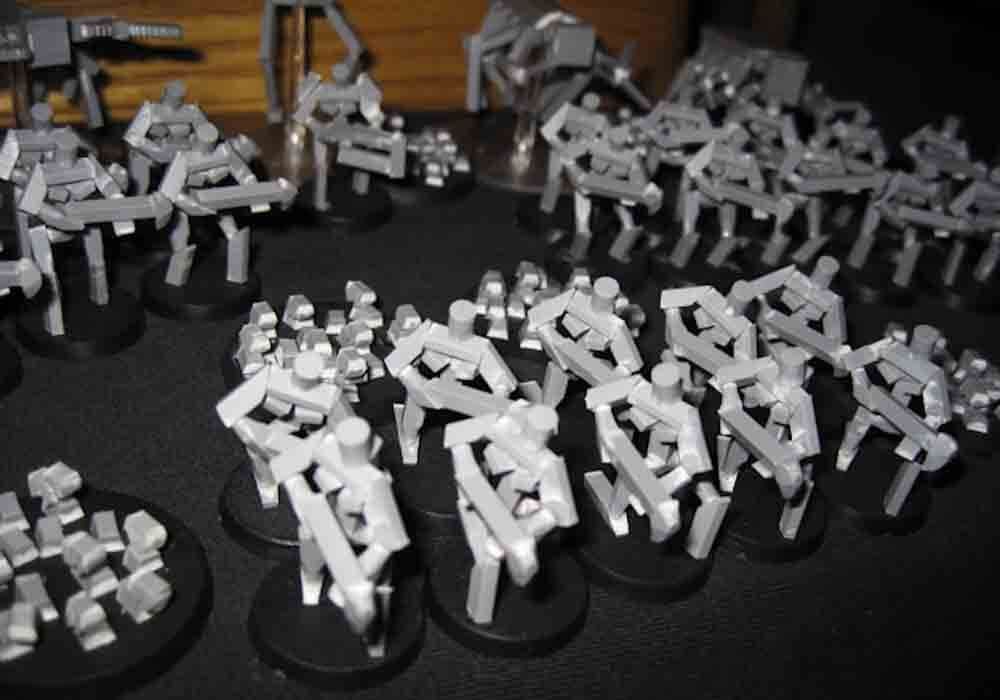
Scratch building or kitbashing with found objects isn’t a new concept. Using empty sprues is an obvious way to recycle the discarded bits from your other model assemblies. Of course, there are many ways you can craft a new model from empty sprues. For example, if you’re planning to make a scale model building, you could cut the sprues down into miniature “bricks” and reconstruct them piece-by-piece into a new structure.

You could also layer sprues together with hot glue to sculpt the skeleton or base form of another miniature. Because the sprues are malleable, there is quite a bit of room for you to project your vision onto the plastic material. You can make mechanized type forms, or use the plastic sprues in an organic sculpt, e.g., a golem or other fantastic creature. With caution, use heat or solvents to shape and sculpt the plastic into almost any form you want!
6. Create Terrain, Model Buildings, and Urban Scenery
Whether you’re model train enthusiast, constructing your railroad empire, or an avid wargamer reenacting an urban skirmish in a far-away land, you’ll need terrain. Use those empty plastic sprues you’ve accumulated from all the models you’ve assembled for constructing those buildings and miniature scenes. Check out this article for a reference chart to help you convert model train scales, e.g., O, HO, N-scale, to the popular 28-35mm wargaming scale.

Emergent gameplay?
I like using my old sprues like Legos. Cut them up and form them back together with glue into whatever building or terrain feature I need. Here’s a trick: You can hold a long piece of plastic sprue over candle or cigarette lighter and melt the tip. Using tweezers or forceps, you can pull the melted end out into a long string.

Once the plastic cools down, you can cut the plastic string into whatever length you need. You can use this melted “string” as miniature wiring for electrical power lines, stringing bows on your elven archers, or as detailing rivets on plate armor or buildings. In the latter case, you may want the diameter of the melted string to be thick or thin depending on your scale.

Another great use for sprues is to use them as the underlying scaffold for other materials you may want to use for constructing buildings. Use the sprues as the girders and cross beams to hold up cardboard or plastic card walls. Hot glue, plastic cement, or super glue work great for this purpose, drying fast and strong enough to hold up fairly large structures.
7. Recast into Plastic Card
Plastic card or plasticard is a plastic sheet that ranges in thickness, usually between 0.5mm and 2mm. For scale modelers, plasticard is purchased for a large number of uses. You can use plasticard to scratch build buildings, vehicles, small objects, e.g., furniture, interior and exterior structural details, and a host of other things.
Did you know you can melt and recast plastic sprues into plasticard? The sheet will have a rougher surface than manufactured plasticard. It is still a great way to reuse old sprues and make a low-cost material for scratch-built terrain and model parts. Use a press reserved for hobby materials. Keep it out of food preparation. Work outdoors or with strong local ventilation, keep the area clear of open flame or excess heat. I would recommend you stop if the plastic smokes or chars/burns.
You’ll need a waffle press with flat griddle plates and baking parchment paper. You may already have these around your home.
Here’s what you do to make plasticard from your old sprues.
Place parchment on the griddle press, add a shallow pile of cut sprue pieces, and cover them with a second sheet. In fact, pretend you’re making a waffle.
Set the press to its lowest heat setting. Close it and apply light pressure until the sprues flatten. Open the press carefully and let the plastic cool before handling it. It’s going to be hot!

If you’ve done it correctly, you should also be able to peel away the new plastic card you’ve made from the bottom parchment paper. Be careful as the plastic will retain a lot of the heat. Experiment with the heat settings and timing to form plastic card to the sheet thickness you want. It won’t be pretty, but you can crop and shape the flattened plastic to your needs. You can use this recast plastic card in many ways, e.g., scratch building, DIY terrain, heat sculpt new forms and much more!

8. Make String or Rope
Plastic sprues melt easily. This makes it great for pulling the plastic into long ropes or strings. Although I mention this use above, it is worth mentioning again as a specific use case. Miniature string or rope isn’t something you can easily buy. The kind, thickness, and type of rope or string you need will depend on the scale and environment of your model.
Creating your own string or rope for scale models is an old concept that remains useful. Gentle heat softens a clean length of sprue so you can pull it into a thin strand. Work in strong ventilation on a clear, nonflammable surface. Keep the plastic above the flame, prevent it from igniting into a tiny flame. Molten plastic can give off flammable vapors. Be careful.

This is an old trick from the scale modeling community
To create your plastic string or rope, move the sprue steadily above the heat source. When the plastic softens, pull the ends apart gently to form a thin strand. You’ll need to experiment a bit because the plastic behaves differently with changes in sprue thickness, temperature, and the diameter you want. You can find more details in this scale-modeling tutorial about pulling rope and string from softened sprue.

The more evenly you distribute the heat, the easier it will be to keep the string the same diameter throughout the melting-pulling process. You’ll need to experiment a bit with this, as the way the plastic behaves will depend on the thickness of the sprue, the temperature applied, and how thick you want to make your string or rope. Finally, remember to clip off any nubs or “branches” from the sprue. For an even melt, you want a single length of “clean” plastic sprue with a consistent thickness along its length.

Once you remove the plastic from the heat source, it cools quickly. The thin strand may be fragile, so I suggest laying the whole piece on a flat surface during cooling to avoid breaking it. Use a hobby knife or clippers to remove the excess plastic. Based on my experience playing around with this technique, you should be able to reliably pull a 3–4 cm length of even string from an 8–10 cm length of empty model sprue.
9. Invent a New Product
Everything you do with old sprues requires imagination and a bit of ingenuity. I searched Google for other ideas people have used to recycle their plastic model sprues. You’d be amazed by some of what I found. I’ve grouped a few of the most interesting examples here.
Here are a few unique things I’ve found that people have made with their accumulated piles of plastic sprues:
- Pencil holder
- A key/coin tray
- Boat
- Dice tower
- A shell for RC car
- Abstract sculpture
- Plant pottery
- Paint organizer stands
- And, much more!
With polystyrene plastic, you can make all sorts of things that go beyond tabletop miniatures and scale models. You can invent and craft up totally new objects.
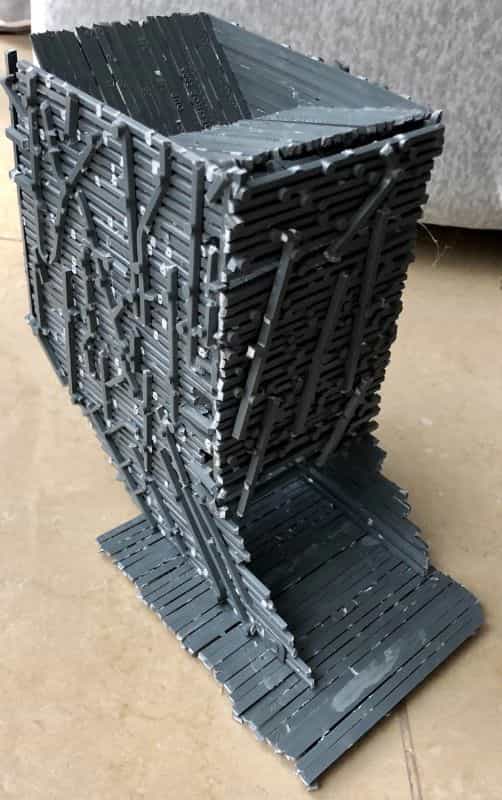
Sprue Terrain Ideas for Wargaming and RPG Tabletop Games
I want to mention that as a tabletop wargamer, sprues are quite abundant in the hobby. They always accumulate as we collect and build model kits. Of course, the possible compulsive hoarder inside us makes it difficult to throw away anything. This is a suffering thought: Maybe, one day I’ll need that!

If you play Warhammer 40k, Age of Sigmar, or use miniatures and terrain in your RPG games, e.g., Dungeons and Dragons, DnD, or Pathfinder, then making terrain features is certainly a good way to reuse your plastic refuse pile.
Check out my Pinterest board for more sprue recycling ideas for all sorts of wargaming and RPG needs.
Easiest Way to Paint your Plastic Sprue Creations?
Let’s keep it simple.
Say you’ve created a new terrain piece from old sprues. What is the best way to paint it? Well, given that you’ve probably painted other miniatures assembled with the same plastic, you could use the same method. For simplicity, however, the fastest and easiest way to paint most structures, including sprue creations, is to start with a good plastic primer.

RELATED: TIPS AND LESSONS FOR PAINTING MINIATURES AND MODELS
Vallejo Surface Primer is my recommended primer for almost any model. For best results, the ideal way to apply a primer is with a spray application, e.g., airbrush or aerosol. If you don’t have an airbrush or rattle can primer available to you, then a brush-on application will work fine. Just make sure you coat your sprues with an even coat of primer without bubbles.
Once your primer is dry, you will have a nice working surface for acrylic model paint. Any hobby brand will do. After you get all your colors painted, a good wash or dip in quickshade will help you pull up contrast and improve definition of finer details. When you’re done painting, make sure you protect your paint job with a durable sealant or varnish.
Final Thoughts
I hope you enjoyed this article. Our hobbies are a privilege. They provide hours of enjoyment, a host of learning opportunities, and an unmatched sense of discovery at every turn. Although waste is natural in any human endeavor (it is a part of living in a material world), we can mitigate the harm it does through the choices we make, e.g., shut off room lights and appliances when not in use.
As wargamers and modelers, we have proven that we are people with powerful imaginations. The piles of plastic sprues we accumulate from building miniatures can return to the hobby as terrain, model details, and props for our tabletop games.
Of course, I’m sure I missed a few points here and there. Are there other niche ways to recycle the plastic from model kits? Do you have any examples of how you reused parts from old plastic model kits?
Until next time, happy modeling!
Enjoying your visit? Join Tangible Day!
Leave a comment, or follow Tangible Day.


Tangible Day on YouTube (Miniatures and More!)

By Andrew M. Tan
Andrew is a commissioned miniature painter with more than 20 years of hands-on experience painting tabletop miniatures, photographing models, and testing hobby tools in real-world use. Read his full bio.
Pingback: 9 Recycling Ideas for Old Sprues from Warhammer and Model Kits — Tangible Day | Ups Downs Family History
A lot of these recycling ideas could apply to leftover support structures from FDM or SLA 3D printing. I shared your article in the 3D printing community on Hive, along with some of my own recycling efforts: https://hive.blog/hive-103035/@steampunkkaja/re-purpose-your-supports-pererabatyvaite-svoi-opory
Excellent!! That’s true with the excess 3D printing material.
By the way, thanks for the link to the blog. We def have a lot of shared interest 🙂
Pingback: The Paperless Benefit of PDF Build Instructions – Build Instructions
Pingback: Exploring The Possibility Of Recycling Plastic From Games Workshop: Benefits Programs And Types - Climate Of Our Future
Pingback: Games Workshop Begins Recycling Warhammer Sprues - Eco Consumer Guide