

Last updated July 27, 2026. By Andrew M. Tan.
Are you looking for the best airbrush for painting miniatures and models? The right airbrush can make priming, base coating, blending, and broader color transitions faster and more consistent. It should also be reliable, straightforward to clean, and supported by readily available replacement parts.
After years of painting miniatures and using many of these airbrushes, I have found that there is no single best option for every hobbyist. The right choice depends on your budget, experience, preferred projects, and the degree of maintenance you are willing to take on.
In this article, I explain what matters most when choosing an airbrush for miniatures and models. I compare 10 recommended airbrushes based on spray control, durability, ease of maintenance, replacement-part availability, and practical value at the hobby desk.

In a Hurry? Check Out the Top 3 Airbrush Picks! 🏆
- Badger Patriot 105 Airbrush (Best overall)
- Harder & Steenbeck Infinity 2-in-1 Airbrush (Professional)
- Iwata HP-CS (Most popular)

Is Airbrushing Worth It for Painting Miniatures?
Airbrushes are a fantastic way to change up your painting style and approach. Airbrushes add paint techniques that a regular brush can’t match. If you’re on the fence about getting an airbrush, check out this airbrushing versus regular brush comparison article for miniature painting.
But, an airbrush for miniatures can also add an element of difficulty to the hobby and, if you’re not prepared, a sore point of frustration. Is airbrushing hard? Maybe. But is it worth it? Absolutely, yes (if you put in the time to use one).
What to Look for in an Airbrush for Painting Miniatures
The best airbrush for miniature painting is the one that fits the work you want to do, your experience level, and the amount of maintenance you are willing to take on. A reliable all-purpose airbrush can make it easier to build consistent habits at the hobby desk, while a more specialized model may be worth considering once you know the techniques you want to develop. For a broader overview of setup, technique, and care, see this complete guide to airbrushing miniatures.
Based on my experience, these are the seven features that matter most when choosing a first airbrush or deciding whether it is time to upgrade.
Here are 7 features you need to know about airbrushes for miniature painting:
- Airbrush type
- Paint feed
- Paint cup size
- Brand
- Nozzle and needle size
- Ergonomics
- Cost
1. Airbrush Type
There are two types of airbrushes: single-action and double-action airbrushes. A single-action airbrush has a trigger that controls only the airflow. This makes the airbrush simple to use and easy to maintain. However, a single-action airbrush does not give you enough control over paint flow for most miniature-painting work.
For airbrushing miniatures, you’ll want to invest in a double-action airbrush. A double-action airbrush has a trigger that lets you control both airflow and paint volume. This gives you much finer control over the spray pattern, allowing you to paint at low air pressures.
This control is why a double-action airbrush is the better choice for both beginner and advanced miniature painters. It gives you more room to learn basic work, such as priming and base coating, while still supporting smoother blends and more controlled detail work as your skills develop. All of the airbrushes reviewed below are double-action models.

2. Paint Feed
There are three main ways to feed paint into an airbrush: bottom-feed, side-feed, and gravity-feed. Each has practical advantages, but the feed system also affects how comfortably the airbrush handles, how much paint it carries, and how well it performs at lower air pressures. For a broader look at airbrush setup and use, see this airbrushing guide.
A bottom-feed, or siphon-feed, airbrush draws paint from a jar or bottle attached below the body of the airbrush. This setup works well for larger projects, terrain, vehicles, and other work that requires more paint volume. The tradeoff is that bottom-feed airbrushes generally need more air pressure, which makes them less useful for controlled close-range work on miniatures.
A side-feed airbrush gives you a clearer view of the working surface because the paint cup is not directly above the body of the airbrush. It can be a useful option for painters who value visibility or work on larger models, but it also tends to require somewhat higher air pressure than a gravity-feed design.
For most miniature painters, the best choice is a gravity-feed, double-action airbrush. Gravity feed allows paint to move into the airbrush with less air pressure, giving you more control for priming, base coating, blending, and detail work. It is the most versatile setup for building steady airbrush habits at the hobby desk.

Additionally, you can use a larger variety of paint thickness in a gravity feed airbrush, which makes these airbrushes more versatile across a range of miniature painting needs. Make sure you use a suitable air compressor that can regulate air flow consistently at low pressures.
3. Paint Cup Size
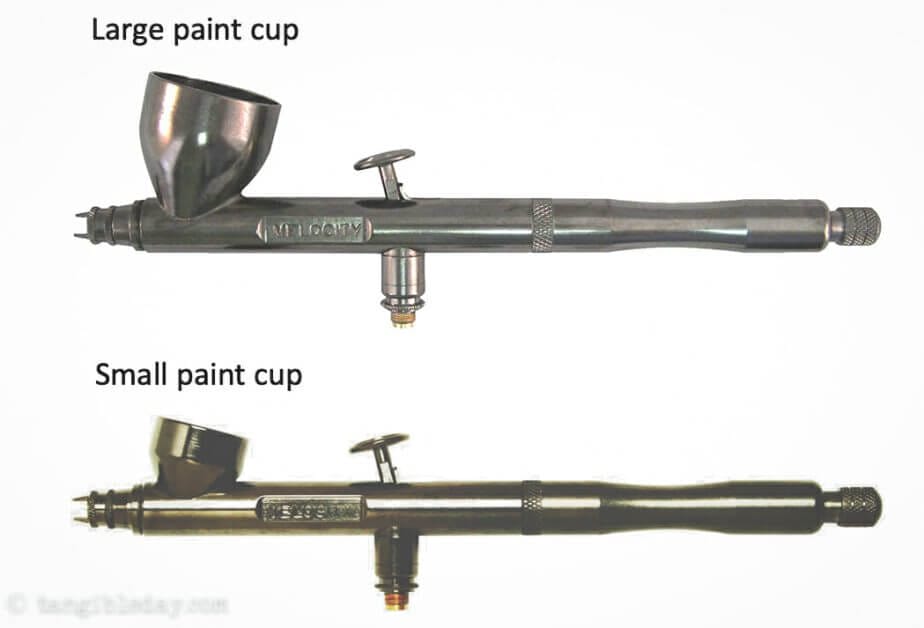
Paint-cup size affects both how much paint you can load and how clearly you can see the miniature while you work. In a gravity-feed, double-action airbrush, the cup is usually fixed to the body, so it is worth choosing carefully before you buy. Some modular systems, including certain Harder & Steenbeck models, allow you to change cup sizes later, but that flexibility is not standard across all airbrushes.
For most miniature painting, a 2–5 ml paint cup is the practical range. A smaller cup improves sightlines and works well for detail painting, while a larger cup reduces refills for priming, base coating, terrain, and vehicles. A 3 ml cup is a strong all-purpose starting point because it carries enough paint for typical work without getting in the way of careful control at the hobby desk.
from: Blick Art Materials
4. Nozzle and Needle Size
An airbrush nozzle size refers to the diameter of the opening at the tip of the airbrush, measured in millimeters (mm). Most miniature-painting airbrushes use nozzle sizes between 0.2 mm and 0.5 mm. The most common and versatile nozzle-and-needle size is 0.3 mm.
The nozzle and needle work as a matched set. The needle moves through the nozzle to control paint flow, so replacement parts must use the same size. You may also see nozzle sizes described as fine, medium, or coarse, but the millimeter measurement is the clearest way to compare them. For most painters, a 0.3 mm setup gives enough control for careful work while remaining practical for priming, base coating, and regular use at the hobby desk.
How Nozzle Size Affects Spray Control
A smaller nozzle can produce a finer spray pattern and give you more control for close-range detail work. Nozzles below 0.3 mm generally work best with properly thinned paint, inks, or other low-viscosity media. They can also run well at lower air pressure, but the smaller opening is less forgiving and more prone to clogging when paint is too thick or begins to dry on the needle tip.
A Smaller Nozzle Is Not Always Better for Miniatures
A smaller nozzle is not automatically the better choice for miniature painting. It requires thinner paint and more careful maintenance, which makes it less practical for priming, base coating, terrain, and other work that benefits from higher paint volume. A larger nozzle is usually more forgiving for these jobs. The goal is to choose the setup that supports the work you want to do consistently, rather than simply choosing the smallest nozzle available.

When choosing the best nozzle and needle size for your airbrush you need to ask yourself what you’ll be painting most of the time.
Best Nozzle Size for Miniature Airbrushes
For priming and base coating, I usually reach for a larger nozzle—0.3mm or greater. A 0.5mm setup handles thicker primers more comfortably. I still thin the primer when needed and adjust the pressure for the paint. Even a large nozzle can clog, and a little prep saves time at the cleaning pot. You can find airbrush-ready primers in article for the airbrush-ready primers.
For an all-purpose setup, I usually reach for a 0.3mm nozzle. It handles most miniature-painting jobs well: base coats, glazes, inks, terrain, stencil effects, and many water-based varnishes. A finer setup gives you more room for very small detail work and asks more of your paint thinning and trigger control.
5. Airbrush Brand
Airbrush brands differ most in build philosophy, replacement-part availability, modularity, and how the tool feels during regular use. For miniature painters, the best brand is not necessarily the most expensive one; it is the one that fits your preferred work, is practical to maintain, and has support when parts eventually need replacing.
The three brands most commonly considered by miniature painters and fine-scale hobbyists are:
- Badger — durable, repairable, and often a strong value for practical hobby use
- Iwata — refined machining, smooth handling, and established professional appeal
- Harder & Steenbeck — modular systems with interchangeable components and flexible setup options
Brand matters less as a status signal than as a long-term maintenance decision. The airbrush you can clean, repair, and keep using regularly is the one most likely to become part of a steady painting practice.
Badger

Badger airbrushes have always felt like workhorse tools to me. They are American-made, heavier than many competing airbrushes, and they have a solid, planted feel in the hand. Some painters will prefer a lighter, more refined tool, but I have always appreciated the stability of a Badger when priming, base coating, spraying terrain, or working through longer hobby sessions.
The other reason I keep coming back to Badger is that the design is straightforward. The parts are not overly fussy, the nozzle system is easy to learn, and routine cleaning does not feel like a delicate procedure every time you sit down to paint. Replacement parts are usually affordable, too. For miniature painters who want an airbrush they can use hard, maintain themselves, and keep running for years, Badger remains one of the easiest brands to recommend.
Iwata

Iwata airbrushes feel expensive the moment you pick one up. The trigger is smooth, the chrome finish is excellent, and the whole tool has a refined feel that many miniature painters notice right away. My first professional airbrush for painting miniatures was an Iwata HP-C, and it showed me how much the fit and feel of an airbrush can matter when you are trying to make careful, repeatable work at the hobby desk. The newer Iwata models are still widely available, including the Eclipse line.
Iwata airbrushes have been around for decades for a reason. They are well-made, reliable tools with excellent fit and finish, and they feel good in the hand during longer painting sessions. You are paying more for that refinement, though. Replacement parts also tend to cost more than comparable Badger components, so an Iwata makes the most sense for painters who know they will use and maintain the airbrush regularly.
For miniature painters who want a polished all-purpose airbrush and enjoy the subtle differences in trigger feel, balance, and spray control, Iwata is still one of the easiest brands to recommend. Even the more accessible Iwata models are not budget purchases, but they can become the kind of dependable tool you keep reaching for as your painting practice develops.
Harder & Steenbeck

Harder & Steenbeck airbrushes are the ones I think about when a painter wants more flexibility from a single tool. The modular design is the main reason. You can change paint cups, nozzle-and-needle setups, and some front-end components without buying an entirely different airbrush. That matters when you may be priming terrain one week, then trying to spray finer blends or controlled shading on miniatures the next. For painters who enjoy adjusting their tools as their work changes, H&S gives you more room to experiment without starting over.
The trigger and needle feel is also a little different from Badger or Iwata. In my experience, H&S airbrushes tend to give you a more gradual sense of paint flow as you pull back on the trigger, which can make fine control feel easier once you get used to it. Some painters will immediately notice that difference; others may simply find that the airbrush feels smooth and predictable in use. Either way, the appeal is not just the modularity—it is having a tool that can adapt as your preferences and painting practice develop.
6. Ergonomics
Ergonomics is really about how an airbrush feels in your hand while you paint. Does it balance near your index-finger knuckle, or does it feel front-heavy? Does the trigger feel too stiff, too light, or about right? Do you prefer a smooth chrome barrel, a rubberized grip, or an airbrush with a little more weight behind it? These details sound small until you are trying to control a blend, paint close to a miniature, or work through a longer hobby session.
A side-feed and gravity-feed airbrush can look similar on paper, but they can feel very different once you start using them. Some airbrushes are light and fast in the hand. Others are heavier, steadier, and a little more planted. At the end of the day, only you will know what feels right, and that usually takes time with more than one tool. The best airbrush is the one that lets you focus on the miniature instead of thinking about the airbrush itself.
7. Cost
You are probably wondering: “How much should I spend on an airbrush?” The answer depends on what you want the airbrush to do and how much frustration you are willing to tolerate while learning. A cheap airbrush can work, but the very inexpensive options are often where you run into rough machining, air leaks, poor spray patterns, and parts that are difficult—or impossible—to replace.
Here is the advice I use for almost all of my hobby purchases: “Pay for the quality you need.”
After collecting airbrushes over the years, I learned this the hard way. Sometimes it is better to start with one good, solid tool than try to learn with something that fights you every time you use it. A frustrating airbrush can make you think the technique is the problem when the real issue is inconsistent airflow, poor atomization, or a nozzle that never seems to behave the same way twice.
You do not need the most expensive airbrush on the shelf. For most miniature painters, I would rather see you buy a reliable airbrush from a company that sells replacement parts, offers decent support, and makes a tool you can clean without a lot of fuss. The nozzle and needle, the fit of the parts, and how easily the airbrush keeps running all matter more than a long list of extra features.
In summary, for beginners, I recommend budgeting between $200 and $250 for a complete airbrush setup, which breaks down to approximately $100-150 for the airbrush itself and about $100 for a reliable compressor. For veterans or serious hobbyists who already own a good setup, you might not need to go beyond $150-200 USD for an airbrush upgrade. You’ll find that high-end models often come with additional features that may not be essential for miniature painting.
Best Airbrush for Beginners?
There are two things you want to look for as a new airbrush miniature painter. You’ll need reliability and room to make mistakes. The best airbrushes to get when you’re starting out in the airbrushing hobby for miniatures are airbrushes with great durability.
The Patriot 105 or Renegade Velocity are very affordable airbrushes with excellent value and reliability. They are easy to use and disassemble easily for cleaning and maintenance. The Patriot 105 is a strong airbrush, machined from solid metal, and has very little exposed delicate parts.

For a first airbrush, the Patriot 105 or Renegade Velocity are practical tools that will let you make mistakes as you learn how to use it. If parts need replacing, they are inexpensive and easy to find online or in local art stores.
The Patriot 105 comes with the larger 0.5mm nozzle, whereas the Renegade Velocity comes with the 0.2mm sized nozzle. I would recommend the Patriot 105 for the casual painter, and the Renegade Velocity to the more serious hobbyist.
The Renegade Velocity will be a bit harder to use, e.g., higher risk for clogging, but the Velocity airbrush will provide you with more control and a smoother spray output (e.g., lower pressure with thinned paint).
If you’re still not sure what Badger dual action airbrush kit to get, take a look at my overview of the top 3 Badger airbrush models I recommend for new and veteran miniature painters.
Best Airbrush for Experienced Painters?
I’m going to get myself in trouble for answering this. Making a claim about the best airbrush for professional or expert use is controversial on so many levels (see ergonomics).
First of all, if you’re an experienced miniature painter with a good work flow, how do you envision the addition of an airbrush? Are you looking for speed? Or, do you want to add a different technique to your miniature painting skill set?

Are You a Pro?
At the end of the day, a professional airbrush is any airbrush you can use regularly with good results. That is, if you have the skill to operate an airbrush, then any airbrush will do the job you need it to do.
In high-quality, fine-art level miniature paint jobs, however, where only the smoothest paint blends are called for, then you’ll want an airbrush that can reliably spray an ultra-fine mist of paint (e.g., ultra-fine nozzle sizes 0.2mm or less).
You’ll want an airbrush with amazing paint atomization potential. This means a very well constructed nozzle, needle, and nose cap assembly.
Although I won’t get into the physics of paint atomization here, I can say that a lot of engineering goes into creating an airbrush that gives its user fine control of the spray output.
As a professional miniature painter, you’ll want an airbrush that can operate with a wide range of air pressures, low to high, depending on your paint viscosity. It does take a lot of practice to use an airbrush for painting miniatures, especially when you want to apply paint blending techniques directly on a model.
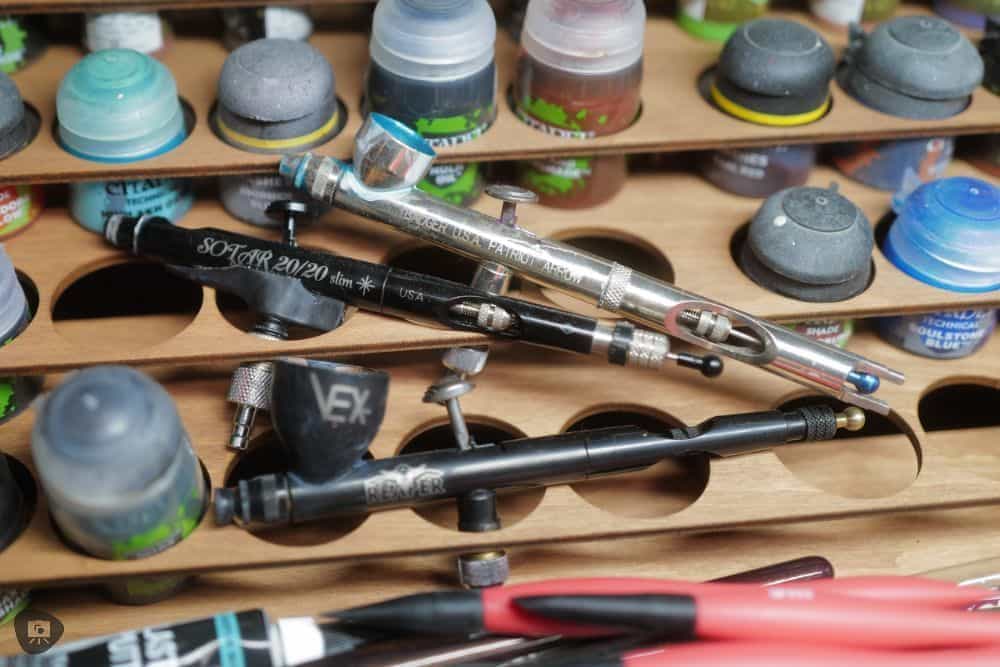
As for recommended airbrushes for professional, expert miniature painting applications, the Sotar 2020 and the Harder & Steenbeck Infinity airbrushes are highly regarded for their precision and handling. The difference between these two airbrushes for professional work is mostly with ergonomics. You won’t know this until you’ve used them for a while.
What If You Could only Choose one Airbrush?
This is never going to be true, even for those of you who have a tight budget. At some point, you’ll be curious about what other airbrushes offer. This is especially going to happen if you start falling in love with the speed, convenience (priming indoors, anyone?), and sheer enjoyment of spraying your hobby paint and other art media.
If you’re curious about an airbrush that can do it all, or perhaps one that will support your ambitions to become a professional, look no further. There are two airbrushes that you can grow into with features that come in handy for more advanced techniques, e.g., glazing, detailed shading, you may want to look at the Reaper Vex airbrush (reviewed here), or the Badger Extreme (shown below).

Although the Vex airbrush may not feature on the top 10 list, that’s mainly because it remains less well-known among miniature painters. It also lags behind in terms of part availability when compared to other models. However, it presents an excellent option for those seeking versatility and the ability to accomplish diverse techniques with a single airbrush kit.
The Badger Extreme is a workhorse airbrush with all the features of the more expensive offerings from Iwata and Harder & Steenbeck. If I had to only choose one airbrush that can handle 90-95% of any miniature hobby task you throw at it, and I had a limited budget, it would be the Badger Extreme.
10 Best Airbrushes for Painting Miniatures and Scale Models
Here are my 10 recommended best airbrushes for painting miniatures and models:
1. Badger Patriot 105

The Patriot 105 is my favorite airbrush and that’s not because it was my first. Here’s why: This is the highest recommended airbrush for anyone who isn’t sure they want to invest a lot into the hobby. It lets you do all the airbrush hobby things in a highly-reliable package, yet do so without spending a lot. You can dabble, or become serious with this airbrush. It’s easy to use, clean and maintain.
Here’s a full review of the Badger Patriot 105 airbrush for painting miniatures. It will handle almost any job you throw at it, except for more detailed airbrushing. For close to $100, this is my top choice for a first, starter airbrush for beginners or those veteran miniature painters who are looking to expand their collection with a robust, daily-working tool.
The Patriot 105 airbrush comes stock with a 0.5mm sized nozzle, and will not be ideal for smooth paint blending on small scale models. For basic priming and base coat work, however, this is a fantastic setup. Set the air pressure close to 30-35 PSI, using fairly viscous paint (i.e., like heavy cream), and the airbrush will atomize and spray well. The Patriot 105 airbrush is not prone to clogging (with careful paint choice and/or thinning). In fact, assembly and disassembly is super easy (note: you shouldn’t have to do this much).
Key features and best use
- The Patriot 105 is a great do-it-all airbrush
- Recommended for anyone who isn’t sure they want to invest a lot into the hobby
- Spray acrylic paints, varnishes, and primers
- Great value airbrush
Who is this airbrush for?
The Patriot 105 airbrush is ideal for any miniature painter looking for a durable, no-hassle tool that will do the job even when your thinned paint isn’t perfect. The build quality is superb, though utilitarian, the airbrush will work for years. Replacement parts are inexpensive and easy to find.
Buy this airbrush as a beginner and it will grow with you. Veteran painters will love the practicality, affordability, and simple maintenance.
Badger Patriot 105
Pros
- Best starting airbrush for beginners that will grow with you
- Badger is a great company
- Replacement parts are widely available
- Build quality is excellent
- Nozzle/needle assembly is modular
Cons
- Heavy
- Disassembly/reassembly requires instruction
- Spray atomization is coarse
2. Badger Renegade Velocity

The Badger Renegade Velocity is similar to the Patriot 105, with a finer 0.21mm needle-and-nozzle setup. Its barrel is narrower, and some painters may prefer the way it sits in the hand. The exposed needle makes tip-dry easier to clear, while two prongs help protect it from accidental damage.
If you’re looking for a finer spray pattern for painting miniatures, I would recommend the Renegade Velocity over the Patriot 105. Just be aware that the finer needle and nozzle assembly will be more prone to clogging and a bit more fragile. As for specific features, the trigger assembly has a different feel than the Patriot 105 and is a tad more responsive (e.g., the trigger spring is stiffer). In both airbrushes, the trigger pull tension is adjustable.
Key features and best use
- The Renegade Velocity can spray finer details than the Patriot 105
- Well-balanced and weighted, narrower barrel
- Uses a 0.21mm needle-and-nozzle setup for finer spray control
- More suited for fine-detail painting
Who is this airbrush for?
The Badger Renegade Velocity airbrush is perfect for those looking for a practical, affordable airbrush that will let you spray with more detail-oriented tasks. As with the Patriot 105 airbrush, spare replacement parts are inexpensive and easy to source. With a strong build quality, you likely won’t need to do much fixing. Just keep the nozzle clear and the airbrush clean after every painting session and you should be good to go.
Badger Renegade Velocity
Pros
- Similar to the Patriot 105 airbrush, but produces a finer spray
- Different ergonomic balance than the Patriot 105
- Easy maintenance
- Nozzle easily changed for other sizes
- Still inexpensive
Cons
- Not as versatile as the Badger Patriot 105 airbrush
- More prone to clogging
- Parts are not widely available (mostly online)
3. Badger Krome Airbrush

The Badger Krome Airbrush is the hybrid form of both the Renegade Velocity and Patriot 105 airbrushes. Aside from the addition of the plastic grip under the trigger (that you can remove) for improving ergonomics, this airbrush has all the features of the Badger Patriot 105 and Renegade Velocity airbrushes.
The Krome has a set-screw for limiting the needle pull, which helps you control the maximum amount of paint you can spray at time. This is useful for avoiding overspray. If you’re still learning how to airbrush, you may want to first learn how to control the trigger manually without the physical limit of this set screw.
Build quality is excellent in the Badger Krome. The entire airbrush weighs close 10-12 ounces (or close to 350 grams), which is quite heavy. The internal structure is machine brass, coated in a chrome finish, as to the airbrush’s namesake. The Krome has a softer trigger pull than the Patriot 105, giving you more resolution in trigger-paint control.
The Krome is a 2-in-1 kit with 0.33mm and 0.21mm needle-and-nozzle setups. That range makes it easy to move between general miniature work and finer detail. It feels like a natural step up from the Patriot 105 or Renegade Velocity as your trigger control improves.
Key features and best use
- The Krome Airbrush is Badger’s flagship airbrush model
- Build quality is excellent
- The Krome has a softer trigger pull than the Patriot 105
- Removable ergonomic finger rest
- The Krome includes 0.33mm and 0.21mm needle-and-nozzle setups
Who is this airbrush for?
The Badger Krome airbrush is best for those looking for a premium spin on their airbrush fit and feel. The Krome airbrush is a more refined version of the Badger Patriot 105, and shares some similarity for precision spraying with the Renegade Velocity. In my experience trying all of these airbrushes, I lean toward the less expensive and more practical Patriot 105 for most miniature painting projects. On the other hand, if you could only have one Badger airbrush for general and precision painting, the Krome may be your best bet.
Badger Krome Airbrush
Pros
- Flagship airbrush model for Badger
- Successfully competes with higher end airbrushes from Iwata
- Perfect setup for painting miniatures and models
- Ergonomics for long-term painting
- Upkeep, replacement parts are generally less costly than other brands of airbrushes
Cons
- Heavy
- Large paint cup may obscure visibility
- Open needle design may be a risk for damage for less experienced airbrush users
4. Iwata HP-CS Airbrush

The is a chrome-plated, gravity-feed, dual-action airbrush with the features most miniature painters need. The current model pairs a 0.35mm nozzle with a 7ml paint cup and typically runs at 25–35 PSI. It costs a little more than the Badger Krome, and you can feel the extra refinement in the trigger and finish. Even the metal cup cap feels substantial.
The Iwata airbrush oozes quality, from the feel of the trigger, to the exterior chrome plating, and the integrated barrel chassis. Unfortunately, replacement parts are more expensive for Iwata airbrushes than comparable Badger components. On the other hand, if you’re someone who is careful with their equipment, an Iwata airbrush kit will return your investment with a pleasurable airbrushing experience.
The standard 0.35mm sized nozzle makes this the one of the most versatile airbrushes you can buy for painting miniatures. Not too small or big, the nozzle in this airbrush is sublime for less clogging, fine paint atomization, and permits thicker paint spray along with thin inks without splattering. This is a professional level airbrush in many ways. To get the most out of this airbrush for painting miniatures, will require you to learn the nuances of how this tool works.
Key features and best use
- A classic starter airbrush for any miniature painting hobby enthusiast
- A competitor with the Badger Krome, but more refined quality
- Spring-steel needle and compression-fit nozzle designed for durability and straightforward cleaning.
- The standard 0.35mm sized nozzle is versatile for painting miniatures
Who is this airbrush for?
Iwata airbrush in general are a legacy brand, known for their high quality, beautiful aesthetic, and high function. I loved all my Iwata airbrushes. Not only did they paint well, they felt great in my hands. The Iwata HP-CS airbrush is the perfect model for the beginner airbrusher looking to start with an Iwata. The trigger pull and larger sized nozzle are forgiving for mistakes and learning acrylic painting techniques.
This is not to say this isn’t for professionals either. The budget minded Iwata airbrush will match the output of any more expensive airbrush on this list with practice.
If you shop through a third-party marketplace, check the seller and packaging carefully. Iwata has warned about counterfeit HP-CS airbrushes, and a suspiciously low price can become an expensive headache.
Iwata HP-CS Airbrush
Pros
- The Iwata HP-CS is the best value airbrush
- The standard 0.35mm nozzle does it all
- Refined construction with a smooth trigger and chrome-plated finish.
- Low maintenance
- Comfortable
Cons
- Replacement parts are more expensive, but longer-lasting
- The paint cup size is large for most miniature painting
- Expensive
5. Badger Sotar 20/20 Airbrush

The is my second-favorite airbrush for professional miniature painting; the Patriot 105 is still my workhorse. It is Badger’s direct answer to the here. The fine 2020-2 version is built for detail work and sprays from a hairline up to roughly 3/4 inch. It gives you precise control with properly thinned paint.
The small gravity cup stays out of your sightline while you work. On the standard 2020-2, it holds 1/12 ounce, or roughly 2.5ml. That is enough for detail work, though you will refill it sooner than a larger general-purpose cup.
As ergonomics of the brush are similar to other Badger airbrushes. It has a hefty, solid feel, with a forward balance toward the nozzle. Note the grip is located near the paint cup and directly under the trigger. This helps give you more fine hand-motor control over the spray pattern, as it is applied to your working surface.
The exposed needle also helps with precise airbrush application. Just be careful, as with any airbrush needle exposed like this, the needle is prone to damage. There is no adapter that you can use to cover the exposed needle on the Sotar 2020. So, I don’t recommend the Sotar 2020 as a starter airbrush to new miniature painters.
Key features and best use
- The Badger Sotar 20/20 is superb for professional, fine-detail miniature painting
- This Sotar 2020 model comes stock with a fine sized nozzle/needle combination (0.2mm nozzle)
- Ergonomic feel is excellent for fine motor control and handling
- Not recommended for new airbrush miniature painters
Who is this airbrush for?
The Badger Sotar 20/20 Airbrush is my current favorite for working with detailed paint jobs where I use thin media, e.g., paint, varnishes. The lightweight feel of the Sotar 20/20 and forward grip give you a leg up when it comes to controlling how close you can bring your nozzle to the painting surface. This is a great airbrush for spraying glazes with thinner mediums, such as acrylic inks or washes. This may be a nice second airbrush to have in your stable as it fills a specialized niche.
Badger Sotar 20/20 Airbrush
Pros
- The extra fine nozzle/needle (0.2mm) creates a smooth fine spray
- Excellent trigger control and handling
- Good visibility with a small paint cup
- Easy access to clean the needle tip without disassembly
- Inexpensive
Cons
- The brush may feel “twitchy” due to forward balance
- Ideal mostly for detail
- Requires thinned mediums
6. Harder & Steenbeck Evolution 2-in-1 Airbrush

The Harder & Steenbeck Evolution Airbrush is an airbrush I would have purchased if I didn’t already own the Iwata HP-CS. The removable cup is one of its best features. You can swap between 2ml and 5ml cups depending on the job, and cleanup is easy.
One detail to check before you buy is the generation. The current Evolution 2024 CRplus comes with either a 0.28mm or 0.45mm head assemblies. I’d use the larger setup for primer, base coats, and terrain, then switch to 0.28mm for tighter spray control. Older Evolution kits used 0.2mm and 0.4mm setups, so the listing should tell you which version you’re getting.
Ergonomically, the Evolution balances evenly with the larger paint cup, front to back, and is very comfortable for long painting sessions. With the smaller paint cup, it has a back-weighted feel, making the airbrush feel a tad more “twitchy”. Fill your paint cup with paint and the weight shifts yet again. Overall, this is a fantastic airbrush for painting miniatures.
Key features and best use
- High gloss, chrome finish with excellent balance and ergonomics
- Switch between 2 and 5 ml paint cups
- Current Evolution 2024 CRplus models include 0.28mm or 0.45mm head assemblies
- Scale modelers will love the flexibility of the modular design
Who is this airbrush for?
The Harder & Steenbeck Evolution Airbrush is for anyone who prefers the fit and feel of a light-weight modular airbrush that doesn’t cost as much as the professional-level models. Get this airbrush if you want the functionality of the Infinity airbrush without the cost. Note that if you’re already invested in the H&S airbrush systems, many of their airbrushes have interchangeable parts between models.
Harder & Steenbeck Evolution Airbrush
Pros
- High quality construction
- Smooth chrome finish, which is easy to clean
- Modular design
- Reasonably priced for the features
Cons
- Relatively pricey
- Extra heads and cups create more small parts to store.
- More parts, means more things to risk losing
7. Harder & Steenbeck Infinity 2-in-1 Airbrush

The Harder & Steenbeck Infinity 2-in-1 Airbrush is the model many experienced miniature painters reach for when they want finer control. The current Infinity 2024 CRplus 2-in-1 comes with 0.25mm and 0.44mm titanium heads plus mini, 2ml, and 4ml cup options. Older Infinity listings may show different parts, so check the generation before you buy.
The Infinity uses an open-needle design, which gives you a lot more spray control, as well as needle access to keep it clear of paint residue and clogs. This does expose the needle to additional damage risk. But, if you’re careful, the Infinity airbrush design is perfectly suited for airbrush painting miniatures and small scale models.
At the back of Infinity airbrush, the cutout in the rear barrel gives you access to the trigger tension screw and needle lock nut. This lets you make fine adjustments to the feel of the trigger and needle without having to remove the entire barrel. It’s a quick and smart feature. The knob at the back of the airbrush limits the needle pull so you can physically prevent paint overspray.
Key features and best use
- The Harder & Steenbeck Infinity 2-in-1 Airbrush is highly respected among professional painters
- Similar to the Evolution airbrush, but has more smart features for painting miniatures
- Great airbrush for painting miniatures and fine scale models
Who is this airbrush for?
The Harder & Steenbeck Infinity 2-in-1 Airbrush is the big brother of the Evolution. This is the airbrush to buy if you’re an experienced miniature painter looking for the absolute best in terms of functionality and quality construction. The Infinity airbrush is also the airbrush you mistakenly buy if you’re a new painter and think spending more means you’ll level up your skills quicker. The Infinity airbrush requires some more technical upkeep for it to operate at its best. If you’re up to the challenge of taming this airbrush, you will be able to easily apply the entire gamut of spraying techniques available for painting miniatures.
Harder & Steenbeck Infinity 2-in-1 Airbrush
Pros
- High-end features for professional use
- Solid build quality
- Tool-less maintenance
- Flexible, modular design
- Smooth, adjustable trigger pull
- Ergonomically balanced for fine detail spraying
Cons
- Very expensive
- Not a starter airbrush
- The premium detail features may be unnecessary for general base coating.
8. Grex Genesis XSi3 Side Feed Airbrush

The takes a different approach from most airbrushes on this list. The needle and nozzle are stainless steel, and the body uses plated metal. It feels solid, well balanced, and easy to repair as parts wear.
First, the grip section of the airbrush may be more comfortable to some who have larger hands. The larger surface area of the airbrush grip may also provide better control and stability. The airbrush is fairly light and well-balanced. Second, this Grex airbrush is a side-feed airbrush. Paint enters into the airbrush from a side-attached cup. The side-cup lets you hold the airbrush with more visibility of your working surface. See the gravity-feed version of this airbrush.
The stock nozzle is 0.3mm, and Grex sells 0.2mm, 0.5mm, and 0.7mm conversion kits. That range lets you move from tighter detail work to primers, terrain, and larger models using the same airbrush body. The needle stays protected inside the nose cap, and Grex offers plenty of accessories for adjusting the setup around the way you paint.
Key features and best use
- Ergonomic design, including rubberized grip and trigger
- Light weight and center-balanced
- Side-feed cup design provides better visibility (see gravity-feed version)
- Standard sized 0.3mm nozzle assembly is versatile
Who is this airbrush for?
The Grex Genesis XSi3 Side Feed Airbrush is the general, all-purpose airbrush. In contrast to the other airbrush models on this list, the side-feed paint cup will give you more visibility to see your working surface. The best reason to choose this airbrush is whether that feature, along with the ergonomics of the grip, are valuable to you. Grex, like Badger Airbrushes, are budget friendly with spare replacement parts that are easy to find.
Grex Genesis XSi3 Side Feed Airbrush
Pros
- Modular design with high-end options
- Innovative ergonomic features
- Maintenance cost is reasonable
- Good for airbrushing miniatures
- Good value
Cons
- May be more difficult to clean
- Fewer users in the miniature painting community
- May need somewhat more air pressure than a comparable gravity-feed setup
9. Badger Renegade Spirit Side Feed Airbrush

The Badger Air-Brush Co R2S Renegade Spirit Side Feed Airbrush is the side-feed version of the Renegade Velocity. It uses the same core components, including the 0.21mm needle-and-nozzle setup. The solid handling gives you good control for finer work, while the side-feed cup gives you a clearer view of the miniature.
Ergonomically, the weight and balance of the airbrush are similar to the Patriot 105 and Renegade Velocity. A screw-limiter at the rear of the airbrush for the trigger and needle pull will come in handy for those who are looking for a fast way to prevent overspray. The exposed needle tip also allow for cleaning and preventing paint tip-dry.
If you were looking for something that gave you more room to see what you’re doing, a bit more versatility in handling larger volumes of paint, I recommend this airbrush. As with any Badger, the Renegade Spirit is a durable airbrush that will last years with regular maintenance and care.
Key features and best use
- The Badger R2S Renegade Spirit Side Feed Airbrush is the side-feed version of the Badger Velocity
- Provides a fine spray pattern with a 0.21mm nozzle-and-needle setup
- More visibility to the working surface
- Solid build quality
Who is this airbrush for?
The Badger Renegade Spirit Side Feed is similar to the Renegade Velocity airbrush (shown above). This is a solid workhorse with some specialization in precision airbrush techniques. As with other side-feed airbrush models, this is best suited for the painter who is looking for more visibility to their painting surface. The ergonomics of this brush will please those who enjoy a heavier tool. As with other Badger airbrushes, I find the ergonomics are balanced in your grip with the center of gravity around your forefinger knuckle.
Badger Renegade Spirit Side Feed Airbrush
Pros
- Good visibility of painting surface
- Excellent value
- Can attach a siphon bottom-feed system
- 0.21mm nozzle size is useful for airbrushing fine detail
Cons
- Upkeep and maintenance may be more involved
- Often needs somewhat more pressure with thicker paint
- Prone to more clogging with low pressure operation
10. Badger Patriot Xtreme

The Badger Patriot Xtreme is a combination of the best features found on the Badger Patriot 105, the Krome, and the micro-air-valve (MAC) found on the expensive Iwata Hi-Line airbrush. The Patriot Xtreme has similar features as high-end airbrushes, but with less refinement and cost. This airbrush is designed for miniature painters who want control over their work.
A few notable features set the Patriot Xtreme from other airbrushes for painting miniatures. For example, the trigger is close to twice the height as other airbrush triggers. The longer trigger included with the Badger Patriot Xtreme allows you to more finely control airbrush paint spray. Note that you can buy this “high roller trigger” separately for other Badger airbrushes.
The MAC valve located near the nose of the airbrush is a miniature air regulator. The MAC knob functions like the valve on the Iwata Hi-line airbrushes. It controls the amount of air flows at the front of the airbrush. This tiny change in air pressure gives you even more control over your paint atomization and spray pattern. The MAC valve is a high-end feature that you may find very useful as you get better at airbrushing miniatures.
The standard kit comes with the standard 0.3mm sized nozzle, which is the most versatile nozzle size for painting miniatures and scale models. The exposed open needle design is interesting on airbrush like this, but should give you some more visible control over where you are spraying. With the other moving components in this airbrush, there is some more nuanced maintenance you’ll need to consider. But, if you’ve already owned and used other Badger airbrushes, there’s not much need you will need to learn to properly maintain this airbrush.
Key features and best use
- This is the budget-friendly professional airbrush
- Similar features as higher-end airbrushes
- The PAC dial adjusts airflow at the airbrush for different spray effects.
- Default 0.3mm sized nozzle is versatile for many miniature painting needs
Who is this airbrush for?
Take all the best features of the other Badger airbrushes, add MAC valve (and increased price) of an Iwata, and you have the Badger Patriot Xtreme. Of course, this is a heavier weighted tool as compared with its competitors. But, maybe that’s what you’re looking for. A heavier airbrush will be more stable in your hand than a lighter one, which would feel twitchy. Note that the plastic grip underneath the Xtreme can be removed if you find it uncomfortable. I would recommend this airbrush to anyone who is looking for a feature-rich airbrush for painting miniatures. Who knows, you may find them handy!
Badger Patriot Xtreme
Pros
- Upgrade for the Badger’s other airbrush lines
- Versatile use
- MAC air regulator
- Excellent value
- Professional or hobby level use
Cons
- Lots of features that may be unnecessary for most users
- Redundant purchase if you already own any other airbrush on this list
- Large paint cup size may obscure visibility
Final Word
Airbrushes come in all sorts of makes and models. The best airbrush kit you choose will depend on what you want to do with the hobby and art.
There is an airbrush that’s just right for everyone who paints miniatures. Before choosing the best airbrush for painting miniatures, ask yourself what you plan to do. If you’re just dabbling and want to base coat and prime your models faster, a starter airbrush like the Badger Patriot 105 would be a great choice.
RELATED: BADGER PATRIOT 105 FULL REVIEW
For more advanced miniature painting, choose the airbrush that fits the work you expect to do most. A larger nozzle makes priming and base coating easier, a 0.3mm setup covers most miniature-painting jobs, and a finer setup gives you more control with properly thinned paint. Progress comes from using it regularly—learning the trigger, finding the right pressure for your paint, and getting comfortable with cleanup.
With practice, the airbrush becomes a true part of your painting process. That muscle memory where you don’t need to think about how to use the tool—the flow—totally frees up your attention for the miniature painting process.
Thanks for reading and happy airbrushing!
Summary: My Top 10 Recommended Airbrushes for Any Miniature Painter
| Image | Model | Features and best use |
|---|---|---|
 |
Badger Patriot 105 | Badger Patriot 105 — Beginner-friendly workhorse for priming, base coating, varnish, terrain, and everyday miniature work. |
 |
Badger Renegade Velocity | Badger Renegade Velocity — Fine 0.21mm setup with a narrower body for painters ready to manage thinner paint and regular tip cleaning. |
 |
Badger Krome | Badger Krome — Two-head 0.33mm and 0.21mm kit for general coverage and finer detail using one airbrush body. |
 |
Iwata HP-CS | Iwata HP-CS — Refined 0.35mm all-purpose airbrush with a 7ml cup for beginners through experienced painters. |
 |
Badger Sotar 20/20 | Badger Sotar 20/20 — Specialist detail brush for thin paint, inks, glazes, and close work. Best suited as a second airbrush. |
 |
Harder & Steenbeck Evolution | Harder & Steenbeck Evolution — Current 2024 CRplus kit with 0.28mm or 0.45mm heads with 2ml or 5ml cups, respectively. |
 |
Harder & Steenbeck Infinity | Harder & Steenbeck Infinity — Premium 2024 detail system with 0.25mm and 0.44mm titanium heads and three cup options. |
 |
Grex Genesis XSi3 | Grex Genesis XSi3 — Ergonomic 0.3mm side-feed airbrush with optional 0.2mm, 0.5mm, and 0.7mm conversion kits. |
 |
Badger Renegade Spirit | Badger Renegade Spirit — Fine 0.21mm side-feed brush for painters who value a clear view of the working surface. |
 |
Badger Patriot Xtreme | Badger Patriot Xtreme — Feature-rich 0.3mm Badger with PAC airflow control, a High Roller trigger, and removable finger rest. |
Enjoying your visit? Join Tangible Day!
Leave a comment, or follow Tangible Day.


Tangible Day on YouTube (Miniatures and More!)

By Andrew M. Tan
Andrew is a commissioned miniature painter with more than 20 years of hands-on experience painting tabletop miniatures, photographing models, and testing hobby tools in real-world use. Read his full bio.
6 by Badger and only one from Iwata?
Yeah – for the cost (upfront purchase and maintenance upkeep) you will get farther with a Badger. Iwatas are great for fine art applications and illustration.
H&S Infinity may be expensive, but its the best on the market in every single way and in my opinion should be on top. Its not cheap, but in my opinion also not expensive and your set for while not needing to replace it and not needing to look for an upgrade. Should come with 5 stars
Hi! I agree with you :). The airbrush order isn’t ranked by best to worst, etc. The H/S is a superb airbrush and indeed for the spec and function it’s worth the cost. I have two :). The star rank is based on overall rating, however for utility in painting minis. For the price (nearly $300), it’s been a hard sell for most miniature painters. To really know an airbrush, you’ve got to use it for a while.
Pingback: Starting my airbrush adventure | The Dining Table Napoleon
Pingback: Complete Guide to Airbrushing Miniatures and Models - Tangible Day
When purchasing an airbrush, deciding between a gravity feed and a siphon feed airbrush is one of the most important decisions to make. There are substantial differences in pressure settings, desired project scale, and paint finishes between these popular airbrush kinds. Gravity airbrushes work at low pressures and are suitable for detailed painting; siphon feed airbrushes, on the other hand, work at high pressures.
Hi….I use the H/S airbrush. Definitely worth the extra cost. The longer you paint the more your willing to go for quality over cost.
Pingback: Best Airbrush for Miniatures and Models (Top 10 Reviewed) - Toy Newz