

Last updated November 26, 2026. By Andrew M. Tan.
For most miniature painters, I recommend an oil-free airbrush compressor with an air tank, an adjustable pressure regulator and a moisture trap. You can get a good one without spending a lot of money.
I’ve used both the Badger Aspire Pro and the Master Cool Runner II for commissioned miniature painting. The Badger has been my personal favorite for years, while the Master offers the features most hobbyists need at a more affordable price. How often you airbrush, the size of your hobby space and how much noise you’re willing to tolerate will help you decide which compressor to buy.

My top three airbrush compressors
- Badger Aspire Pro TC910 — My personal favorite
- Master Cool Runner II TC-326T — Best value for most miniature painters
- SilentAire Super Silent 20-A — Premium option for noise-sensitive workspaces
My recommendations draw on my own experience with the Badger and Master compressors, alongside manufacturer specifications for the other models. Published airflow and noise figures are not results of a controlled side-by-side test. Some links are affiliate links; I may earn a commission if you buy through them.
Airbrush compressors at a glance
| Image | Product | Recommended Use | Price |
|---|---|---|---|
 |
Badger Aspire Pro TC910 | My personal favorite — 3 L tank | Check price |
 |
Master Cool Runner II TC-326T | Best value for most miniature painters — 3 L tank | Check price |
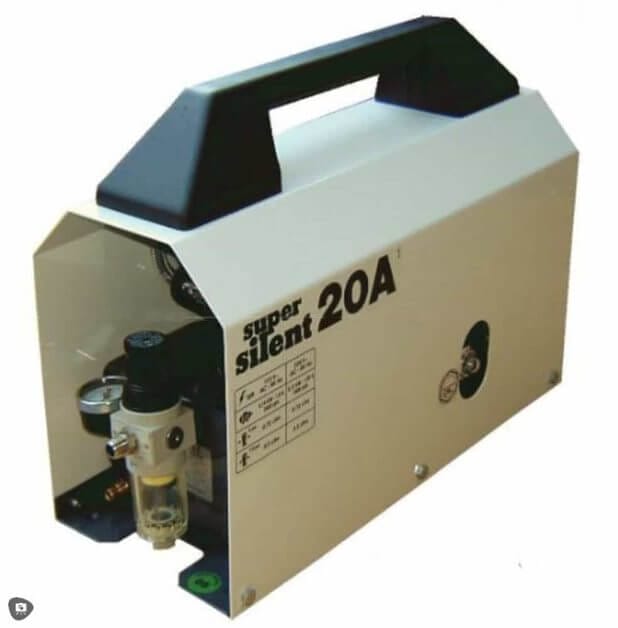 |
SilentAire Super Silent 20-A | Premium option for quiet workspaces — oil-lubricated | Check price |
 |
VIVOHOME Professional (tank model) | Budget alternative — 3 L tank | Check price |
 |
Master C16-B Mini | Budget portable compressor — light work only | Check price |
 |
Iwata NEO AIR | Travel and low-pressure work — 4–15 PSI | Check price |
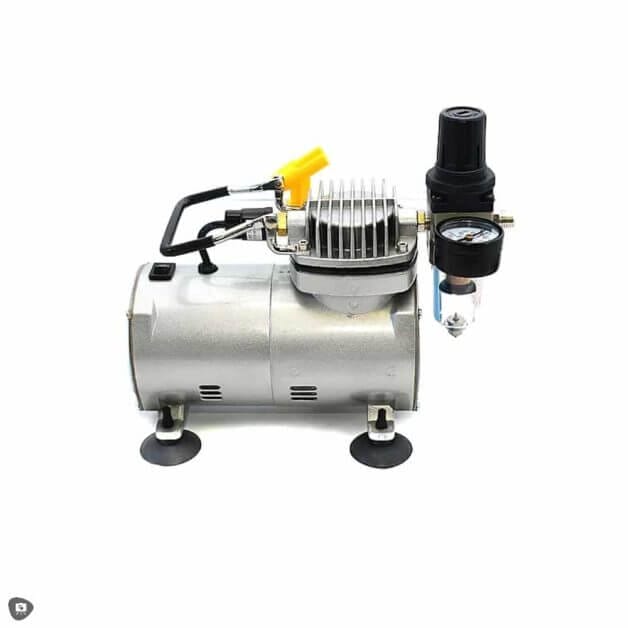 |
SilentAire Scorpion I | Tankless option for occasional use | Check price |
 |
Iwata Power Jet Pro | Independent pressure control for two airbrushes — 2 L tank | Check price |
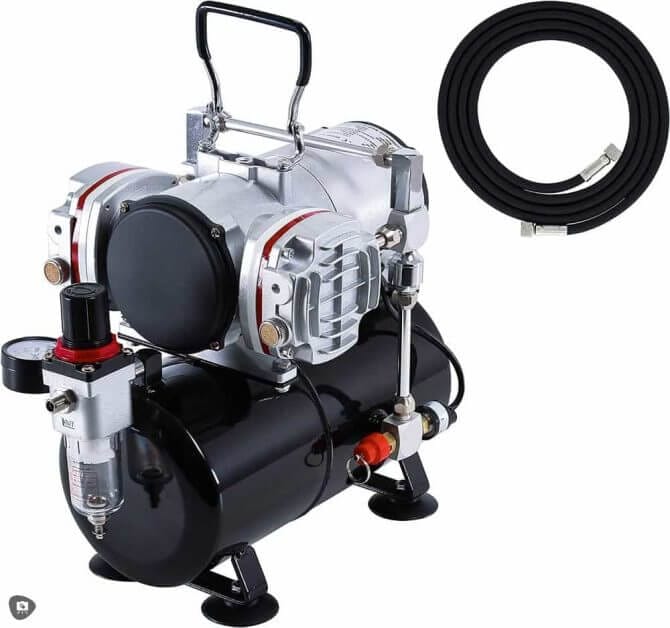 |
Master TC-828 | Higher airflow for demanding projects — 3 L tank | Check price |
What to look for in an airbrush compressor
- Power
- Consistent air pressure
- Moisture control
- Noise
- Weight
- Durability
- Other features
- Cost
Airflow and motor power
Look for sufficient airflow at the pressure your airbrush needs. Airflow is commonly expressed in cubic feet per minute (CFM) or liters per minute (L/min); pressure is expressed in pounds per square inch (PSI).
For a single gravity-feed airbrush, sustained airflow at your chosen working pressure matters more than the motor’s horsepower. Larger nozzles, simultaneous airbrush use and long priming sessions may require more capacity.
Check the manufacturer’s duty cycle and airflow rating at pressure, especially if you tend to paint for long sessions. Horsepower alone does not establish durability or efficiency.
Almost all compressors have a pressure gauge that you can adjust. The Iwata Power Jet Pro, for example, is a premium compressor for miniature painting that has dual regulators with its pressure gauge setup.

A regulator lets you set the pressure delivered to your airbrush. Check the gauge with the airbrush trigger depressed, since the pressure while spraying can differ from the static reading.
The maximum tank or pump pressure is not the pressure you should spray at. Adjust the regulator to suit the nozzle, paint consistency and application, and stay within the equipment’s specified operating range.
This is actually one of the reasons why I don’t recommend you use compressed gas canisters you find in budget airbrush kits.
Compressed gas cans may be cheap initially, but their pressure can fall during use and the recurring cost adds up. Always, always try to use a motorized compressor if you’re serious about painting miniatures.
Consistent air pressure
As with any compressor, you’ll want one with a regulator and an accurate pressure gauge. The gauge indicates pressure, not the volume of air flowing through the hose.
Pressure regulation helps you deliver air consistently. If you have difficulty atomizing paint, check the pressure while spraying, paint viscosity and nozzle size.

A tank helps smooth the pulses produced by a piston or diaphragm compressor. I usually work at 20–35 PSI with my airbrushes; use less pressure for thin paint or finer work when your setup allows.

For fine-scale modelers, controlled spray pressure and properly thinned paint make it easier to build smooth color blends.
Practice on a spare model or test surface until the paint sprays evenly without pooling or drying before it reaches the surface.
Moisture control
Air contains water vapor. As compressed air cools in the tank or hose, water can condense into droplets.
A moisture trap collects liquid water before it reaches the airbrush. A tank and periodic draining also help manage condensation.

Liquid water in your air line, hose, and airbrush is a nightmare for the airbrush artist. Water condensation will drip into your air flow, splatter through your airbrush, and create a mess all over your working model’s surface. It sucks.
Look for a compressor with a moisture trap, particularly if your hobby space is humid.
Managing moisture
A moisture trap is a small chamber that you see at the outlet from your compressor to your air hose. The trap collects condensed water and prevents build up inside your hose.

A drain valve at the bottom of a moisture trap allows you to empty the collected water. Follow the manufacturer’s instructions to drain the trap and tank safely.
An air tank stores compressed air, allowing the motor to cycle off when the tank reaches its preset pressure.
This can reduce pulsation and give the motor a chance to cool between cycles. Drain the tank regularly according to the manual.
I highly recommend an air tank if you plan to airbrush regularly or work for extended periods.
In humid conditions, consider an additional inline moisture trap near the airbrush if condensation persists.
For fine miniature work, I recommend a gravity-feed airbrush, which generally requires less working pressure than a siphon-feed design.
My guide to airbrush compressor basics explains pressure regulation, airflow and moisture control in more detail.
Noise
Compressor noise ratings are reported in decibels (dB). Measurement distance, operating conditions and weighting affect the result, so published values are useful only as rough comparisons unless measured under the same conditions.
Consider how the compressor sounds in your particular workspace, especially if other people are nearby. Use appropriate hearing protection when equipment noise is excessive.

When it comes to comfortable noise levels, however, it’s relative. A single piston compressor for miniature painting will produce a lot of noise. When I lived in a small apartment, I had to avoid airbrushing late at night because the sound would wake my roommates trying to sleep.
Not all airbrush compressors make the same amount of noise. A smaller, compact airbrush compressor can vibrate during operation and some even have that lawnmower chugging noise.
Some compact compressors operate quietly but cannot sustain the airflow required for larger nozzles or lengthy priming sessions.
A tank allows the motor to stop between refill cycles. Noise also depends on the motor, housing, vibration isolation and the surface on which it sits.
Of course, you’ll have to decide for yourself if the extra cost is worth the reduction in noise.
If you paint in a shared living space, noise and vibration may justify paying more for a quieter unit.
Weight
Are you going somewhere with your airbrush? Weight is my least important factor when deciding what airbrush compressor to buy for painting miniatures.
As long as the compressor delivers stable working pressure, has adequate moisture control and fits my hobby space, I’m not particularly concerned with its weight.
In my experience, some heavier compressors are quieter, but weight and piston count alone don’t determine noise. Vibration isolation and the compressor’s construction make a difference.
Somewhere in this metric, there’s a balance between weight, noise, and size that you’ll have to find works best for your airbrushing needs.
Durability
Most hobby compressors are compact, oil-free machines. They still require routine checks, draining the tank and moisture trap where fitted, and cleaning or replacing filters as specified in the manual.
Thermal protection can shut the unit down if it overheats. Cooling fans can help dissipate heat, but neither feature means the motor is rated for continuous operation.
Respect the manufacturer’s duty cycle and allow the compressor to cool when necessary. Oil-lubricated silent compressors may also require oil checks and service.
For frequent airbrushing, I would give reliability, serviceability and available spare parts more weight than a long feature list.
Other features
If you run multiple airbrushes, then you may want airbrush holders. Some airbrush compressors have an airbrush holder compartment or system built into the frame.
For those using a simple mini airbrush kit, such a feature may get in your way. You want to keep things compact. When I was moving around to different living spaces, I knew that “less was more” when it came to my hobby equipment. If it didn’t have a clear purpose, I would eschew buying it.

A dual-regulator setup can be useful when you want two airbrush stations with independent pressure settings. A regulator is not a substitute for a moisture filter.

If you only use one airbrush at a time, a single regulator is generally all you need.
Running two airbrushes simultaneously increases the combined air demand. Check the compressor’s rated airflow at the intended working pressure before choosing a small portable model.
Cost
A small tankless compressor can cost less than a tank-equipped model, but it may be a poor investment if you frequently prime models or paint large batches.
But, you’ll find that even the basic compressor models are affordable for the budget-minded hobbyist. They are much better than the pressurized air cans that you see in arts and crafts stores (don’t bother with them).
My recommendation here is to “buy the quality you need”. Think carefully about how much airbrushing you’ll be doing with your miniature painting or scale modeling hobby. Are you 3D printing large terrain pieces and want to paint them alongside your D&D miniatures?
A tank-equipped hobby compressor is often the most economical all-around choice. Compare the current price of the Master and VIVOHOME models before purchasing.
Premium models from Badger, Iwata and SilentAire can be considerably more expensive. Pay extra for a feature you will actually use, such as quieter operation, independent regulators or long-term serviceability.
Airbrush compressor reviews and recommendations
- SilentAire Scorpion I Airbrush Compressor
- SilentAire Super Silent 20-A Compressor
- Iwata Neo Air Miniature Compressor
- Master Airbrush Cool Runner II Dual Fan Tank Air Compressor
- Master Model C16-B – Black Mini Airbrush Air Compressor
- VIVOHOME Professional Air Compressor
- Testors Mini Airbrush Compressor
- Iwata-Medea – Power Jet Pro Air Compressor
- Badger Air-Brush Co. TC910 Aspire Pro Compressor
- Master Airbrush Model TC-828 Compressor
For most tabletop miniatures, scale models and Gunpla kits, a compact compressor with a tank is a good starting point. A small tankless model may suit occasional travel or very light work.
The specifications below are manufacturer or retailer ratings unless I explicitly describe my own experience. Ratings can differ by model version and measurement conditions.

The SilentAire Scorpion I is a compact, oil-free, single-piston compressor with automatic shutoff, designed for light general airbrushing.
The specifications for older Scorpion I units and current Scorpion IW models differ. Check the exact model and rating plate before purchasing; SilentAire’s current model information is a useful reference.
Its compact tankless design makes it practical for occasional use. Check the included fittings and moisture-control accessories for the specific version you buy.
Key features
- Single-piston, oil-free, tankless
- Automatic pressure cycling
- Compact design
- Confirm pressure and airflow for exact version
Who is this for?
This is a compact option for hobbyists who don’t have much space. Oil-free operation avoids routine lubrication, although the hose, filter and fittings still need attention.
I would choose a tank-equipped model for long painting sessions. A tankless compressor generally needs to run more often and may require cooling breaks.

The SilentAire Super Silent 20-A is a premium, oil-lubricated compressor intended for noise-sensitive workspaces. The retailer describes it as suitable for one or two airbrushes.
The 0.4-gallon tank stores compressed air. Use the outlet regulator to set spraying pressure rather than confusing the tank’s automatic cut-in and cut-out settings with working pressure.
Key features
- Oil-lubricated compressor
- 0.4 US gallon tank (about 1.5 L)
- Free-air capacity: 0.70 CFM (retailer rating)
- 1/5 HP (retailer rating)
- Check oil and servicing requirements
Who is this for?
I’d consider this if quiet operation is a priority and you have the budget for a specialist compressor. Its price makes it difficult to justify for most miniature painters.
An oil-lubricated compressor needs the maintenance specified in its manual. If you paint late at night or share a studio, the reduced noise may make that extra expense worthwhile.

The Iwata NEO AIR is a tiny travel compressor. Iwata specifies a working pressure of 4–15 PSI and a weight of 0.95 pounds, with dimensions of 5.1 × 3.9 × 2.5 inches.
It includes three pressure settings, a detachable airbrush holder and hose, and an international power adapter. It’s intended for light, low-pressure applications.
If you’re traveling and want to bring your airbrush kit without the bulk, this is a good choice. On the other hand, the Iwata Neo Miniature Compressor is not for heavy duty airbrushing.
The limited working pressure means I would reserve this for thin paint, inks and short sessions. There is no tank or conventional pressure regulator; it would not be my first choice for priming or spraying larger surfaces.
Key features
- Working pressure: 4–15 PSI
- Three pressure settings
- No air tank
- 100–240 V adapter
- Weight: 0.95 lb
- Published noise: 52 dB
Who is this for?
This is a specialized travel option for light work with a compatible gravity-feed airbrush.
If you’re buying your first compressor for everyday miniature painting, I would spend the money on a tank-equipped model instead.

The Master Cool Runner II is my value recommendation for most miniature painters. I use one alongside my Badger Aspire Pro.
The TC-326T tank-equipped model has two cooling fans and a three-liter air tank. The supplier lists 47 dB and approximately 25 L/min of airflow. These are published ratings, not measurements from my own workshop.

The compressor comes with an adjustable pressure regulator, water trap filter and air hose as well as two holders for airbrushes. All in all, this is a great compressor for anyone looking to get started with airbrushing.
I recommend the tank-equipped version for anyone getting started with airbrushing or upgrading from a small tankless model. It has the practical features I use most.
Key features
- Model: TC-326T
- Oil-free single piston; two cooling fans
- Tank: 3 L
- Rated airflow: approximately 25 L/min
- Automatic cut-out: 57 PSI
- Published noise: 47 dB
Who is this for?
This is the compressor I would recommend to most new miniature painters. It’s relatively affordable and combines a tank, pressure regulator, moisture trap and automatic motor cycling.
Make sure you’re selecting the TC-326T with a tank rather than a similarly named tankless kit.

This is a small budget compressor for low-pressure work. It runs from a 12V DC supply via the included AC adapter.
The supplier lists a maximum of 25 PSI and an airflow adjustment control. That may be sufficient for short sessions with properly thinned paint, but actual spraying pressure depends on the airbrush.
The pressure switch starts the motor around 15 PSI and stops it at 25 PSI. This is automatic pressure cycling, not evidence that the unit is rated for continuous use.
At less than two pounds, this Master Model C16-B Black Mini Airbrush Compressor is compact, portable, and easy to carry from place to place. It even comes with a 6 foot long braided hose.
If I were traveling more with my airbrush, I would consider this for light work. I would still choose a tank-equipped compressor for regular hobby use.
Key features
- 12 V DC with AC adapter
- Maximum pressure: 25 PSI
- Automatic start: 15 PSI; stop: 25 PSI
- Tankless
- 6-foot hose with 1/8-inch ends
- Weight: under 2 lb
Who is this for?
Consider this for occasional, light airbrushing or a very small workspace.
This is not for heavy-duty airbrushing. It stores away quickly and may be useful for short spraying sessions.

The VIVOHOME is a brand that I’ve come to recognize more and more in the miniature painting hobby space. They make a number of useful products for us hobbyists, including spray booths, lamps, and other tools. One of those tools is their Professional Air Compressor.
The VIVOHOME tank-equipped compressor is a budget alternative to the Master Cool Runner II. Compare exact models and bundle contents before buying.
The 1/5 HP oil-free model with a three-liter tank is commonly listed at 23–25 L/min free-air output. A tank helps smooth airflow; automatic pressure cycling limits unnecessary motor runtime.
The moisture trap helps collect condensed water. Published noise ratings are not comparable unless the test conditions are equivalent.
I would buy this for the compressor rather than the included airbrush. A separate Badger Patriot 105 is a good all-purpose option if your budget allows.
Key features
- Tank-equipped model: 3 L
- Oil-free piston
- Listed airflow: 23–25 L/min
- Regulator and moisture trap
- Check exact bundle and duty cycle
Who is this for?
This is an affordable alternative for painters who want a compressor with a tank, particularly if the bundle costs less than the equivalent Master kit.
Check that the listing includes a three-liter tank, regulator and moisture trap; VIVOHOME also sells tankless versions.
Testors Mini Airbrush Compressor (legacy model)

The Testors Aztek Mini is an older design. Hobbylinc lists the Blue Mini as discontinued, so I’ve removed it from my current buying recommendations. The Master C16-B and Iwata NEO AIR are better starting points if you need a portable compressor.
If you already own the Testors, consult the original manual for its working pressure, duty cycle and fittings.
Legacy specifications
- Older tankless model; not a current recommendation
- Confirm specifications from the original manual
Who is this for?
Existing owners looking for replacement parts should confirm compatibility before purchasing anything secondhand.
Iwata Power Jet Pro air compressor
Iwata makes some of the best-known airbrushes for hobby and professional use. The Power Jet Pro is worth considering if you regularly use multiple airbrushes.
The compressor has a two-liter tank, a protective case, a carry handle and two airbrush holders.
Iwata’s published specifications list 1.08 CFM at 60 PSI, a 1–50 PSI working range, 75 PSI maximum pressure and 62 dB. Its dual regulators let you adjust the two stations independently.
If you’re painting a lot of miniatures and have multiple airbrush setups (e.g., one for base coating and another for fine detail), then this compressor will fit the bill.
Automatic shutoff reduces unnecessary motor runtime. Quick-disconnect fittings attach the supplied Iwata hoses to the compressor.
This is a premium option for anyone who regularly uses two airbrushes. For a less expensive setup, I would consider the Badger or Master compressors.
The current model includes two hoses and adapters for several other airbrush brands. Verify fittings if you have a mixed-brand setup.
Key features
- Tank: 2 L
- Airflow: 1.08 CFM at 60 PSI
- Working pressure: 1–50 PSI; maximum: 75 PSI
- Independent regulators and two outlets
- Published noise: 62 dB
- Weight: 25.84 lb
Who is this for?
This is for serious hobbyists or professional artists who need independent pressure adjustment for multiple airbrushes, or who work on larger projects.
If you’re teaching a workshop, the independent outlets may be particularly useful. Check combined airflow requirements if two people will spray simultaneously.

This is my personal favorite airbrush compressor for painting miniatures. I’ve owned a Badger Aspire Pro for more than 10 years and it has performed flawlessly in my experience. It’s reliable, quiet and requires no routine motor lubrication.
The compressor has a sturdy metal case, handle, adjustable regulator, pressure gauge, moisture filter and two airbrush holders. The TC910 manual specifies a three-liter air tank (approximately 0.79 US gallon), a 1/8-inch BSP outlet and a 1/4-inch NPSM adapter.

The manual lists a working range up to 4 bar (about 58 PSI) and a maximum pressure of 6 bar (about 87 PSI). Some Badger catalog ratings differ, so confirm the specification of the version you buy. In my opinion, the Aspire Pro has been worth the investment.
Key features
- Oil-free single piston
- Tank: 3 L
- Rated air output: 20–23 L/min
- Working pressure up to 4 bar; maximum 6 bar (manual)
- Published noise: 47 dB
- Regulator, gauge and moisture trap
Who is this for?
This is my pick for experienced hobbyists who value long-term reliability. The tank, regulator and automatic pressure cycling are useful for everyday airbrushing.
Although the price is higher than many basic tank-equipped compressors, my own Badger has served me well for years.

The TC-828 is a twin-cylinder compressor with a three-liter tank. TCP Global lists airflow of 40–46 L/min (up to 1.6 CFM at 57 PSI). Check combined demand before using two airbrushes simultaneously.
It has a regulator, pressure gauge, water trap and pressure-relief valve. The tank helps smooth airflow; use the manufacturer-specified normal operating mode.
Its greater airflow capacity is useful for larger nozzles, priming many models or workshop setups where more than one airbrush may be operating.
Would I recommend this compressor for simply painting miniatures? Sure, but it may be overkill for smaller projects. If you regularly work with multiple airbrushes or larger surfaces, it is worth considering.
Key features
- Twin-cylinder piston
- Tank: 3 L
- Rated airflow: 40–46 L/min
- Working pressure: 5–57 PSI (supplier)
- Automatic cycling: 43–57 PSI in normal preset mode
- Regulator, gauge and water trap
Who is this for?
Consider the TC-828 if you need more airflow than a typical single-piston hobby compressor provides.
It may be more conspicuous in a shared workspace. Confirm the current model’s noise rating and weight before buying.
Air hoses and compressor adapters
So you got a new air compressor? Now, you want to attach it to your air hose and airbrush. You’ll need to make sure you have compatible air hose connectors.
Iwata and Harder & Steenbeck typically use 1/8-inch BSP airbrush connections; Badger uses a proprietary fitting. Some Iwata hoses have a 1/4-inch compressor-side fitting. Iwata’s setup guide explains which adapters may be required.

Check both the thread diameter and thread standard at each end of the hose. A 1/4-inch NPT connection is not interchangeable with a 1/4-inch BSP connection simply because the nominal diameter matches.
An appropriately specified adapter can connect a 1/4-inch compressor outlet to a 1/8-inch hose. Confirm the thread standards before buying.

If you’re totally unsure what adapters you’ll need for your particular air compressor, air hose, and airbrush setup, then just pick up an all-encompassing adapter set (it’s not expensive!).

Some adapter kits include a quick release and miniature flow-control valve. A quick release makes it easier to swap airbrushes, while the compressor regulator remains useful for setting working pressure.

I wish these adapter kits existed when I first started airbrushing. They would have made fitting any airbrush to my air compressor much less of a hassle.
Frequently asked questions
- What compressor should I get for airbrushing?
For a single gravity-feed airbrush, I recommend an oil-free tank-equipped compressor with a regulator and moisture trap. Check sustained airflow at working pressure and the manufacturer’s duty cycle.

- What PSI should I use for airbrushing models?
For airbrushing models and miniatures, I set my air pressure regulator to deliver between 20-35 PSI. This gives me sufficient air flow to spray thin and thick paint media through my Badger Patriot 105 or Iwata HP-C hi-line airbrushes. For more details about how to operate your compressor and settings for airbrushing miniatures, check out this complete airbrush guide.
- Can you use any air compressor for airbrushing?
Yes, provided the compressor supplies clean, dry air at a stable regulated working pressure and has compatible fittings. But why would you use a sledgehammer when a regular hammer will do the job?
A compact dedicated hobby compressor usually takes up less space and is easier to live with than a garage compressor.
- How much CFM do I need for airbrushing?
CFM means cubic feet per minute, a measure of airflow; PSI measures pressure. They cannot be converted into one another. A single gravity-feed hobby airbrush often works well with a compact compressor rated around 0.5–1 CFM, but check the rating at your intended working pressure and the requirements of your nozzle. A larger nozzle or multiple airbrushes may require more airflow.
- What is the best airbrush for painting models?
For my recommendation for the best airbrushes to use for painting miniatures, their pros and cons, check out this airbrush overview.

- Does my airbrush matter for painting miniatures?
In general, you want a dual action airbrush that allows you to independently control your airflow and paint mixture. Additionally, I suggest using a gravity feed airbrush, since these airbrushes can operate at very low air pressure without losing spray consistency.
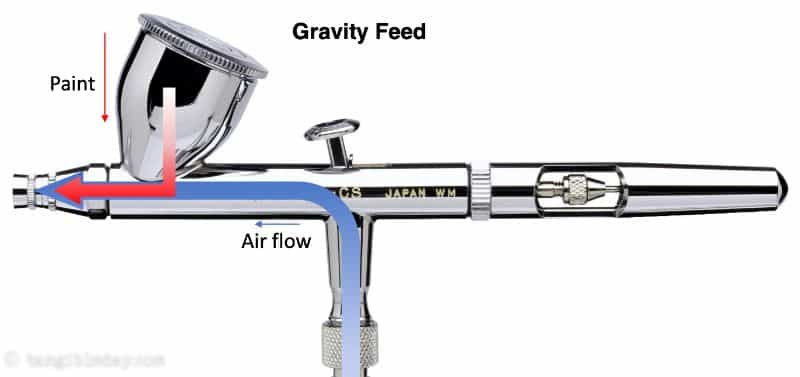
The Badger Patriot 105 is an excellent example of a gravity feed airbrush with a dual action trigger system. It is an ideal airbrush for new and veteran miniature painters.

For the budget minded, looking for an affordable alternative to the Badger Airbrush, you can check out the Master Airbrush. Although I haven’t tested the Master airbrush, I’ve heard fairly good things for those using it for light duty miniature painting.

When it comes to pairing your airbrush with a compressor, it doesn’t matter what airbrush you use as long as the hoses and fittings are compatible. There are inexpensive adapter sets for the female-male ends of the airbrush hose to the compressor, depending on the model, e.g., Iwata versus Badger.
- Is an airbrush worth it for miniature painting?
Yes, airbrushing is worth it for painting miniatures. But they can be hard to learn if you want to use them regularly for miniature painting.
With practice, an airbrush can speed up priming and base coating and help you create smooth gradients that are difficult to achieve with a regular brush alone.
Summary
Of the airbrush compressors I’ve used for painting miniatures, the Badger Aspire Pro remains my personal favorite. For those on a tighter budget, I recommend the tank-equipped Master Cool Runner II.
Choose a compressor that fits comfortably in your hobby space and delivers reliable working pressure for the kind of painting you enjoy.
I’ve found that the best tools in my hobby workspace are often the ones I forget are there. My attention is on the model in front of me.
I hope you found this article helpful! I’d love to hear which compressor has worked well for you.
Enjoying your visit? Join Tangible Day!
Leave a comment, or follow Tangible Day.






Tangible Day on YouTube (Miniatures and More!)

By Andrew M. Tan
Andrew is a commissioned miniature painter with more than 20 years of hands-on experience painting tabletop miniatures, photographing models, and testing hobby tools in real-world use. Read his full bio.
Pingback: Best Airbrush Compressor for Models (10 Recommendations) - Toy Newz
Pingback: Air Compressors for Airbrushing Miniatures (Quick Info Guide) - Tangible Day