

Published July 24, 2026. Last updated July 24, 2026. By Andrew M. Tan.
I am rearranging my hobby space this year, and the lamp giving me the most trouble is the one I already own. It clamps to the edge of the desk, throws a single cone of light down at roughly a 45-degree angle, and leaves a shadow under the far side of anything taller than a coin. I have painted around that shadow for fifteen years. Tilt the miniature, tilt the lamp, hold the brush at an angle that is not the angle I want to paint at. It works. It has never stopped working.
But I am strongly considering building a new setup from scratch, and “it works” is a low bar when I am also trying to solve a second problem at the same time — recording video for the Tangible Day YouTube channel without turning my desk into a lighting rig with three stands and a mess of cords. That second problem is why a $39–60 nail technician lamp has had my attention for the past week.

A half-moon of light solves a shadow problem and a camera mounting problem, simultaneously
The NEEWER BASICS ARC LAMP is a 29.1-inch foldable arc lamp built for manicure stations, sold with tattoo artists and content creators as the secondary audience. It is not marketed to miniature painters at all. I do not think Neewer has ever considered that a wargamer would look at this thing and see a desk lamp.
But the shape is the entire reason I’m seriously eyeing it: a wide half-moon of diffuse LED light that wraps over the work area from both sides at once, instead of pouring down from one point.

I have recommended diffuse, even lighting for as long as I have written about this hobby. In my roundup of the lamps I actually use, the throughline across the Phive, the Neatfi XL, and the Redgrass R9 is the same one: a daylight-balanced lamp that does not create a hotspot is the difference between comfortable three-hour sessions and painting through squinting and eye fatigue.

In my longer list of thirteen lights worth considering, the recommendation holds regardless of price point — color temperature in the 5000 to 6500K daylight range, and enough diffusion that contrast and shadow detail on the model read accurately rather than getting swallowed by glare.
An arc that wraps around the subject from two directions is a more direct answer to that requirement than a single swing-arm lamp will ever be, because it removes the geometry problem instead of managing it. A cloak’s interior, the underside of a gun barrel, the inside curve of a horned helmet — every recess a point-source lamp leaves dark is a recess this shape has a chance of reaching from the opposite side.
The specifications, as published, have limitations…

| Spec | Value |
|---|---|
| Model | NEEWER BASICS HM02-D (SKU 66607311) |
| Arc diameter | 29.1 in / 738 mm |
| Power | 36W, 364 LEDs (182 warm, 182 cool) |
| Color temperature | 5 discrete steps — 3000K, 3500K, 4400K, 5600K, 6500K |
| Dimming | 10–100% |
| Illuminance | 2,920 lux at 0.5 m; 730 lux at 1 m |
| CRI | 80 (manufacturer-published) |
| Mounting | 1/4″-20 thread, cold shoe, locking phone clamp, 180-degree adjustable angle |
| Dimensions | 29.45 × 6.26 × 15.08 in / 74.8 × 15.9 × 38.3 cm |
| Weight | 2.58 lb / 1.17 kg |
| Price | $59.99 list; frequently discounted to around $40 on Amazon |
The number I’m not keen on is the CRI (aka what is color rendering index?). Eighty is a mid-tier commercial rating, well under the 90 to 95 I look for when color accuracy at the brush tip is the whole point, and the absence of a published R9 score (the measure of how well a light renders saturated reds) means I cannot promise flesh tones and deep reds will read the same under this lamp as they do under daylight—this issue will show up most when you’re taking photos of your minis. Of course, I have better, other dedicated lighting systems for photography.

The part nobody selling this lamp to nail technicians thought about
Every review photo Neewer publishes of their arc lamp shows the same accessory: a locking phone clamp mounted at the apex of the arc, with a cold shoe and a second 1/4″-20 thread built in beside it. That mount exists so a nail tech can film an overhead close-up of a manicure in progress without a separate rig. It is, unintentionally, close to a perfect answer to the setup I actually want for hobby video.

I wrote a while back about smartphones versus dedicated cameras for miniature photography, and the conclusion I came to then still holds: under controlled, well-lit conditions, a modern smartphone produces images that are close to indistinguishable from a consumer-grade camera for most social and tutorial purposes.

Where a smartphone falls apart is lighting. Give it deep shadow or a single hard-angled source and the noise and softness show up immediately. Give it broad, even, adjustable-temperature light and the sensor stops being the bottleneck.
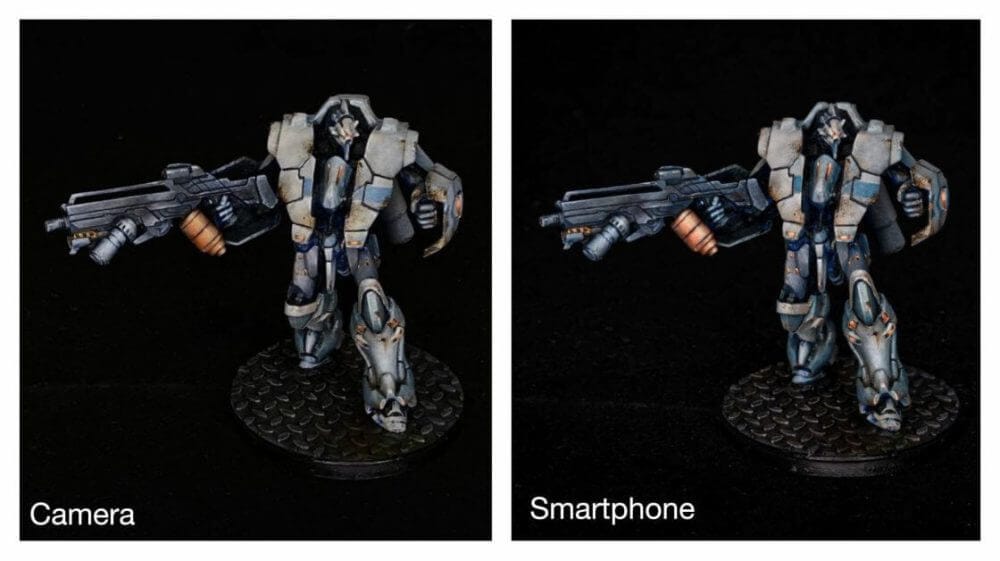
That is the case for using this lamp as a video rig rather than only a desk lamp. An overhead phone position with a 29-inch soft source wrapped around the subject is a genuinely better lighting setup for filming painting tutorials than most of what I have improvised with clamp lights and bounce cards over the years for the YouTube channel.
I have wanted a simpler setup for a long time — fewer stands, fewer cords, one piece of hardware that already knows it is going to have a phone mounted on it. This lamp was built for exactly that job, just for someone painting nails instead of miniatures.
Why I am strongly considering buying this instead of waiting for something built for the hobby

Nobody makes an arc lamp for miniature painters. The closest thing on the market with real color-accuracy credentials, the Redgrass R9, uses a different approach entirely — two parallel light bars with a gap between them rather than a continuous arc, and a price several times higher than this.

The Neatfi XL I already recommend to most people solves the shadow problem with raw output and a wide shade, not with geometry. Nothing in my existing lineup does what a wraparound arc does, and nothing in my existing lineup has a mount built for overhead phone video.

I have been burned before by assuming an expensive, purpose-built tool is the only correct answer. The Phive lamp I have used for over five years and still recommend cost a fraction of the Redgrass R9 and has never let me down. Cheap, well-designed lighting has earned my trust more than once.
Forty to sixty dollars is a low-stakes way to find out whether a wraparound arc actually reaches into the recesses a point source cannot, and whether the built-in phone mount actually replaces the improvised rig I have been using for the channel. If the CRI80 rating turns out to matter as much as the spec sheet suggests it might, this becomes a fill light and a camera rig that sits alongside my Redgrass R9, not a replacement for it. Either outcome is useful. Neither outcome costs me much to find out.

Final Thoughts
I have enough lights. I have had enough light for years! What I did not have was a light shaped like the problem. A recess under a cloak does not need more lumens pointed at it from one angle; I don’t want any angles. No tilting lights or angular swing arms. Just light it all up, evenly. A wraparound arc built for someone else’s job (painting finger nails) happens to be shaped exactly like my problem, and it happens to come with a smartphone mount for the other want/need I have been putting off for just as long.
I am placing the order this week. Full review coming in the future!
Enjoying your visit? Join Tangible Day!
Leave a comment, or follow Tangible Day.




Tangible Day on YouTube (Miniatures and More!)

By Andrew M. Tan
Andrew is a commissioned miniature painter with more than 20 years of hands-on experience painting tabletop miniatures, photographing models, and testing hobby tools in real-world use. Read his full bio.