

I grew up playing the original StarCraft until my computer fans screamed for mercy. Long nights on Battle.net, LAN parties packed with half-empty Dorito bags, too much soda, and custom-map tournaments where I was convinced my APM (actions per minute) was essential to glory (I used to “practice” improving my “micro”). When I heard a StarCraft tabletop miniatures game was officially on the way, something clicked—a lost memory came to life—“Remember this?”
If you spent hours micromanaging space marines or base-rushing with zerglings, you know what I’m talking about: real StarCraft miniatures you can build and paint! If you’re like me, the idea of holding a miniature hydralisk or Siege tank, priming it, watching the colors come alive under a lamp… well, “it’s about time!”

Here’s what we know so far, and why hobbyists and longtime fans should keep this game on their radar.
Why the New StarCraft Miniatures Game Hits a Sweet Spot for Miniature Painters and Gamers
The new StarCraft tabletop miniatures game (officially announced by publisher Archon Studio) is designed as a modern skirmish or small-army wargame, built to bring Blizzard’s universe onto the tabletop in a way that captures the feel of the RTS but gives you tactile, creative control. (StarCraft: Tabletop Miniatures Game).

“Hell, it’s about time.”
— Tychus Findlay, StarCraft II: Wings of Liberty
From early previews and the ask me anything (AMA) held by Archon Studio for the StarCraft: Tabletop Miniatures Game, the game looks like it blends:
- Character-driven squads
- Mission-type scenarios
- Dice-based combat (D6 system)
- Asymmetric factions (Terran, Zerg, Protoss)
It’s made for two players (and expansions and multi-player formats are confirmed to be a part of the game). This core two player format mirrors established games like Warhammer 40,000: Kill Team or Star Wars: Legion, where you field a handful of units and leaders and fight across a mid-sized battlefield.
Yes, this is a skirmish-level game, similar in scale to Kill Team or Warcry.

Who is this game really made for?
- StarCraft veterans who want something nostalgic and a physical collectible
- Miniature painters hungry for the new sculpts. The SC miniatures look amazing for the hobbyist
- Tabletop gamers who enjoy tactical systems in varied sci-fi themed worlds
- Younger players discovering StarCraft for the first time
I’m in the first three categories. The last one… yeah, not really.

What the StarCraft Miniatures Look Like and Why They’re Great for Painting
The early concepts and photo-previews show detailed, dynamic sculpts of the fan-favorite units:
- Terran Marines, Firebats, maybe a Siege Tank
- Zerglings, Hydralisks, monstrous centerpiece creatures
- Protoss Zealots, Dragoons, perhaps a High Templar

If you’ve seen my Hydralisk 3D print post, you already know I’m weak for the xeno lines.

The sculpts are 32 mm scale for basic units, with larger models for hero or monstrous units. If you’re a miniature painter, the sizes are wonderful. Not too large, which would make for a lot of extra tedium, eg., basing; but big enough to hold and display all the juicy details. Really, it’s a great size that supports crisp details without overwhelming new painters. You’ll want to pick up and play your painted pieces.

What You’ll Get Inside the Model Kits
I expect plastic kits that:
- Require light assembly (multi-part sprues)
- Unpainted
- Prime easily
- Feature good detail edges and clean silhouettes (makes standard painting techniques easy to apply, e.g., drybrushing)
The Zerg especially will be fun to paint; organic shapes, carapace gradients, wet transitions that invite contrast paints or glazing. If you like the tyranid miniatures in the Warhammer 40k universe, the zerg minis will be right up your alley.

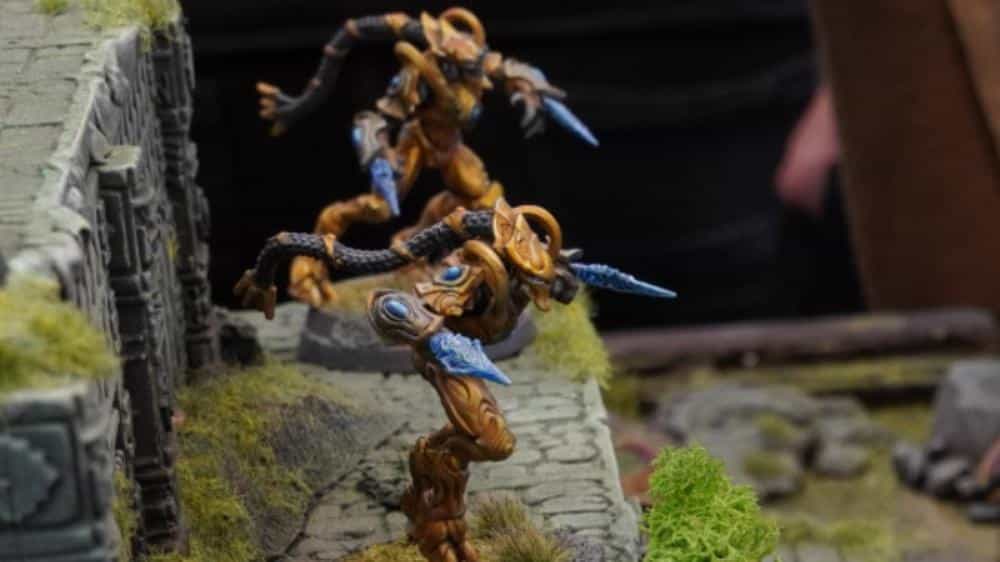
Terran armor offers room for edge highlights and weathering. Oh, I’m so looking forward to the weathering techniques and battle-damage effects on armor.

Protoss units open the door for object-source lighting (OSL) effects, glowing psi-blades and psionic orbs and accents.

If you enjoy painting miniatures that feel instantly gratifying, this lineup is promising. Yep, I’m definitely looking forward to the mini painting part of this tabletop game.
How the StarCraft Miniatures Game Plays Based on Early Publisher Details
Mechanics look like a tactical skirmish wargame grounded in:
- Movement templates or simple measuring sticks
- D6 dice pools for action resolution
- Unit stats with attack/defense modifiers
- Scenario-driven objectives
- Faction-specific abilities
I think of it as StarCraft distilled from its fast-paced RTS vibe, that adrenaline-headiness of the endgame “all-in” main base push; but turned into something you can actually hold, move, and command on a tabletop. You won’t be building structures or managing resources.

You’ll be commanding small squads, making turn-based tactical decisions, and leveraging the individual playstyles and meta for each faction.
- Terran: Flexible, defensive, ranged firepower
- Zerg: Swarm pressure, mobility, ambush
- Protoss: High cost, elite units, powerful abilities
Maybe there’ll be missions where positioning matters: holding points (aka flag or objective domination), victory scoring, or completing mission-objectives.
From the announcements, a standard game takes around 1-2 hours.
- Small ~1–1.5 hours (3′×3′, 1000 pts)
- Standard ~2 hours (3′×6′, 2000 pts)
This is pretty standard, and great for casual play and tournaments. You can commit an evening, or cram an entire campaign over a full weekend.

How Big Will the Gaming Table Be?
Most skirmish games of this type use a 3′ × 3′ or 3′ × 6′ play area, which is confirmed to be the sizes for Starcraft small and standard games. Based on screenshots and demos, this means it’ll fit kitchen tables, fold-out gaming tables, and standard gaming mats. If you’ve played Warhammer 40k, Warmachine, Bolt Action, or any of the popular 28-32mm scaled miniature tabletop games out there, you’ll be right at home.
Marketed or your DIY terrain may include:
- Sci-fi industrial scatter
- Alien environments (Zerg creep, Protoss pylons)
- Modular systems compatible with other games
Overall, I think the smaller game size makes games run quicker.
Your painting goals stay focused, and setup becomes something you can handle without too much effort. Ah, yes; this also makes photographing your models easier. With the action pulled in close, you can frame shots cleanly, catch the details you worked hard on, and share them without wrestling with lights or space.

Will the Minis Be Hard to Paint?
Short answer: No. They look approachable but rewarding. The sculpts appear to have:
- Deep recesses for shading
- Bold contours for edge-highlights
- Clean, clear shapes for quick readability
If you’re starting out or just want a fast way into painting these StarCraft models, I’ve got a simple beginner guide for you: Miniature Painting Tips for Beginners.

StarCraft Miniatures Game FAQ
Here are some of the common questions I’ve noted from the community:
- When is the release date?
Promised for early 2026, with Q1 preorders - What’s the price?
Estimated at ~$150–160 for a Two-Player Starter, ~$60–80 for a Faction Box. - How many units come in the starter box?
Two-Player Starter (Terran vs Zerg)- Terran:
- 2× Marine squads (6 models each)
- 1× Marauder squad (2 models)
- 1× Medic squad (3 models)
→ 17 Terran models
- 2× Marine squads (6 models each)
- Zerg:
- 1× Queen
- 2× Zergling squads (12 models each)
- 1× Roach squad (3 models)
→ 28 Zerg models
- Terran:
- Will there be expansions?
Yes, long-range roadmap extends ~9 years. (Wargamer) - Is painting required to play?
Technically no, but one look at the sculpts and you’ll want to. - How competitive will it be?
Early indications: tactical, tight gameplay; probably less complex than full-scale wargames. - Is it beginner-friendly?
Probably more accessible than large-scale options. - What scale are the miniatures?
Around 32 mm scale for basic units. - What terrain will be required?
Sci-fi modular terrain; compatible with other systems perhaps. - How many players?
Core game likely 2 players; future modes maybe more.
Some of these questions and topics deserve their own future articles (stick around—I’ll keep you guys updated).
Final Thoughts
Ugh, I can’t wait. There’s something about the nostalgia, of decades ago, when gaming PC computers were literally boxes that took up your entire desktop.
Gaming was fresh, unadulterated by the social media spin and splash of today’s gaming ecosystem. Here, the StarCraft miniatures tabletop game feels like that memory, and fills (I think) that longing for a slower pace to life. It’s a human touch in a digital, AI-filled world. Bring a friend. Paint some models. Kill ’em with dice rolls.
If the sculpts are half as good as the previews suggest, I’ll be painting those ‘toss and zerg units long into the night, just like the old days.
What unit would you paint first? Drop a comment, I’m curious!
Enjoying Your Visit? Join Tangible Day
Free newsletter with monthly updates (no spam)



Tangible Day on YouTube (Miniatures and More!)

Pingback: Painting-Guide: Warum StarCraft TMG ein Traum für Miniaturenmaler ist – Klares Plastik, HIPS und magnetische Basen - SC Tabletop News
Pingback: Painting-Guide: Zerg-Schwarm bemalen – Contrast Paints, Carapace-Verläufe und organische Texturen - SC Tabletop News