
Last updated September 1, 2026. By Andrew M. Tan.
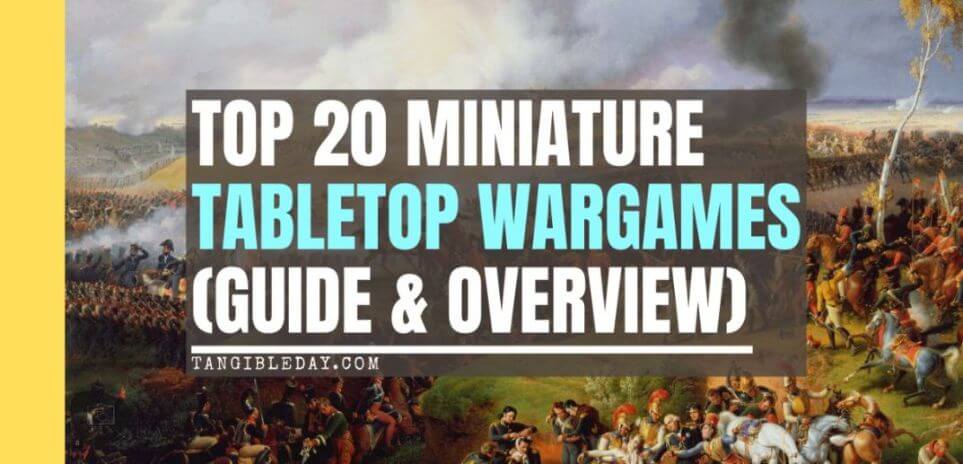
Tabletop wargaming is a hobby where players use miniature armies to simulate battles on a tabletop. The miniatures can come from any period or genre, so you can recreate history, fight in imaginary worlds, or make up your own scenarios.
Players move models across terrain, measure distances, roll dice, and follow a shared set of rules to see how the battle unfolds. A few painted miniatures, some scenery, and a bit of imagination can turn an ordinary table into a small world. That is a big part of the fun.
In this article, I’ll take a look at the basics of miniature wargaming, why people play, and 20 popular tabletop miniatures games you can try. If you’re looking for a game to start with, scroll on down.

What is Tabletop Wargaming?
There is no one way to play a tabletop wargame. Some players enjoy a small skirmish with only a handful of models. Others collect large armies and spend an afternoon playing through a battle with friends.

The models can be plastic, metal, resin, or even 3D printed. You can paint every detail or get a few miniatures ready for the table and learn as you go. The hobby has room for both approaches.
Is Tabletop Wargaming Popular?
It is hard to put an exact number on everyone who plays tabletop wargames. The hobby is spread across hundreds of games, local groups, conventions, clubs, and smaller miniature companies.
Still, there are a few clues about its scale. Games Workshop’s annual reports show revenue of £617.5 million, or roughly US$830 million. That was up from £525.7 million, or about US$670 million. That is only one company, of course, but Warhammer is a pretty good indication that tabletop miniatures reach far beyond a few people playing in somebody’s basement.
Researchers have also started paying closer attention to the hobby. In a study of 8,590 miniature wargame players, researchers examined why people play. They found that players were drawn to different parts of the hobby, including socializing, competition, storytelling, and a chance to step away from everyday life. Of course, studies like these do not really tell us how many wargamers exist in total. But they do show that this is a large enough hobby to attract serious interest beyond the game table, so much so that it garnered a published academic journal study.
Warhammer 40,000, Warhammer Age of Sigmar, and BattleTech are some of the names you will see most often, but there are plenty of smaller games with devoted players and beautiful models.

How Hard is it to Play a Tabletop Wargame with Miniatures?
Tabletop wargaming can be a complex hobby, with a wide variety of rules and strategies. Games such as Warhammer 40,000, BattleTech, and Flames of War all ask you to learn different things. Some players build and paint a full army. Others begin with a small starter set and a few models.
You do not need to learn every rule before your first game. A starter set, a small force, and someone willing to teach you can get the first battle moving quickly. From there, the rules begin to make more sense as you see them working on the table.

Most tabletop wargames take some time and effort to learn. That is part of their appeal. You learn a little more about your models, your opponent, and the game each time you sit down to play.
In my experience, very complex games can be harder to remember after a long break. A smaller skirmish game can be a good place to get your feet under you first.
Is it Expensive to Play a Tabletop Wargame?
Tabletop wargaming can be an expensive hobby. The actual cost depends on the game, the size of army you want, and how much you want to add over time. Miniatures, paint, terrain, books, dice, and a gaming table can all become part of the project.

Many games have starter sets that give you enough models and rules to begin playing without building a massive collection. Other systems encourage larger armies, elaborate scenery, and long-term collecting. Both can be rewarding.
For many hobbyists, the depth of miniature wargaming is the main draw. You can build one unit at a time, paint it, learn how it works, and slowly create an army that feels like your own.
Why do People Play Miniature Wargames?
People play tabletop wargames for many different reasons. Some enjoy learning rules and strategies. Others enjoy recreating historical battles, exploring a favorite fictional world, painting miniatures, or competing in tournaments.
For me, painting and customizing miniatures are part of what keeps the hobby interesting. A model can spend a week on the desk, then finally make it onto the table with a job to do.
Ultimately, there are many reasons to play tabletop wargames. The right game is the one that gives you a reason to come back to the table.
Before you pick a game, think about what you want from it. Do you want a handful of models or a full army? Do you care most about the setting, the painting, the rules, or the people you can play with?
I’m sure I missed a few great games. Every wargamer has a favorite, and this list is a place to start looking.
1. Konflikt ’47


Konflikt ’47 is a skirmish-level tabletop wargame set in an alternate-history World War II, where nuclear-era Rift technology has spawned walking mechs and strange new weapons on both sides. The current game has its own rules and army lists, though Bolt Action players will recognize some familiar ground. If you want WWII history with a strange technological twist, this is a great game.


Warhammer Age of Sigmar (AOS) is a fantasy-themed tabletop wargame that is popular among beginners and experienced players alike. From Games Workshop, the models come in plastic kits that usually require some assembly and painting.
Armies move and fight on a tabletop battlefield, with players measuring distances with a tape measure. You can start with a small game and a handful of models, then build toward larger battles over time.
The rules are simple yet challenging, and the battles have a great balance of strategy and luck. Warhammer Age of Sigmar is straightforward to begin learning, with plenty of room to grow into its tactics and lore.
If you’re into fantasy lore, want to indulge in a collection of amazing-looking miniatures, and have a taste for the whimsical mingled with horror, Warhammer Age of Sigmar is for you. From my friends who play this game regularly, in grand events and local tournaments, to my personal experience, I can tell you that it has something for everyone.
3. Kings of War


Kings of War from Mantic Games is another fantasy-themed tabletop wargame that is easy to learn and affordable. It is a good choice for players who enjoy fantasy mass battles and ranked units. The game uses 6-sided dice (D6) for resolution and has a points system to balance armies. The current Fourth Edition rules are available through Mantic’s Companion, with updates and expansions in the same place.
4. Malifaux

Malifaux is a skirmish-level tabletop wargame, e.g., only uses a few models in gameplay, that is set in an alternate history Victorian world. Here, characters emerge within a steampunk world to do battle against other fantastical characters, full of whimsical, horrific and deadly creatures.

Malifaux uses playing cards to resolve conflict and player decisions, which gives each game a feel that many players find interesting. Great looking scenic terrain, either company-brand or custom, unique terrain pieces, work together to create an immersive playing experience.

Conquest: The Last Argument of Kings is a dark-fantasy themed tabletop wargame that is set in an imaginary world. Para Bellum also offers First Blood, a smaller skirmish game in the same setting.

The game uses miniatures in the 35mm scale, which is a larger size than most other popular wargames. Battles occur in a dark world with a style of play that is both engaging, tactically complex, yet simple to learn.
In terms of gameplay, I’ve always been attracted to the alternating activation ruleset where each player takes turns to perform actions. It keeps both players involved throughout the game. The main starter kits use plastic miniatures, which some have said are close in quality with those in Warhammer games. I’m not so sure, but they are fun to paint. Take a closer look!
6. Warmachine


Warmachine is a skirmish-level tabletop wargame that is set in a “steampunk” themed world. Magic and firearms mix on the battlefield for a tactical, chess-like experience. This continues to be a favorite game of mine that I hope more people will play.

One of the reasons I enjoy this game so much is that each model on the tabletop has an enhanced functionality that you need to consider for the whole army to work well together. In other words, to have your army function properly, you need to immerse yourself a bit more in the game than in other systems, which I find more rewarding.
7. Battletech

BattleTech is a tabletop wargame that is set in the future. Although BattleTech appears in other gaming mediums, e.g., board games, video games, and more, the miniature game has endured as a primary way people experience this universe. This game is best for people who want to simulate giant Mech warfare on a war-torn battlefield.

You can begin with only a few BattleMechs, learn the rhythm of the game, and build from there if the setting grabs you. In my view, these are the best miniatures from this universe I’ve ever seen. In fact, I’m keen on trying to pick up some more just for the challenge of painting them up.

Glory and Carnage II is a historical tabletop wargame that is set in different periods of history. Here’s a hands-on overview of Glory and Carnage 2. There are several to choose from, ranging from a pre-gunpowder age, all the way to Napoleon’s Europe with cannon and artillery.
9. Malediction

Malediction is a dark-fantasy skirmish game that blends card-driven combat with miniature positioning, set in the world of Agnar. You build a deck around your Seeker and field their warband using cardboard standees or your own 3D-printed miniatures. I found the card mechanics do a lot of the heavy lifting here, resolving conflict and player decisions without a pile of dice to track.
Malediction is a good fit for anyone who wants tactical skirmish combat with the deckbuilding depth of a card game, and doesn’t mind an evolving digital-and-physical approach to miniatures.
10. Warhammer 40,000


“In the grim darkness of the far future, there is only war.” Warhammer 40,000 is hugely popular for so many different reasons. If I had to describe it quickly, Warhammer 40K is the grimdark science-fiction miniatures game that anyone should know about, if not try.
For new miniature wargamers, Warhammer 40K can be one of the easier games to find opponents for, because of its huge range of armies, miniatures, local events, and beginner resources. A good first game with someone willing to teach you can make the rules feel much less intimidating.

The community around it is one of the most creative I’ve been a part of.


Are you a Marvel fan? Marvel Crisis Protocol (MCP) is a superhero tabletop wargame set in the Marvel universe. Think: the toy soldiers are now superheroes! Players build a small team, paint the characters in their favorite comic-book schemes, and fight across a terrain-heavy urban battlefield. I have not had the chance to play this much, but it’s high on my list!
12. Necromunda

Necromunda is a tabletop skirmish game that is set in the Warhammer 40,000 universe. The game draws from the Warhammer 40K universe and uses the same atmospheric fluff and background lore. Necromunda is a place where gangs and mercenaries battle it out for control of the storied “hive city.” Gameplay is brutal, fast, and immersive with RPG-like elements. A player, for example, can create a specific gang with their own unique skills and abilities.

As a conflict progresses, new abilities unlock within a player’s characters depending on how the gameplay develops. Third-party creators have made all sorts of additional gameplay elements and scenery you can place within your games. Necromunda is simple to play, but has a lot of depth that can be explored.
I highly recommend it for people who want to get into Warhammer 40K, but don’t want to commit to a large army. Kill Team is another Warhammer 40,000 skirmish game. It is its own game, separate from Necromunda.
13. Infinity Miniatures Game

Infinity Miniatures Game is a skirmish-level tabletop wargame that is set in the future. Aesthetically, the world is set in a cyberpunk universe, i.e., think Ridley Scott’s movie “Blade Runner.” Gameplay is tactical and forces players to make difficult decisions in order to achieve victory.


The rulebook has been translated into English, Spanish, French, and German. The game continues to reward careful positioning and a deep understanding of its rules. Never mind that these are the best miniatures I’ve ever collected in terms of cool-factor, hobby painting fun, and epic scale. Here, the game has an expansive line of models that can be used even for non-Infinity players. If you’re looking for a futuristic tabletop wargame with beautiful models and a deep rule set, then Infinity is the game for you.
14. Kill Team 40k


Kill Team is Games Workshop’s skirmish version of Warhammer 40,000, built for small squad-level engagements. It lets you focus on a small team of operatives, with far fewer miniatures required than a standard 40K force.

From my observation, the game trades 40K’s scale for tighter tactical decisions, since every model and every activation matters more when your whole force fits in a small box. If you like the Warhammer 40K setting but want quicker games and a smaller shelf commitment, Kill Team is worth a look.

Dropzone Commander is a tabletop wargame that is set in the future. Unlike many other wargames on this list (or any of the other ones you may find), Dropzone Commander (DZC) use miniatures in the 10mm scale. Basically, this means that the game plays with large-scale battles between armies of miniatures in a smaller space (read more about different miniature gaming scales).


Skyscrapers and other urban features enhance the battlefield and give players more tactical options. Yes, painting these miniatures is a unique challenge (though not necessarily more difficult) because of their size. But, you won’t have to spend a lot of time on each model to make it look good on the tabletop. If you’re looking for a large-scale futuristic wargame that you can play in a smaller tabletop space, Dropzone Commander is my pick!
16. Bolt Action

Bolt Action is presented by Warlord Games, a company based in the UK, and is a World War II tabletop miniatures wargame. The current Third Edition keeps the action at the troop level, with players trying to outmaneuver one another across the battlefield.


In Bolt Action, there is a back and forth between players as they try to outmaneuver their opponent. If you’d like to fight epic battles on the tabletop with an approachable ruleset and plenty of social chitchat, Bolt Action is an excellent place to start.

Dropfleet Commander (DFC) is a spaceship combat game, similar in appearance to Star Wars Armada, but at a smaller scale—literally—at 1:15,000 scale size. Gameplay is strategic and, dare I say, cinematic. The ship details on the models, in my opinion, are amazing and are the first draw to the game. If you wanted to battle it out in space, this is the coolest tabletop miniatures game using spaceships that I’ve seen.


The game is still supported, with a current starter set and ongoing releases from TTCombat. Overall, I think Dropfleet Commander is one of the best spaceship combat games that brings both strategic gameplay depth and fantastic tabletop models.

Warhammer Blood Bowl is a soccer or football themed tabletop wargame set in the Warhammer Fantasy universe. As the title suggests, the game is a combination of blood bowl (a euphemism for a violent, bloody football game) and Warhammer.

This game can be a lot of fun if you’re familiar with the Warhammer Fantasy setting and want to try something new. While I”m not a huge proponent of bringing sports (an athletic, fast-paced, physically involved activity) into the more stationary tabletop setting, I can see how some people would get a kick out of this game (pun intended).
19. Flames of War

Flames of War (FoW) is a World War II tabletop wargame in a similar vein to Bolt Action. However, there is a bit more tactical depth and miniature range within the game. On the other hand, Flames of War is one of the first broadly popular WW2 history-themed games that removed the complexities of old-fashioned wargaming, with those lengthy spreadsheets and hit tables.


So, if you want a fast-paced, action-packed game that is still historically accurate and has good miniature models to boot, Flames of War is an excellent choice. If you’re looking for a “casual” historical wargame with fantastic looking scale models, Flames of War is a great option.
20. Warcry

Warcry is a fast-paced skirmish game set in the Age of Sigmar universe, where small warbands clash across ruined battlescapes. It is similar to Kill Team 40K. Terrain and battleplans make each game feel active and a little unpredictable.
If you want Warhammer’s fantasy setting in bite-sized tactical skirmishes with a small collection of miniatures, Warcry is worth a look. It is one of the best skirmish tabletop games available, in my opinion, and the miniatures are really fun to paint!

Bonus Game: StarCraft: Tabletop Miniatures Game

StarCraft: Tabletop Miniatures Game is a new tactical game that brings Terran, Zerg, and Protoss battles to an actual tabletop. For anyone who spent years clicking through a StarCraft match, there is something pretty great about seeing those familiar units as miniatures you can build, paint, and move across the battlefield.
I wrote a closer preview of the StarCraft Miniatures Game with the early details, the models, and why I am already looking forward to painting a few Zerg.
Did I Miss Any Favorite Games? I Sure Did!
And, I certainly did miss a few favorite games. It would be impossible to list and describe all the wargames you can choose from. Well, not impossible, but I think we captured a good sampling.

I’ll note that I haven’t even mentioned the many board games that use miniatures that simulate pitch battle-like scenarios, e.g., Warhammer Underworlds, or hybrid games that use a eclectic mix of digital media, e.g., augmented reality, to enhance the tabletop gaming experience. So, if you’re looking for something a little different, be sure to do some digging; you may be surprised what you find out there–it’s always changing!
Final Thoughts
Tabletop wargames can be as simple or as deep as you want them to be. Start with the setting and models that make you want to sit down at the table. Pick up a small force, play a first game, and let the hobby grow from there.
The games I describe above are some of my favorites. They are only a starting point. Every wargamer has a favorite game they would add to the list.
If you are looking for something new, pick one game that fits your budget, the time you have, and the people you can play with. A few painted models and one good game are enough to make a table feel like your own little world.
Do you play games with miniatures on epic tabletop battlefields? Did I miss any favorites? I’d love to hear from you. Leave me a comment below.
Happy wargaming! 🎲
Enjoying your visit? Join Tangible Day!
Leave a comment, or follow Tangible Day.


Tangible Day on YouTube (Miniatures and More!)

By Andrew M. Tan
Andrew is a commissioned miniature painter with more than 20 years of hands-on experience painting tabletop miniatures, photographing models, and testing hobby tools in real-world use. Read his full bio.
How is Battletech expensive you only need 4 models to make an army which you can get for $20, it’s the least expensive game on here.
You’re right! Thanks for the comment. 🙂 In my defense though, I wrote that the game “used to be expensive“ which it was.
Blood Bowl isn’t 40k but Warhammer Fantasy.
Fixed! Old world fantasy 🙂