

Published August 6, 2026. Last updated August 6, 2026. By Andrew M. Tan.
I often get hung up when there’s a big miniature-painting project ahead of me. My head gets wrapped up in the minutiae of which paints I need, every step I’ll eventually have to complete, and the cleanup waiting for me afterward. Then there’s the decision of whether to use an airbrush and whether it will actually save enough time to justify setting everything up. Even something as foundational as deciding how to properly basecoat the miniatures can become its own small planning problem. And don’t get me started on choosing a color scheme.
Before I have touched a brush, I have mentally expanded one painting project into dozens of interconnected decisions. I am no longer thinking about the next thing I need to do. I am trying to hold the entire project in my head at once.
That is usually where the project starts to feel heavier. The miniature is still sitting in front of me, unchanged, while my mind is already managing the airbrush, the basecoat, the color palette, the later details, and the final cleanup. The sequence has collapsed into a pile of unresolved decisions.

Overcoming the “Fear of Starting”
The actual application of breaking that pile into smaller tasks can be pretty hard, of course. It’s not natural for me to think in small bites. I’m not sure it is the default most of us fall back on when we see something big that needs to be done — it’s usually the final stretch of a project where that habit breaks down.
Whether it is for our job, for school, or for the hobby itself, we want to do the “thing.” We can often picture the finished result clearly enough. The challenge is deciding how to begin, how to maintain the motivation to keep going, and how to persist long enough to finish well.
From a high level, the project looks scary because we see the entire distance at once. We see the completed miniature, the full army, the written report, or the finished assignment, along with every decision and complication between here and there.
The operational hack is to stop treating the whole project as the unit of work. I break it into smaller tasks that each have a clear beginning and a clear end. I finish one, move to the next, and string those completed pieces together until the larger whole exists.
One solution I use is to narrate the entire project to myself using my phone, then let an AI tool, such as Claude or ChatGPT help me organize what I said.

How I Get the Whole Project Out of my Head
So far, this probably sounds like fairly generic advice. “Break a large task into smaller ones” is useful, but it does not explain how to do that when the project is still tangled up in your head.
I open a voice-notes app and start talking through everything I think I need to do. I describe the project, the result I want, the paints or tools I might need, the decisions I have not made, and the parts I am already worried about. If it comes out jumbled, that is fine. The point at this stage is to capture the whole project before I try to organize it.
The point is to get the pieces, wants, expectations, and personal vision for the project out of my head. As long as they remain internal, they continue competing for attention and triggering hesitation. I keep revisiting the same questions, anticipating problems, and trying to mentally organize the entire project before I have begun any part of it.
Once those thoughts are stored somewhere else, I can examine and organize them more deliberately. They become a record of the project rather than a rotating set of unfinished decisions.
Pen and paper can accomplish the same thing. I prefer my phone because speaking is faster for me than typing, especially when the ideas are still disorganized. Lately I’ve been using a Plaud Note voice recorder for this instead of my phone — one less screen with notifications competing for my attention. I record the note, transcribe it into text, and then send that transcript to ChatGPT. You could use another AI platform for this part. What matters is whether the system can help organize your notes without replacing your intent.

I give AI my discombobulated notes, competing ideas, practical concerns, and overall vision for the thing I want to make. Then I ask it to help me separate that material into smaller tasks.
AI helps me identify the structure already buried inside what I said. My original voice note still provides the priorities, preferences, uncertainties, and creative direction for the project.

Here, AI helps sort those elements into a sequence with clearer boundaries. I end up with a set of smaller actions that each have a recognizable beginning and an obvious condition for being finished.

How this might work with a Skaven Verminlord
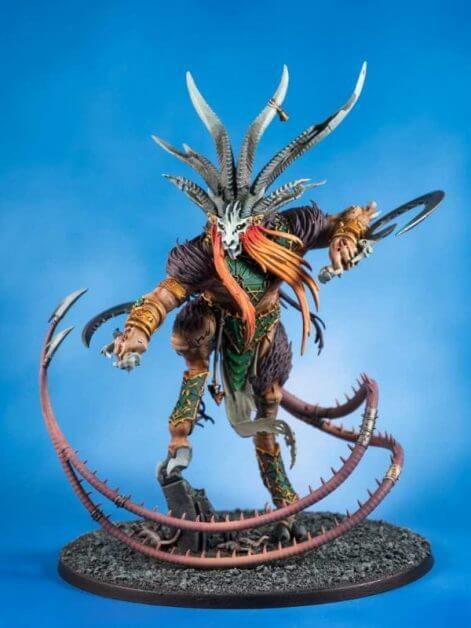
For example, say I want to paint a Skaven Verminlord. That model is large, visually complex, and full of decisions. I can run the project through this process before I begin painting.
1. I narrate the entire project into my phone
I talk through everything I am thinking about the model. I mention the color scheme, whether I want the skin to look pale or diseased, how dark the fur should be, whether the armor should appear rusty, how I want the weapon to read, and what kind of base would look good with the finished piece.

I also emphasize the need for maintaining high contrast across the model. Not just dark to light, but also color temperature, e.g., hot vs cold hues, to keep a viewer’s interest and mine. In many ways, I love that AI helps me resolve some of the early decision-paralysis by helping to structure my decision-making process for a color scheme.
I also say what I am worried about, including the size of the model, the amount of detail, and whether I should use an airbrush for the first base coat layers. Basically, I do a brain-dump and let AI sort out the process into the steps I can actually work through A to Z.
2. I transcribe the voice note and give the raw text to ChatGPT
I do not clean it up first. The transcript can be repetitive, incomplete, and disorganized. That rawness is useful because it preserves the full project as I currently understand it, including the practical decisions and the creative direction I want to preserve. It’s pure, and unedited, and so it flows. No pressure; nobody is judging this.
3. I ask AI to separate the project into clean phases
For the Verminlord, those phases might become preparation and priming, skin and fur, armor and weapons, detail work, and basing. I’ve shown this process on my YouTube channel.
Each phase has a clear starting point and a clear condition for being finished.
4. I reduce the first phase to one immediate task
Instead of telling myself to begin painting the Verminlord, I give myself a smaller instruction, such as: clean the model, assemble the major sections, and prepare it for primer. Priming a model is honestly my favorite step because I know it’s one of the most important early steps for painting any model, but it is almost impossible to screw up.
Once that is done, I stop. I reward myself by admiring the primed model. I’m done; it is not a gray bit of plastic anymore! I’ve reached the peak of a mountain…in a range of many mountains. But, I did reach the pinnacle of a task.
Now, breathe. The skin, armor, weapon, and base can remain decisions for later phases.
5. I complete the phases in sequence and revise the plan when needed
After each small task is finished, I move to the next one. The plan serves as a working map that I can adjust as the project develops. It keeps me from carrying the entire Verminlord in my head every time I sit down to paint. I even refer back to the same AI chat (e.g., ChatGPT remembers what I did, as I continue the conversation in the same project window. A simple prompt like “What’s next?” leads to a clear response of what we discussed earlier on what steps to take).
By the way, I strongly do not recommend asking for feedback at any stage of your painting process. I wouldn’t even ask AI for its feedback. Feedback stumbles you, at least it does for me. I don’t need judgement on an incomplete project. I just keep going; maintaining the flow.

Rinse and Repeat
The first useful step is often moving the project out of my head so I can see its structure clearly. Go back to step #1 if you get stuck. Putting it altogether, this is my simple process nowadays. Once each part has a clear beginning and a clear end, I can complete the larger project one finishable piece at a time.
Finishing the Next Small Thing with the Help of AI
It comes down to an operational hack I have started using more often lately. When a project feels too large to hold comfortably in my head, I talk it out, capture the mess, and turn it into a sequence of smaller tasks with clear boundaries.
The phone is often the first tool in that process. AI voice note takers are also amazing and I want a new one. Speaking the project aloud helps me surface the confusion, preferences, worries, and ideas that would otherwise continue circling in the background.
Transcribing those thoughts and using AI to organize them gives the project a visible structure—and if you’d rather do the sorting step by hand instead of handing it to an AI, the list-making version of this same idea works too.
Conclusion
The painting of any miniature still requires patience, and the painting takes time. Lots of time.
I simply no longer need to carry the entire project every time I sit down at the desk. I only need to finish the next bounded piece of work.
The next time a large hobby project stalls before it begins, open a voice-notes app and describe the whole thing exactly as it exists in your head. Do not organize it first. Get it out, transcribe it, and ask an AI system to turn it into five or fewer clear phases with a defined start and finish for each one.
Then choose the first phase and begin there.
Enjoying your visit? Join Tangible Day!
Leave a comment, or follow Tangible Day.



Tangible Day on YouTube (Miniatures and More!)
By Andrew M. Tan
Andrew is a commissioned miniature painter with more than 20 years of hands-on experience painting tabletop miniatures, photographing models, and testing hobby tools in real-world use. Read his full bio.
How much do you ask the AI for original input? I’ve been pleasantly surprised by how much it can contribute just by uploading a picture of the mini and asking for suggestions. It’s not perfect by any means but some suggestions from left-field have proved very useful.
For miniatures, I often try to get started with my idea first. That way I’m not “influenced” by AI’s often generic ideas. And, if I understand correctly how AI models work, they “borrow/take/steal” original ideas and average them together—an oversimplification of course—and then send you the refined response based on your prompt. So in fact, I’m not sure AI can give you an “original input”, but rather get your creative juices going by “seeding” some ideas for you to start working with.
I love using AI, though there are drawbacks…
Before AI, I often used reference images I found just by doing a Google image search. Or, even walking into a local game store to look at the box art on model kits and stuff. You can get inspiration and ideas for miniatures almost anywhere you go, actually.
To take it back to your original question, if you mean just a blank unpainted miniature and you’re trying to figure out how to take that next step in choosing colors, process of putting it altogether, yeah that also comes with time and practice trying things out. AI is just a wonderful way imho to kick start that process; as they say “it’s just another tool”.
Thanks for stopping by!
Andrew