Are you looking to take great pictures of your miniatures? After you’re done painting your miniatures, you may want to take photos of them in various locations. Professional photos always tell a story or evoke an emotion. With miniature photography, you have an excellent way to document your work, tell a narrative, and share what you’ve accomplished. If you’re looking for helpful tips for taking great pictures of your miniatures, you’ve come to the right place.
In this article, I share simple tips to help you produce better pictures of your miniatures.

7 Simple Tips for How to Take Great Pictures of Your Miniatures
Here are 7 tips for how you can take great pictures of your miniatures and models:
- Practice, break, practice
- Play with different cameras and equipment
- Prepare or scout your scene
- Use the right lighting
- Try different angles and perspectives
- Get in the zone
- Gather, analyze, apply
What Does the Word “Photography” Mean?
Photography means “drawing with light” in Greek. A photograph is an image you create with a camera, which is a tool that captures the light from the environment. This is an important definition of photography–Because light unifies the process of capturing photographs, it doesn’t matter what type of camera you use.
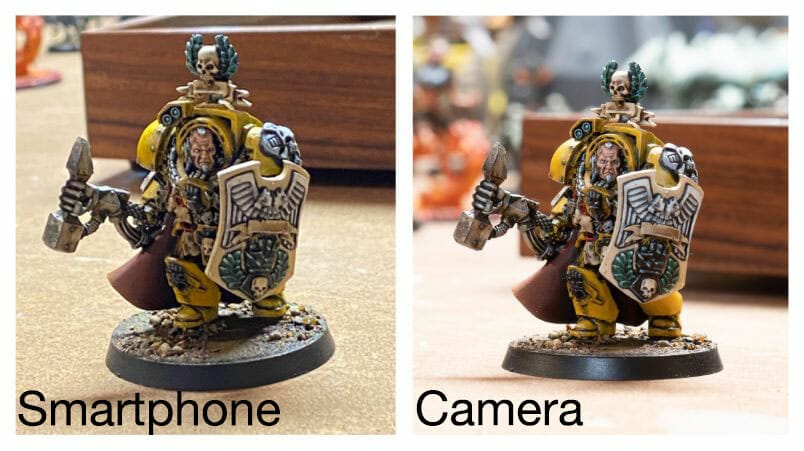
Whether you’re using a smartphone or dedicated camera system, the principles of photography are the same. In fact, under the right conditions, there is little difference between images you create with a smartphone versus those you capture with a “real” camera.
You can see in-depth comparison of miniature photos taken with a smartphone versus a full-frame camera, e.g., DSLR or mirrorless. The results are eye-opening! Suffice it to say, at its core, photography is about capturing light. Light is the key to painting miniatures, but also in making great images of your painted minis.
For the aspiring new photographers, taking photos of miniatures can be challenging because of a lack of knowledge about how a camera functions to capture light. For simplicity, I will first share basic tips that will get you up to speed with your photography of painted miniatures.
Tip 1 – Practice, Break, Practice
You can produce better pictures by going out and taking more photographs. Like with any skill or hobby, you must make time to practice what you’re doing if you want to get better. Grab your miniatures and put them in different spots and locations and begin snapping away and seeing what develops. Remind yourself that you’ll improve as you take more pictures and get more comfortable behind the camera.
Have you heard of “muscle memory“? It’s not exactly a memory that you store in muscle tissue. But, rather muscle memory refers to the effect of forming and strengthening neural pathways that control a specific activity, e.g., like juggling bowling pins. Building this memory allows an individual to perform certain takes more efficiently and reliably.
In photography, you can build a similar “mind-eye” memory that allows you to see photos before you capture them. In fact, with tons of practice, interspersed with rest, also known as spaced repetition (i.e., practice, break, rest), you’ll quickly learn how to see your images even without holding your camera. For lack of a better term, build up your mind-visual memory.
Anticipating what your photos of your miniatures look like before you click the camera’s shutter is one of the golden keys to professional looking pictures. To get this point in your photography, take tons and tons of pictures. Don’t even edit them. Just go through the repetitive motion of clicking the shutter and making images that you think will look good.
Painted miniatures are the best subject for this kind of repetitive practice, because they don’t move. Trust me. Snap photos until it hurts. It’s the digital age–You’re not wasting any film!
Tip 2 – Play with Different Cameras and Equipment
I hinted above that under optimal lighting conditions there is almost no difference between photography using smartphone and dedicated cameras. However, did you know that the experience you gain by playing with different cameras types can help you solidify your understanding of how these tools capture light?
Using a DSLR, for example, camera can help you take better pictures with your smartphone (and vice versa, if you avoid relying entirely on “auto” modes). Although I would say that any cheap, affordable budget camera system is decent for taking pictures of your painted miniatures, there is a reason expensive tools exist.
Do you need a professional camera?
No. I’ve taken a lot of photos for this website using a cheap camera and my smartphone. But, I would say that my images did get a lot better when I upgraded.
For one thing, professional level cameras and lenses give you more control over, you guessed it, light. The more control you have over how light enters your camera, the more you can push your creative vision for creating amazing looking photos of your miniatures.
For those of you interested in acquiring the best photography equipment (e.g., camera bodies, lenses, drones) for tabletop hobby photography or whatever you chosen genre, e.g., landscape, street black and white, aerial photography, check out B&H, KEH Camera, or Dr. Drone. At the minimum, I would recommend anyone interested in any photography genre to invest in a good tripod.

A tripod allows you to stabilize your camera and use slow shutter speeds. Slow shutter speeds give your a camera time to capture more light. This brightens dark photos, and for moving subjects, will make subjects appear in your photos with a motion-blur effect.
Camera equipment is only a small piece of the pie when it comes to the making delicious photos of your miniatures. Don’t buy stuff thinking it will immediately improve your photos. Remember Tip #1–practice, break practice.
Here’s where experimenting and playing with different equipment will help you produce better pictures of your painted miniatures. Your experience with different tools will add crucial knowledge about the strength and limitations of what you can do with your hobby photography.
Tip 3 – Prepare or Scout Your Scene
Unless you’re using a lightbox (which have pros and cons), you’ll want to consider what else will appear in your photo. Your subject, the painted miniature, will be in a picture with other things in the background. What’s back there? How does it inform the viewer about the painted model?

Before you take a photo, prepare the scene. That is, step back and analyze what will appear in your final photograph. This process of scouting or preparing your picture scene is part of composing a photograph. For example, if you’re taking photos outside, make sure you include only what you think will help set the scene. This may mean moving your camera angle, or waiting for a car or person to move out of the way.
Additionally, pick a spot for your model that you believe will place the model in the best light. Literally, look for where the light is coming from to ensure your painted miniature appears the way you want it. You’ll be surprised how much a shadow can do to add drama to a photo of your painted miniature.
Visualize how you want your picture to turn out within the scene. You have full control of your miniature and how it will appear in your viewfinder and ultimately in the picture you take. Walk around the model, kneel to the ground, and make sure you’ve got the composition you want before you start snapping images.
Think about what you are taking photographs of and know what you are trying to achieve in advance.
Tip 4 – Use the Right Lighting
I don’t want to belabor the point–but, light is crucial. Underscore, emphasize, highlight, whatever it takes to make this the crux of any photo process you engage with: make sure to use the right lighting. You can control your lighting with a photo light box, or use a ring light with a DIY studio setup.

There is a lot that goes into choosing the right light for taking professional quality pictures of your miniatures. Not only is there the brightness of lighting, there’s also variables of color temperature and soft/hard qualities of light to consider. If you’re working under artificial LED lighting, you may also want to learn more about Color Rendering Index (CRI).
RELATED: LEARN MORE ABOUT THE BEST HOBBY LIGHTS FOR PAINTING MINIATURES AND MODELS
For painting miniatures, you’ll likely be working indoors with a lightbox or in a controlled studio environment. But, if you’re interested in making photographs at night, or adding some drama to your miniature photography, check out these great tips for awesome night photography.
Get the composition right so that you don’t have to spend a lot of time editing each photo and modifying the lighting. Snap a few images to test out the lighting before you are ready to begin taking your actual photos.
Tip 5 – Try Different Angles and Perspectives
Here’s a fun tip for improving the way you take photos of miniatures. Try different angles and perspectives with your camera. All miniature subjects have a best angle. This is usually when you’re looking at them from their eye level, not yours.
In other words, when you’re towering above the miniatures on the tabletop or desk, this DOES NOT give you the best angle or perspective. Although this vantage point is natural for you, it is unnatural from the miniature’s point of view. Get into their world.

A great way to take better pictures of your miniatures is to find surprising angles. This means creating photos where the miniature is tilted a certain way, conveying confusion or a dream-like state. You could also try the hero-shot, where you get below the miniature and take the photograph from below at a steep angle. This gives the viewer of your picture that the miniature is heroic, a towering figure within the image.
Change your position to capture the “best shot”
It’s amazing how powerful a camera is when you consider the camera’s ability to capture pictures that change your sense of scale and imaginary place.
Another useful related tip for photographing better pictures is to avoid setting up in one spot and clicking away without making changes to your position. This is lazy. Instead, explore that angle. Make subtle adjustments and find the one that perks your interest. Push yourself to do better by moving around.
Use your feet to change distance to the model, too. Even if you have a zoom lens, the real distance to the miniature affects how it will appear in your final picture. Learn more about telephoto and wide angle lens effects on subject compression or distortion.
Ultimately, the more you explore angles and perspectives, the better sense you’ll have of what works and what doesn’t. You are honing your instincts, keep at it!
Tip 6 – Get in the Zone
If you want to produce better pictures of your miniatures, then you should take the hobby seriously. You are no longer a snap-shooter. You are photographer. That means business.
You must be fully focused on what you’re doing and in the “zone”. Learn to focus on the photography with as much impetus as you would when you were learning how to do that advanced color blending technique. Remove and eliminate any potential distractions and make sure you choose the right locations where you can concentrate and perform great work.

Am I being overly melodramatic? Sure, a bit. But, let’s say you wanted to really get mind-blowing photos of your painted minis. This is how you do it. You dig deep. Repeat everything 30 times, then do it another 30 or 3,000 times, until nothing else haunts your sleep except how you can improve your pictures of miniatures.
Did you know a miniature photographers can make money with their images? I have. Check out my Dreamstime stock photos; some are of my painted miniatures. I have sold quite well! There are many things you can do once you’re good at painting miniatures, why not photography?
Look at the end of the day, dive into the process of taking great photos of miniatures and don’t let outside influences and distractions discourage you. Dedicate yourself to hobby photography just as you would with the miniature painting. Keep at it until you’re happy with the outcome.
Tip 7 – Gather, Analyze, Apply
This is the scientist in me speaking now. When you’re learning how to improve your photography, you need to learn the basic information of how your camera works and what you need to do to create images that you love. This is the information gathering stage. It is a combination of observation and experimentation. You’re gathering results by taking more photos, even bad ones, so that you can take a step back and learn.
After your experimentation and results, you need to analyze the results. This also means you have to open yourself up to critique and feedback from others. Although I mentioned you should avoid discouragement and distraction (Tip #6), feedback is an important facet of any creative endeavor.
Reachout and receive feedback from experts, professionals, or others whose work you admire. If you want to get better at something, including photography, then you need to take these individual’s criticism well. Open your arms and welcome any information, good and bad, so you can improve your skills and ability to see “good” images from “bad” images.
Of course, onces you’re finished with any photography session, you will need to analyze your results yourself, too. Be critical and make a list of what you want to do better the next time around.
Once you have all this information, the natural next step is to apply it to your next photo. Information is useless if you don’t apply it.
Conclusion
Photography is just another way to express the care and effort you’ve already poured into your miniatures. These tips aren’t about chasing perfection—they’re about helping you enjoy the process while getting results you’re proud of. Take your time, experiment, and let each photo teach you something new.
Most of all, have fun. Watching your painted minis come alive through the lens is one of the most rewarding parts of the hobby. So pick up your camera, set the scene, and start capturing the stories you’ve already created with your brush.
What’s your favorite tip for photographing miniatures? Drop your thoughts or a photo link in the comments below—I’d love to see what you’re working on!
Enjoying Your Visit? Join Tangible Day
Free newsletter with monthly updates (no spam)




Tangible Day on YouTube (Miniatures and More!)