Miniature painting, an art that demands precision, patience, and a sharp eye for detail, can be significantly enhanced by mastering the skill of achieving seamless blends on surfaces like cloaks. This technique has the potential to make your miniatures truly stand out. “Layering opaque color” to create smooth transitions between two colors is a basic skill every miniature painter should know.
In this article, I’ll dive into the basic skill of blending paint on miniatures using color “layering”. This technique will serve you well for more complex techniques, providing you with a core foundation to grow from. Learning how to blend paint will provide the necessary skill for any paint job you want to do. I hope you find this article helpful and fun!
Materials in this Tutorial
There are many other supplies, paints, and equipment tools that you can use. You can check out this article to find the essentials. But for this example, these are the tools and media that I used for this project.
Summary: Seven Steps and TIPS for Blending Paint on Miniatures with the Layering method
Step
Description
1. Setting the Foundation
Start with proper priming using light gray Vallejo surface primer via airbrush.
2. The Art of Thinning Paint
Thin your paint with a 1:1 ratio of paint and water to achieve proper consistency.
3. Learn to Blend Paint on Flat 2D Surfaces
Base coat the model with your chosen color on a flat surface. Layer thin coats and let them dry between applications.
4. Applying the Layering Technique to 3D Sculpted Surfaces
Base coat the model similarly on 3D sculpted surfaces, ensuring even coverage.
5. Layering the Second Color
Apply the second color undiluted, layering it where you want it to be strongest.
6. The Magic of MixingandAchieving a Seamless Blend
Mix the base and second colors in a 1:1 ratio and apply at the boundary between them. This creates the blended color transition. Soften the edges between boundary colors, using thin paint for transparency. Repeat until satisfied with the blend.
7. Final Polish with Glazing (Optional)
For smoother transitions, add water to your middle-color mix, creating a transparent glaze. Apply multiple coats, ensuring each dries before the next. Use it to soften sharp color edges.
Before we dive into the approach of blending paint, it’s crucial to establish a solid foundation. The first step in miniature painting is priming, which plays a pivotal role in the final result.
It all starts with a base layer of primer. The color of primer doesn’t matter.
Vallejo Surface Primers come in all sorts of colors. If in doubt, then go grey.
Using a light gray Vallejo surface primer applied via an airbrush, you create a undercoat that is ready for your artistic touch. A smooth, solid base coat is essential, and it begins with a prime model. We recommend checking out this article or video on priming miniatures.
One of the key factors in achieving smooth blends is the proper thinning of your paint. To begin, mix your paint and water in a 1:1 ratio.
Thinning your paint helps paint flow off your brush. But, don’t over-thin your paint. It will make it harder (and slower) to blend over the long run.
This thinned paint behaves differently on a surface, displaying improved flow and a degree of transparency. Understanding how your paint behaves when thinned is essential for successful blending.
This is a good consistency of paint. To properly coat a model, however, it may take 3-4 layers to create an even surface.
3. LEarn to blend Paint on Flat 2d Surfaces
Now, let’s explore a fundamental technique for blending paint on miniatures. We’ll start with a flat surface. In this example, I use a flat white-primed plastic card (i.e., a hotel room key card).
Begin by base coating the model with your chosen color. While it may not be the smoothest coat initially, adding thin layers will eventually result in a flawless base undercoat. A smooth, even base coat of color will make blending later easier and more convincing.
Remember to let each layer dry before applying the next.
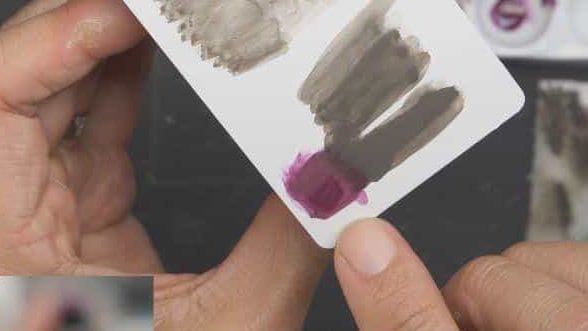
Using a flat white card, I demonstrate how to blend two colors together. The key is to create two solid color base layers where you want the colors to be placed on your model surface. You can see the brown and purple side by side here.
After your first basecoat color is done, take your second color that you want to blend and create a basecoat of this color next to the first basecoat. This boundary will be sharp and delineated. This is okay.
To create the blend, mix your first two colors in a 1:1 ratio (equal parts).
To blend the two colors with layering, mix each color on your palette in a 1:1 ratio. This “middle” color mixture will do the work of blending your paints together.
Use your mixture to blend the sharp boundary between your first two colors. Apply it right over the boundary, overlapping the first two colors. This will create the transition. Allow each coat to dry before applying another on top.
Apply this middle color mixture you made (from the 1st and 2nd color), and apply it as close to undiluted as possible over the boundary between your two color base coats. Cover the sharp boundary with your mixed paint and allow this layer to dry.
As you layer up the mixture between the two base coat colors, you’ll notice the emerging blend. The more layers you overlap over the sharp boundaries, the smoother your transition.
You may need a few layers to create the blended transition you want, depending on a few factors, e.g., how thin the paint is, the paint brand, etc. But the overall blend should look pretty smooth when everything is dry.
4. Applying Techniques to 3D Sculpted Surfaces
Moving to the three-dimensional world of sculpted surfaces, you’ll use a similar approach to what you do on a flat surface. Remember, that whether you use a wet palette or a dry one, the choice is yours.
Once you get the hang of the process, you’ll be able to apply this method to any miniature surface. Sure, it takes practice, but the basic principle is the same.
Base coating the model follows a similar process. Use undiluted paint and cover the crevices and details carefully. Ensure even coverage, as it’s the foundation for successful blending.
A solid base coat should retain surface detail, too.
Sure, if you need to dampen your paint with water to make it flow better off your brush, feel free to do so. Some may suggest thinning until your paint is like milk “cream”.
You’ll have to experiment with whether you need to thin your paint or not. In general, add just enough water to make the paint color flow off your brush without becoming too transparent.
Once you’ve loaded your paint brush, feel free to base coat the surface of your miniature. Cover the entire area that you want in that first paint color. Make sure you cover any primer and allow each layer to dry before applying another on top. It can take up to 3-4 layers of the first color to create a satisfying base coat.
Again, when you’re done, allow this basecoat to dry completely before moving on.
5. Layering the Second Color
After achieving a solid base coat, it’s time to introduce the second color on the model. Apply this color undiluted, layering it on top of the areas where you want it to be the strongest. Don’t worry about blending just yet; the goal here is to build up the color.
Paint the second color on all the surfaces you want that color. Don’t worry about blending. Focus on creating a solid area of paint. The two colors will have a sharp boundary, and that is okay.
The placement of this second color will depend on your miniature. Remember, how much area you cover with the second color doesn’t matter because you can adjust this in the blending step later. The key is to create a solid base coat of the second color right on top of your first color. There will be a sharp boundary between the two.
6. The Magic of Mixing and Achieving a Seamless Blend
Let every coat of paint dry before moving to the next. This is really important when using the base coat and layering method.
When it comes to blending the paint colors together, you can do the same thing you would do on a flat 2D surface. First, mix your two colors in a 1:1 ratio. This mixture should be thorough and even. Try not to dilute this paint.
Mix the two base colors together, like so. The mixture is equal parts of the first and second paint color.
Once mixed, apply it at the boundary between the two base coats you’ve already applied. Paint over the sharp boundary between the two original base coat colors. The “middle color” you mixed should overlap the two base colors you applied earlier.
Paint over the boundary between the two base colors using your mixture. This is the same procedure that was shown above on the flat white card. Overlap the middle paint color over the boundary and the two base colors, i.e., brown and purple paints.
The results will start to show as the middle-mixed color dries. Keep layering bit by bit, covering any sharp boundaries between the two base colors.
Keep applying the layers of the transition paint over the entire piece. Make sure to cover every sharp boundary to create the blended effect.
7. Final Polish with Glazing (Optional)
If you want a smoother transition, add a bit of water to your middle-color mixture. This will create a glaze or transparent version of the paint color. Apply this “glaze” or thinned layer of paint over and over, allowing each to dry before adding further coats. Layer over any “sharp” edges between paint colors to soften them.
If you use thin paint with some transparency (e.g., a glaze), multiple layers will be required. But, the blended effect will appear smoother and more gradual. Painting smoother transitions takes time and patience.
Again, to achieve a seamless blend, focus on softening the edges between any boundary in-between colors. It may take several layers to smooth out that transition, but patience pays off. Repeat this process until you’re satisfied with the result. This process can take as long as you like, and eventually the two colors will seamlessly blend together.
Here’s the accompanying video for this tutorial
Conclusion
In conclusion, mastering the art of blending paint on miniatures, particularly on cloaks and similar surfaces, is a skill that can take your miniature painting to the next level. By understanding the importance of a smooth base coat, learning to thin your paint effectively, and following the step-by-step process of blending, you’ll be well on your way to creating stunning miniatures that capture the eye and imagination.
Smooth blends made easy! I hope this quick overview for blending paint color on miniatures helps you find your way in your painting journey. The use of layers to blend paint is one of the simplest methods for making smooth transitions between acrylic paint colors. It takes some practice, but the internalizing the process is well-worth it. It provides you with a powerful tool to perform all sorts of cool things in your miniature paintings.
If you have any questions or would like to leave feedback, I’d love to hear from you! Please feel free to leave a comment below.







Pingback: Warhammer Målartekniker: Från Grundfärg till Avancerade Effekter -