Acrylic inks are an essential tool for any miniature painter. I’ve discussed using inks for washes, glazes, and highlighting, as well as the best techniques for incorporating them into the hobby. In this article, I’ll cover some of the most effective ways to use inks when painting miniatures.
In this article, I review 8 great ways to use inks in miniature painting. Whether you’re a tabletop gamer looking to get your Warhammer 40k model painted, or a diorama artist recreating epic scenes from days gone by, I hope you find these tips helpful or inspire you to try out new ideas in your projects. Part of the enjoyment of the art is in the discovery from trying new things. And I know from experience that inks are a wonderful way to add excitement to an old project or to build upon (and improve) an old formula.
…And, here we go!
1. Creating washes
Probably the most well-known and common way to use inks in miniature painting is to create DIY washes. A wash is thinned, low-viscosity, medium that a painter uses to add shade to a painted piece. Often, a wash is a darker color applied to a model that looks like it’s adding contrast to a piece. Certainly, you can buy premixed washes, like Citadel’s shades like Agrax Earthshade.
A mixture of purple and yellow ink prepared as a wash or glaze in miniature painting.
These commercially made washes are superb for you’re looking for convenience. In general, using inks to create your own bespoke wash is a quick way to add contrast and depth to your miniatures.
To make a wash, you can try my formula (or experiment for yourself). Mix the following media in a separate empty bottle or pot to save your mixture for later:
1 part dark ink color (whatever ink you like as long as it’s water-soluble)
1 part matte varnish (I like using Liquitex because it’s inexpensive and easy to find online or at a local store)
1 part water (add a touch more if your mixture is too thick for your liking. But, don’t add too much!)
You may need to adjust these ratios based on your ink brand or preferred viscosity. This is simply a suggested starting point, and the formula may vary depending on your project or painting style. Feel free to play and experiment!
Liquitex Matte Varnish used for protecting miniature paint jobs while maintaining a flat, non-reflective finish.
Quick note: Choose a matte varnish over a matte medium, because a varnish is thinner, i.e., less viscous, art medium. The thinner varnish will help create a wash that flows properly when mixed with your ink and water.
2. Thinning paints
This is a powerful use of inks that not many people know about or use. This is odd given how this method of using inks to thin your hobby paints solves many problems—the most common being that painters often overly thin their hobby acrylics with too much water.
Maybe this is you? You want to thin your paints to make them flow better but add too much water, and the color becomes much too transparent. And, then you end up having to apply so many layers…And, this slows down everything and not with the results you were looking for.
Thinning with inks helps to create smoother paint layers. Make sure you don’t use too much!
To get proper coverage, inks are a wonderful way to thin-hobby acrylic paints. Thin your hobby acrylics with of ink-color (and water). For example, add a drop or two of ink with water to thin your acrylics to help them flow better off your brush. Inks are naturally thin and will hold a tint inside the paint. This gives your thinned-paint much better saturation, body, and coverage than adding only water.
A quick tip: Consider adding inks that are similar in color to the paint you’re thinning to reduce major shifts in tone or hue.
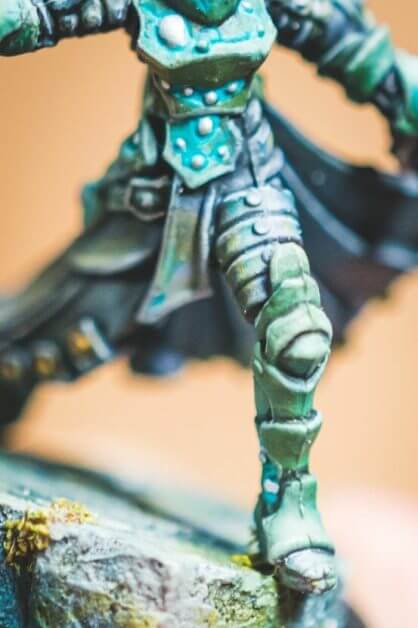
Using inks to add shading and depth to armor plates, enhancing the texture and visual interest of the model.
There’s no exact formula for what will suit your specific needs or preferences, but this approach works especially well for paints that need to blend smoothly with other colors. Try thinning your thicker acrylics with a touch of ink!
3. Color Filters for Basing
So, you’ve finished painting your model? Now it’s time to finish the base. But all you have is a bare model base; it’s dead and soulless, flat board, essentially. Here is where inks come into play….
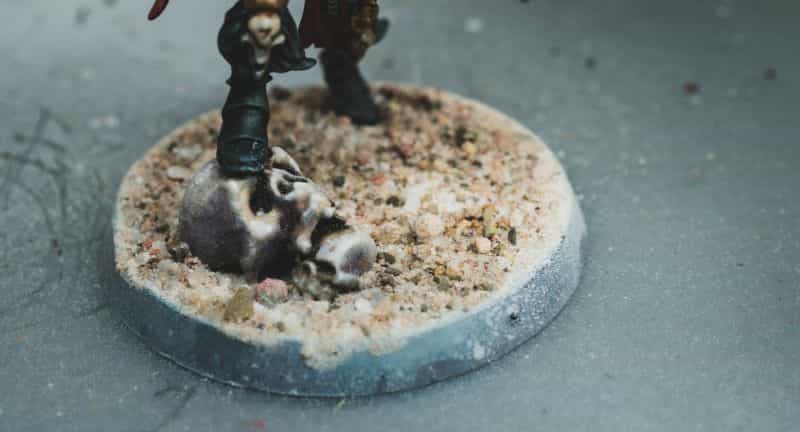
A sandy textured base featuring a skull, adding realism and storytelling to the miniature scene.
Because inks are thin, low-viscosity mediums and flow through texture more easily than regular paints, you can use ink to add that extra pop of color to your base without much work.
Here’s what I do:
First, add a bit of texture to your model’s base. For example, I like using gluing sand to model’s base—which adds some “tooth” and character to your piece without much work or expense. You can see how I quickly apply sand to a miniature’s base in this article.
Then, apply a bit of ink to a very damp brush, and touch the bristles to your base’s texture. If your brush is wet enough, a lot of that ink color will transfer to the surface of your base and flow naturally within the texture. Allow this to dry; rinse, repeat as many times as you like.
A Warhammer 40k Tau Battlesuit showcasing a base flocked with sand and inked for contrast and interest.
Overall, the ink pigments will provide a color pop, also known as a color filter, over the textured base’s surface. Of course, there is a bit of unpredictability to this method, and you’ll need to be open-minded about what you can expect.
But I’ve always enjoyedhappy accidents…that arise in my work. Inks as color filters can bring character and personality to any piece.
4. Dark lining model elements
This is the most straightforward use for inks in your work. Dark lining involves using dark-colored ink (or you can try watercolor paints, too!) to paint a border around elements on a painted model. For example, fill in or paint recesses with dark inks to make armor panels appear more visually striking.
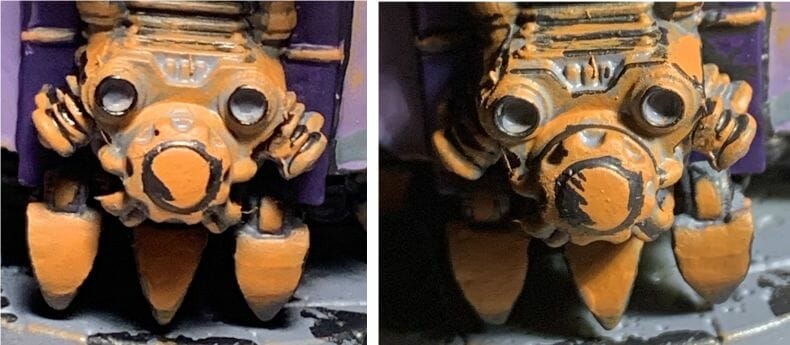
Dark lining helps bring out the painted elements on this model’s face. Notice how the bone color stands out from other adjoining parts because the dark, black-lining delineates the jaw and the shapes around the eye.
There isn’t much to say here, because the method is so simple. Take your ink of choice and paint it onto your model along lines, space, and recess where you want to outline things. It’s almost kind like the reverse of a coloring book. You’ve painted your model; now you’re just filling in the borders with an ink, i.e., I usually just use black ink.
An Infinity TAG model featuring dark lined armor panels using a fine detail brush.
If your inks do not flow that well off your detail, fine bristled brush, try mixing in a touch of matte varnish which will help the ink color flow evenly off your brush.
Let the results speak for themselves.
5. Airbrushing effects
Because inks are essentially thinned pigments with a binder, they make a naturally good airbrush paint. Most water-soluble inks are very, very thin, of course, and so you may in fact find them to be a bit too easy to spray. Not to worry! Inks require a much lower air pressure if you want to airbrush them.
While most hobby paints can be airbrushed at around 20–30 PSI, inks typically perform better at lower pressures, around 15 PSI, or even less, for really fine control. I’ve also sprayed inks at close to 5 PSI—only a whisper of air.
Airbrushing techniques used to create smooth blue highlights on a miniature’s claws and armor for a dynamic look (still a work in progress).
Now I won’t get into each application with airbrushing inks here—there are so many! But I will note that one fun way to use inks in my airbrush (and add unique interest to my models) is to tint and create pops of color to my models.
This Minotaur miniature showcases detailed flesh tones with muscle definition and fur texture. But, it does need a bit more color….Enter inks.
A really effective example is using airbrushed inks to create realistic “lived-in” flesh tones. Airbrushing that extra bit of green hue on pale flesh tones is all it takes to make a tabletop standard paint job into a display-quality painted model or one that is painting contest-ready.
Notice the subtle green tones and hues on the skin of this miniature. The use of transparent inks or other media make these kinds of more realistic effects easier to apply over hobby acrylic base layers.
To see details for how to get the most out of your airbrush, check out this collection of airbrush articles.
For airbrushes, cleaning up after using water-based inks is easy since they’re water-soluble. After each session, flush your airbrush with water or a mild soap solution, followed by a rinse with water.
Harsh chemicals aren’t necessary—just clean your airbrush right away to prevent clogs from dried ink. An ultrasonic cleaner can be useful for a deeper clean, but you’ll only need to do this every 10-15 sessions.
Using inks for OSL effects is one of the most rewarding techniques in miniature painting. The thin consistency of inks allows for advanced color layering, creating stunning light effects on your models.
OSL, or Object Source Lighting, is a painting technique that simulates the effect of light emanating from a specific point on the model. The goal is to create the illusion that the light is casting realistic shadows and highlights on surrounding surfaces.
Glowing object source lighting (OSL) effect with ink filters or other techniques give a model that magical, illuminated special effect.
To simplify the process, use inks as a color filter over a black and white under-painting. This base layer should be painted to mimic the desired light effect. The ink adds color while allowing the underlying contrast and values to shine through, creating a convincing OSL effect.
The glowing green staff on this ogre miniature is enhanced by object source lighting (OSL), creating a dramatic, atmospheric effect.
The key to successful OSL with inks is using transparent inks that let the underlying highlights and shadows show through. This creates a combined effect where the under-painting provides depth, and the ink adds saturation, enhancing the illusion of light.
I love paint schemes that make 3D sculpts look like they’ve been lifted straight from the pages of a comic book.
For a detailed guide on how to achieve this comic book style, you can check out this article.
Black ink is used to emphasize the comic book-style shading on this mechanical part of a miniature. The inking brings out details and gives it a bold, stylized appearance.
Your go-to ink for this style is black ink. It’s the key ingredient for creating the bold, high-contrast effect that defines comic book miniatures. When paired with bright, vibrant colors, black ink helps bring out the sharp outlines and dramatic shading that give the model its comic-like appearance.
These miniatures are painted in a vivid comic book style, using strong lines and colors to bring out dynamic action in the scene.
One essential technique is painting bold black outlines around major elements of your model. These outlines may not follow the traditional backlining you’re used to—they’re more exaggerated, just like in comic art.
Liquitex black ink, a versatile tool in miniature painting, known for its classic style and modern application for shading and lining.
If you’re new to this style, I recommend looking at reference images from your favorite comics and replicating the effects. You’ll also find plenty of helpful tutorials on YouTube to get started. There are some great resources out there!
8. Adding Water Effect Depth
This is a great use of inks for those who love making dioramas with water-effect resins. Water effect resin is often a two-part resin you mix and “pour” into a pre-prepared, liquid-proofed part of your model or diorama. This is usually done to recreate the effect of water in a pond, a river, an open body of water, or even a muddy puddle.
Realistic water effects enhance the base of this miniature, simulating a wet, dynamic environment.
Most epoxy resins used for water effects are completely clear and transparent. While this works for shallow water, deeper bodies of water can look unnatural and plastic-like when left clear.
Resin water effects provide depth and realism to this miniature’s base, creating the illusion of a watery surface. A touch of ink in the resin mix provides an illusion of more depth in the water than there really is.
By mixing inks into your resin, you can create the illusion of depth, making the water look more realistic. While there are specific additives for this purpose, inks offer a flexible and easy way to achieve similar results. They provide subtle coloration and depth without overpowering the effect.
Inks also give you creative options for adding unique flair to your water effects, not only enhancing depth but also lending a smooth finish that other mediums often lack. The result is a more lifelike and visually interesting water feature for your diorama.
3 Must-KNOW TIPS for using inks FOR BEST RESULTS
1. Ensure Semi-Transparency for Effective Ink Washes
Ink washes need to be semi-transparent to be effective. Make sure your custom ink-made washes natively transparent use inks. Yes, some inks are opaque. Here are my recommended inks for use in miniature painting.
2. Use a Matte Varnish for a Professional Finish
Almost all inks dry with a glossy finish. While this can be useful in some art projects, in miniature painting, a matte or non-reflective coat creates more professional results.
A matte, non-glossy finish improves color contrast, especially in photographs. My suggestion here is to finish your models with 2-3 coats of a matte varnish, like Testors Dullcote (see the full review and guide).
Testors spray enamel varnish offers durable protection for painted miniatures, preserving the paint job for long-term use.
3. Experiment with Ink Dilution for Unique Effects
Inks can be easily diluted with water or an appropriate thinner to adjust their transparency and flow. By experimenting with different dilution levels, you can create unique effects, from subtle shading to vibrant color washes.
Use more diluted inks for softer transitions and more concentrated inks for bold, striking highlights. Adjusting the dilution also lets you control how much the ink settles into recesses, perfect for enhancing details on miniatures.
The King of Nothing miniature I painted used a lot of different techniques, including the judicious use of inks within the acrylic paint base layers. What do you think?
Conclusion
Hey, so what do you think?
I’m always trying new things myself, and I’m of the mind that inks are one of the most underappreciated mediums for miniature painters. They aren’t often thought of as a mainstay for our hobby. But whether you’re shading, blending, or adding highlights, inks offer a unique way to approach your work.
They help create subtle transitions, bold contrasts, and a rich depth that can bring your miniatures a bit of character. The beauty of inks is also in their flexibility—there’s no right or wrong way to use them. I only highlighted some of the ways you can use them in this article.
And, the only way you’ll know if any of these approaches with ink is useful (or for fun for you) is to try them out! It’s about experimentation and pushing the boundaries of your creativity. Make mistakes!
Anyway, I hope you found this article helpful. I know you may have questions, or want to know more and I’m happy to help! Please leave a comment below 😀.