

If you’ve ever stared at a wall of metallic paints and wondered which ones actually perform well on miniatures, you’re not alone. Metallics behave differently from regular acrylics, and choosing the right one can change the entire look of your model.
Some metallics are bright and reflective, others lean dark and gritty, and a few are surprisingly versatile once you learn how to use them. After painting hundreds of minis over the years, I’ve found that only a handful of metallic paints consistently give me smooth coverage, realistic shine, and dependable results—whether I’m painting armor plates, weapons, pipes, or machine parts.
In this article, I walk you through my five go-to best metallic paints for miniatures and why I keep reaching for them. These picks are easy to use, work well with washes and glazes, and cover almost anything in a single coat.

Key takeaways about metallic paints for miniatures
- You only need a small core set of metallics (steel, dark steel, bright gold, warm gold, copper) for ~95% of jobs.
- Water-based metallics are easier to live with than alcohol-based paints for most miniature projects.
- Glazes and mixes let you push those five paints into almost any metal effect you want.
QUICK SUMMARY OF MY RECOMMENDED METALLIC PAINTS
Here’s a quick comparison of my five recommended metallic acrylic model paints before we get into the details.
| Paint | Finish / Tone | Best For | Why Use It |
|---|---|---|---|
| Vallejo Model Air Steel | Bright neutral steel | Armor plates, weapons, machinery | Smooth shine, brush-friendly, pre-thinned |
| Citadel Leadbelcher | Dark steel / raw iron | Base-coating metals, mechanical parts | Thick, reliable, excellent one-coat base |
| Vallejo Metal Color Gold | Bright shiny gold | Trim, warm metals, polished gold surfaces | Airbrush-ready, thin but opaque |
| Retributor Armour | Warm rich gold | Brass, ornate details, heroic armor | Strong warm tone and dependable coverage |
| Vallejo Metal Color Copper | Reddish copper | Pipes, steampunk parts, copper accents | True copper look with dense pigments |
RELATED: HOW TO THIN HOBBY PAINTS
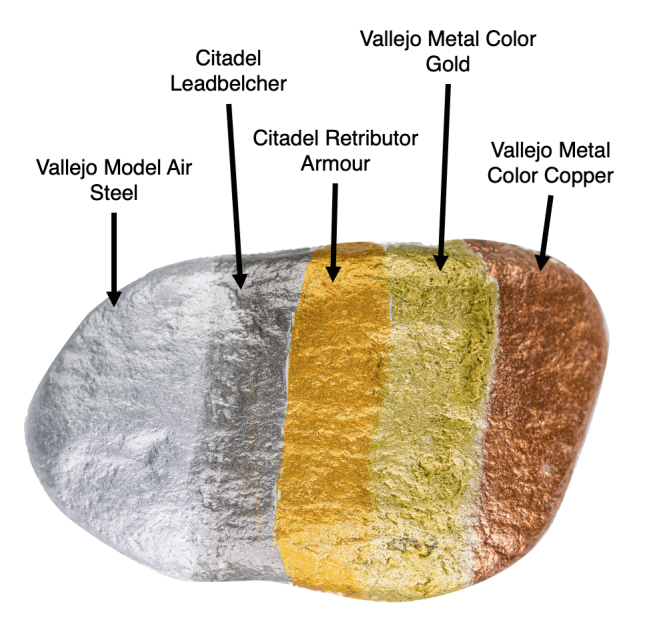
Continue reading for the top 5 best metallic paints for miniatures and models.
5 Best Metallic Acrylic Model Paints for Miniatures (Review)

The Vallejo Steel Paint sells for about $5 per dropper bottle. This is part of Vallejo’s model air line, which is an airbrush-ready paint. But, you don’t need to use an airbrush to apply this steel metallic.
In fact, I prefer using this paint with a regular brush. Because the metallic is already pre-thinned, all I have to do is dispense some onto my palette and directly apply it to my model.

The color is bright and highly-reflective. It’s closest competitor is the slightly brighter (more “silvery”) Citadel Stormhost Silver. On a smooth surface, the final dried metallic is like a bright polished steel or even aluminum.
A single coat metallic coverage using a regular brush will completely cover a surface. This metallic is also durable and I am able to apply a number of different inks and paint glazes over it without varnishing first.
Overall, if you’re looking for the best steel metallic paint for miniatures, this is one I highly recommend for its ease of use, versatility, and amazing coverage. In my opinion, if you’re not sure what steel, neutral colored metallic to get, start with Vallejo Model Air Steel.
Vallejo Steel Paint
Pros
- Shiny, polished steel finish
- Easy to use
- Excellent coverage with a regular brush
- Durable
- Versatile
Cons
- I can’t actually think of one

The Games Workshop Citadel Base Paint Leadbelcher sells for about $5 per dropper bottle. It has a tad less volume than the Vallejo Steel mentioned above, but is still a really good value. In general Citadel metallics are reliable in their brush-on qualities. In fact the entire Citadel range from my view are popular because, despite their cost, people know what they are getting.
As a Citadel base paint, Leadbelcher is a highly pigment-dense paint. Leadbelcher is viscous and will require a bit of shaking to properly homogenize the paint properly before using.
Tip: Leadbelcher doesn’t thin very easily. But you may not need to do much other than keep your brush damp with water so it applies easier to your model.
What you’ll get painted with this dark silver metallic is a fantastic steel or raw iron metallic surface. Great for weapon parts, machinery, and other mechanical objects. The clearest alternative for Leadbelcher is The Army Painter Gun Metal paint, which in recent years I’ve relied on when I don’t want to bother with the flip-caps of the Citadel paint pots.
Leadbelcher has really good coverage and will coat a surface in a single coat. For this reason alone, I use this metallic paint for nearly every metallic base coat job. If I need a brighter metallic, I’ll mix in a little Vallejo Model Air Steel (using my favorite dry palette).
Citadel Leadbelcher
Pros
- Raw iron, dark steel metallic finish
- Great coverage
- A great metallic for base coating anything requiring a neutral colored metallic paint
- Easy to mix with other acrylic based metallics to darken them without shifting the overall color or tone
Cons
- Really thick paint that may be harder to use straight from the pot
- Requires vigorous mixing or shaking before each painting session
- May easily clog airbrushes, if not properly thinned

The Vallejo Gold Metal Color sells for about $10 per 32ml bottle.
This is my most frequently used gold metallic paint. Similar to Vallejo Model Air Steel paint, this gold metallic paint has all the qualities I look for in a metallic. This leans toward a bright gold paint which makes it versatile when you need to use other shades or washes over it.
The metallic is pre-thinned for airbrushing, but is amiable to regular brush application techniques. Dispense onto your palette and it’s ready to go.
Because of the formulation, a single coat will cover most surfaces completely. And, because of how thin the paint is, the details on your model will still be visible (e.g., it won’t fill them in like much thicker paints will if you’re not careful).
This gold metallic is so easy to use, it’s almost cheating. If anything, my only qualm with this gold metallic is that it might be too bright and shiny to be realistic.
I generally don’t leave this gold metallic on a model by itself. I will glaze or apply a wash over it to add some depth and contrast to it. Without some additional work, this gold metallic’s shine will literally outshine other parts of your model.
Make sure you shake this bottle before using the paint. It does tend to settle quickly, and you’ll want those pretty gold metallic pigments to stay in-solution.
Vallejo Metal Color Gold
Pros
- Very shiny gold metallic
- Awesome coverage (usually a single coat)
- Large bottle with easy to dispense nozzle
- Pre-thinned metallic, which is great for airbrushing or applying with a regular brush without any additional dilution necessary
Cons
- Might be too shiny
- Require shaking and mixing before use
- May not be useful for a lot of warm metallic effects without extra work, e.g., glazing, ink washes

The Games Workshop Citadel Base Paint Retributor Armor is about $6 per pot, and worth every-single-penny!
This is the absolute best gold metallic paint for miniatures on the market.
Tried and true over many years, I rely on this metallic gold for nearly every model that has anything resembling gold or brass.
RELATED: IN-DEPTH REVIEW OF RETRIBUTOR ARMOR GOLD METALLIC PAINT
I even use this gold to highlight copper and dark tin metallics.
As with Leadbelcher, you’ll need to mix the paint vigorously for best results. It is a Citadel Base paint, and designed to cover surfaces with very little effort. A single coat will do the job for most work.
The resulting paint job with Retributor Armour is smooth and looks regal with a warm, gold reflective finish. If you want to make this darker, all you need to do is mix in a sepia ink, or glaze over it with an appropriate wash.
This is a must-buy for any miniature painter looking for a versatile gold metallic.
Retributor Armour Gold Metallic
Pros
- Best warm-toned gold metallic paint
- Great single coat coverage
- Versatile paint when used with different glazing and washing techniques
- Easy to color match with different color schemes
Cons
- Very thick paint that requires mixing before use
- Not easily airbrushed

The Vallejo Copper Metal Color is about $10 per bottle. This reddish, copper metallic fills a slot where the other gold metallics may be too bright.
When you need a copper that feels like a brand-new 1 cent penny, this is the metallic to get.
Are you looking for a metallic paint that looks like a copper pipe from your gas stove, water system, or for a steam punk vibe? Well, Vallejo nailed the copper look with this metallic paint.
Similar to the Vallejo Gold Metal Color (mentioned above), this copper metallic is formulated for airbrushing. The paint is thinned to the proper consistency and will work well as a spray-on metallic.
However, I’ve found it works just as well with a regular brush. Because of how dense the pigments are, coverage is complete with a single brushstroke.
Of course, you’ll need to shake this bottle frequently to keep the metallic flakes in solution. I suggest dispensing a little at a time on your palette to make sure you have a homogenized mixture of it to work with.
Finally, unlike the other metallic paints on my list, you may find limited use for this copper colored metallic paint. It is hard to color shift with glazes and washes because it is already on the darker side.
I like mixing this metallic with other paints to change how they look. For example, if I want to shade a gold, I might mix a little of this copper metallic paint with the base gold metallic.
Using this mixture, I’ll apply a metallic shadow in the recesses. This adds contrast in an interesting way without detracting from the overall reflectiveness (e.g., that a regular paint or shade might do).
Vallejo Metal Color Copper
Pros
- Fills the copper, reddish metal niche in the overall metallic palette
- Great coverage
- Airbrush ready
- Great bottle design for dispensing onto your palette
Cons
- Requires frequent shaking or mixing for best results
- Glazes and washes will be more difficult to use when you want to shift the tone or color of this metallic
- Limited use (unless you have a lot of copper in your painting) because of its color and tone
Why these 5 metallic paints cover almost everything
Every miniature painter or scale modeler will need a metallic paint. It’s really the only way to create a realistic painting. Sure, you can paint with the non-metallic metal (NMM) style (see example here). But, whether you’re painting the auto cannon of a Warhammer 40k vehicle, a rifle barrel on your Bolt Action model, or simply to add some flair to a piece of terrain (i.e., piping or wires), metallic paints are always handy.
But, there are so many choices! What about color metallics or pearlescent colorshift paints? Where do I start?
Well, over the years of painting tons of miniatures, I’ve come to realize that you only need a select few metallic paints to cover 95% of the mini painting jobs you’ll encounter.
My absolute favorite two metallic paints for painting models are Vallejo Steel Paint and Citadel Retributor Armor (a gold model paint). With these two paints, I can paint almost every metal-material surface that I need. These are my recommended metallic paint for plastic models, pewter, and resin. For a bit more flexibility, however, I also have a few other metallic paints that I rely on for painting miniatures.
I’ve painted a lot of miniatures with each of these metallic paints. I find that these 5 paints do everything I need. For simplicity, I’ll focus on painting with a regular brush.
How metallic paints work on miniatures and why they look different from regular acrylics
Metallic model paints contain actual metal “pigments”.
Metallic paints contain a few key ingredients, including a clear binding medium (which acts as a delivery vehicle) and the metal flakes in the paint.
Depending on the formulation, a model metallic may have different reflective characteristics. The reflective characteristics of a metallic model paint include how the paint reflects ambient light. This may alter the hue (e.g., color or light cast) and amount of light that bounces off the painted surface.

The size and angle of the metallic flakes on the painted surface affect its reflective properties—the final metallic “look”. Additionally, as you may have figured out already, the color of the metallic flakes in the paint will change the color of the painted surface.
In summary, metallic model paints are simply an art medium that contains an acrylic-based binder that delivers metallic fragments or flakes (e.g., metal pigments) to your working surface. Other features, such as pigment size, density, and shape will effect the final metallic look of the painted miniature.
How colored metallic paints behave on miniatures and when to use them
The problem I’ve had in the past with colored metallic paints is the limited color palettes that are available for these kinds of paints. There might be a specific hue or tone you’re looking for, but can’t find a way to reproduce it with simple colored-metallics.
I’ve experimented a lot with metallic paints. For my style of painting, I generally lean toward more realistic looking miniatures. I look to reproduce some of the effects I see in real-life, e.g., weather, dents, scratches on metal surfaces.
I also haven’t had much fortune in learning how to make a specific type of colored metallic look “different”. That is, there are some effects that I’m looking for in which a colored metallic paint may be counter productive.

For example, if I want to add rust (an orange-brown color), it is difficult to figure out how to do this over a colored-metallic paint that has an unpredictable influence on the final look with overlying glazes, inks, or dry pigments.
A colored-metallic paint doesn’t simply color a model like a normal paint. It also reflects the ambient light around you (which may also have a color) and the combined reflective surface may be skewed, unpredictably.

Of course, you may prefer this unpredictability in your miniature paint job. Metallic paints add interest to a model that would otherwise look flat. The natural reflections in a metallic painted surface add contrast and can help your miniature look a lot more interesting.
Using Pearlescent and Colorshift Metallic Paints (Miniature Metal Paints Guide)
Some metallic model paints may contain different types of metal-flake, including those of different sizes and color.
Turbo Dork makes amazing color shift paints for miniatures.

Pearlescent paint uses iridescent materials to produce different colored reflections when the painted surface is viewed from different angles.

| Createx Pearlized Paint Sets |
|---|
| Price on Amazon |
| Price on BLICKS Art |
| Price on Walmart |
In general, I don’t use pearlescent paints in my miniature painting. I prefer to control how my paints look on a model, and pearlescent paints are a bit unpredictable. They also tend to be thick and hard to thin because of all the “extra” stuff in them.

Pearlescent Paints Work Best on Larger Open Surfaces

As a result, on small-scale miniatures (e.g., those pesky space marines), the color shifting effect of pearlescent paints can be very subtle, and defeat the purpose of using them to start with.

But, you can find a lot of great examples of painters who use pearlescent paints to great effect in various modeling and miniature hobby applications.

You can try Green Stuff World Chameleon color shift paints or use the alternative color shift paints here.

There are also spray-on type colorshift paints you can use. But, just be warned that they are designed for larger applications, e.g., cars or outdoor furnishings, and may be very difficult to use on miniatures.

How to Tint or Mix Your Own Metallic Acrylic Model Paints
Yes. There are actually two ways you can change the color of metallic paints.
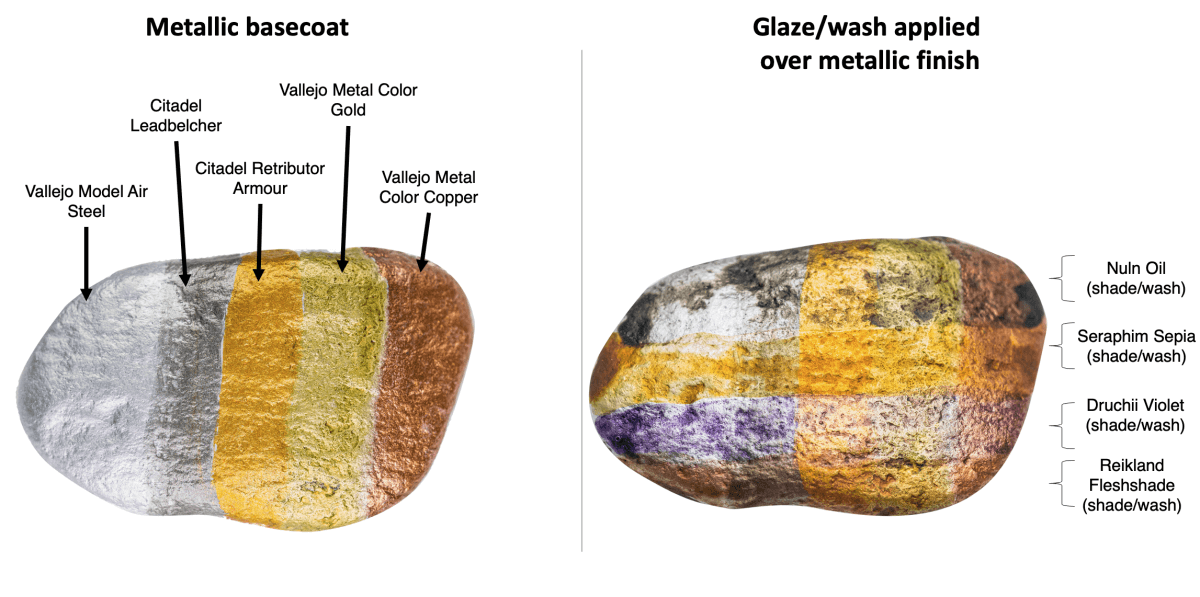
- Glaze – Apply a thin, translucent layer of color (usually an ink) over the metallic painted surface.
- Pre-mix metallic paint with colored paint or ink – As mentioned above, you can mix metallics and regular color inks or paints to create new metallic hues and tones.
How to Glaze Metallic Paints for Shading and Depth (Metallic Paints Coverage Tips)
With glazing, you can make subtle adjustments because you’re applying thinned color over the pre-painted metallic surface. However, glazing is slower and does take more skill and patience to do well.

On the other hand, if you mix your metallic beforehand with colored paints or inks, you can move a lot quicker. But, this method may be unpredictable because the exact ratio between metallic and colored paint/ink may not be perfect. Be sure you have enough paint mixed up so you can paint the desired surface in a single session.
It could be difficult to match the same metallic color if you don’t get the mixing ratio correct each and every time. Here’s an article about why you shouldn’t thin your metallic paints and other common issues with metallics.

Note: the best way to mix metallic paints is to use a dry palette, preferably a glazed ceramic palette with round-bottom wells. Check out what dry palette I use for mixing paint.

Porcelain palettes are amazing for mixing paint and keeping pigment density predictable (e.g., paint thickness). Glazed porcelain is also super easy to clean and useful for thinned media, like washes or inks. For metallic paints, they prevent your paint from getting too thin, which can make even base coverage really hard. I highly-recommend these kinds of “dry palettes” for working with hobby acrylic paint.
Types of Metallic Paints for Miniatures (Water-Based vs Alcohol-Based)
As I mentioned above, there are pearlescent model paints that have reflective surfaces that shift color depending on the viewing angle. But, for all intents, these paints are situational. You have to decide how you want your models to look when you’re done.
In general, there are two formulation types of acrylic metallic model paints.
- Alcohol-based metallic paint
- Water-based metallic paint
Alcohol-based metallic Acrylic Model paints
As the name implies, alcohol-based metallic paints use alcohol (usually isopropanol, or rubbing alcohol) as the thinner medium.

Vallejo has an entire line of these liquid metallics. All of them are excellent. These are fantastic because they produce a brilliant metallic finish in a single coat. Paint coverage is amazing.
There is something about an alcohol-based formula that produces a metallic finish that is bright and magnificent. This is probably because the alcohol vehicle allows the manufacturer to use pigments with highly reflective metal ingredient, which can usually be prone to oxidation.
The stuff is literally liquid metal, including all the problems of actual rust and degradation when exposed to oxygen in the air.
On the other hand, because of the alcohol, metallic paint dries quickly. Of course, to dilute these paints, you will need to use alcohol, not water.
Seriously, be careful. If you add water to these alcohol-based metallic paints, the metal inside will actually rust and change into a nasty color.
This also means you shouldn’t use your regular brushes to apply alcohol-based metallic paints. These paints will ruin your fancy kolinsky sables. Use nylon synthetics, which are resistant to the alcohol solvent in these paints.
Suffice it to say, these alcohol-based metallics are great for those of us who don’t mind experimenting a bit. They are a bit pesky to use.
Water-based metallic Model paints
Water-based metallic model paints are the most popular metallics for a good reason. As a water-based acrylic paint, they are simple to use and look great.

Unlike alcohol-based metallic paints, you can use regular water for all your thinning, mixing, and cleaning. This simplifies your workflow.
Some might say that these metallics aren’t as bright or reflective as the liquid metal version (alcohol-based metallics). But, at the end of the day, I don’t think you can tell the difference, especially on small miniature surfaces.
Perhaps, on larger models, the alcohol-based metallics might have more sheen or metallic “feel”, but for all intents for painting miniatures, I prefer the water-based model color metallic paint line.
What Makes a GREAT Metallic Paint for Miniature Painting?
The best metallic paints have 5 key characteristics that make them useful across a wide spectrum of miniature and model painting.
- Color
- Coverage
- Reflectiveness
- Versatility
- Reliability
In the corner case, there are a few tricks you can use to make adjustments to metallic paints, e.g., glazing, to make them look the way you want.
1. Color (Steel vs Gold Metallic Paints)
The color of a metallic paint must be strong enough to add interest to the painted model. For my preferred look, I also lean toward metallics that appear more realistic.
That is, I recommend metallic paints that allow you to easily add weathering and glazing effects on top, while retaining the reflective, metallic feel of the surface.
Some metallics have a muted reflective surface, which messes with the color saturation of whatever glazes or effects you apply on top.
In general, I stick with a select few neutral steel colored metallics (a light or dark version) and warm gold- or copper-colored metallics.
By keeping to only a limited palette of metallic paints, I can envision a large number of ways to use them. There is an elegance in simplifying and limiting your choices. It helps you paint faster and, in my opinion, helps you learn how colors work together, e.g., harmonize (see here about how to choose colors for your miniature painting).

2. Coverage (Metallic Paints Coverage Explained)
How well does your metallic paint cover a working surface? Can a single coat completely cover the surface, or do you need to apply multiple coats of paint?
Over the years, I have settled on the fact that the best metallic model paints for me are those that don’t require a lot of work. If don’t have to apply multiple coats of metallic paint, then I’m a happier painter.
Of course, the metallic still needs to look good. Some metallic paints are too thick and end up concealing surface details. Other metallic paints are too thin and create a splotchy look, which require multiple coats to smooth out (this is a lot of work!).
The best metallic model paints are those that 1) cover the surface in a single or few coats, and 2) provide a smooth even finish.
Painting with metallics can be very satisfying when the paint behaves as expected. I don’t need the hassle of trying to fix and adjust a bad metallic paint job. When applying metallic paint, you shouldn’t need to thin it with anything. The best metallic paint will be easy to apply AND have good solid coverage when brushed on.

3. Reflectiveness
This refers to how reflective the metallic finish appears on the model. Metallics have different reflective values, or how much light bounces off the dried painted surfaced.
For versatility, I prefer using metallic that have strong reflectiveness. It makes the painted model brighter, and helps give you more contrast in the final look.
In addition, the nice thing about using a highly-reflective metallic is that it gives you the ability to add more effects over the painted surface.
For realism, for example, you can shade the shadowed areas using a wash (like Nuln oil) to make the recesses less reflective. You can then dry brush a bright, reflective metallic on raised edges to really make a metallic surface appear more realistic on the miniature.
If you’re adding rust weathering effects, using a base coat of a nice reflective metallic also emphasizes the difference between areas of rust and normal metallic.
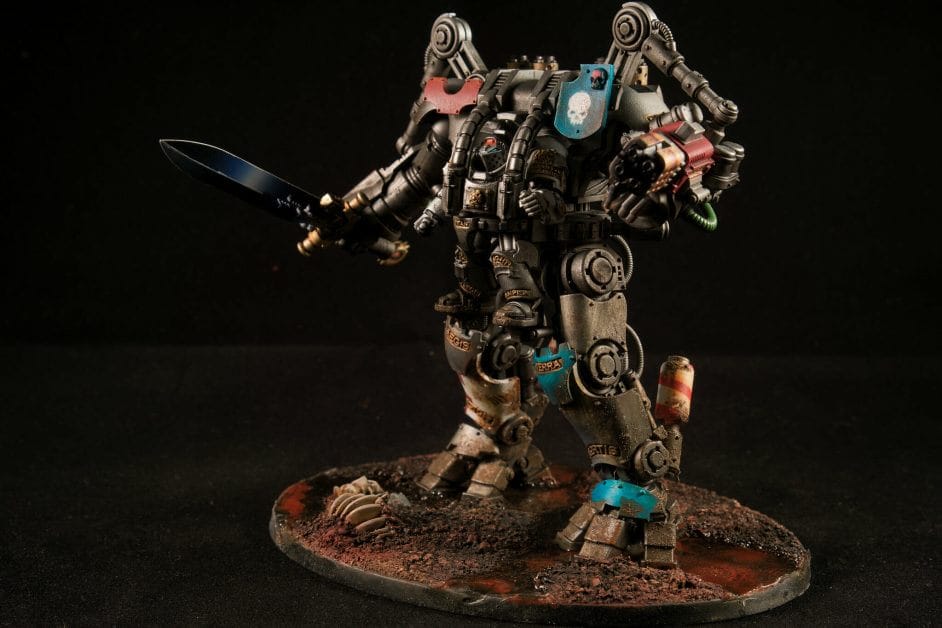
For gold or copper materials, I love how adding a cool, green-ish patina looks when the warm reflective hues of the underlying metallic appear within the same context.
4. Versatility
How useful is a single metallic paint? Can you use one kind of steel-colored metallic to paint a wide variety of neutral-gray metallic surfaces, e.g., aluminum, stainless steel, cast iron, gun metal, black metals?
You don’t need to buy different neutral gray metallics for every kind of steel.
All you need are a select favorites that you can mix, glaze, or shade later to achieve the desired metallic effect.
For example, I can use Vallejo Steel Metallic paint for a brighter metallic (e.g., like a shiny sword). But, I can also use the same metallic for the dark barrel of land raider’s auto cannon. All I have to do is wash and shade with a darkened ink. Another way to darken Vallejo Steel Metallic paint is to mix in Citadel’s Leadbelcher (another highly-useful neutral gray metallic).
The same principle of using a single metallic paint as the foundation for a host of different metallic classescan be applied to warm-colored metallics. For example, I can use Citadel Retributor Armour (a gold metallic) as a warm, rich gold, or as a brighter brass color when highlighted with Vallejo Gold Metal Color.
I can even shift these metallics toward a dark copper, or muted gold by washing or shading with a purple or flesh-colored ink.

In general, my recommended metallics provide you with a high degree of flexibility. You won’t need a pile of different metallic colors for every surface. Just use the foundational metallics and adjust them with overlying inks, washes, and shades to achieve your desired metallic effect.
5. Reliability
This is a simple attribute to value in any model hobby paint. How well does your paint behave at any given moment? Does it act in a predictable fashion?
A lot of this has to do with quality control from the manufacturer.
When you purchase a paint, it is possible that there is variability between production lots.
Of course, the major model paint brands have a generally excellent track record for maintaining quality.
However, I’ve been on the receiving end of model paints that come out…for lack of a better word, weird. The pigments are clumped up, sticky, and have separated beyond normal re-mixing methods.
RELATED: BEST MOTORIZED SHAKERS AND MIXERS FOR MODEL HOBBY PAINTS
Whether is due to how they were shipped (e.g., maybe stored in an area that is too cold), or another unknown reason, it is annoying.
The best way to metallic paints are those that act in a predictable fashion. This also means that you should probably get metallics that are formulated for painting miniatures and models, rather than the less expensive craft-store metallic paints.

Save money with a Metallic Paint Set (Warhammer Metallic Paints Options)
Okay, so you’re still not sure what metallic paints to get. Well, if you’re like me and want to have those other paints (…for you know, just in case), then check out these paint sets below.
Here are a few metallic paint sets that I recommend if you want to start a collection.
Vallejo Metallic Set Model Air Paint

This is a complete set of 16 metallic paints in the Vallejo Model Air line. This contains all the metallic paint colors you’ll likely ever need for your miniature and model paint needs.
Each of these paints is formulated to be airbrush-ready. All you need to do is dispense these metallics into your paint cup and you’re ready to go.
If they all act like the Vallejo Model Air Steel paint I reviewed above, I expect these will work very well with regular brush applications, too.

Professional miniature painters regard Scale 75 as the best paint line for many reasons. This metallic paint set includes 8 metallic paints within the “steel” class of paint colors. This includes cooler hues, like cobalt, to warmer hues, like amethyst.
As with other Scale 75 paints, these metallics are more viscous than other paint brands. This means you will need to shake the bottle well before use.
Although you can airbrush many Scalecolor paints, the metallic paints in this set may be harder to thin for spraying. I recommend using these paints with regular brush techniques.

This is like the Scale 75 Steel Series paint set, but with gold metallic paints.
This includes 8 metallic paints with golden colors. They work well with a host of advanced miniature painting techniques.
Although you can airbrush these paints, I prefer to use a regular brush when painting with Scale 75 paints.
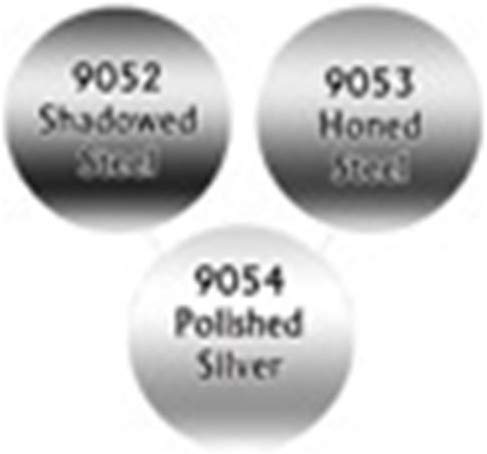
This paint set comes with 3 metallic steel paints. The triad reaper paint system shown here is convenient because it provides you with the exact dark-to-light paints you may want for adding more contrast to your miniature.
In my opinion, Reaper Master Series paints are the best model paints you can get for painting miniatures. However, their metallics in aren’t as useful or easy to use as the ones I mentioned earlier. They don’t have good coverage, and require a lot of extra work to apply smoothly.
However, if you’re looking for a metallic paint set that has the shadow, midtone, and highlight for steel painted material, this is the best you’ll find.
This paint set is also fairly inexpensive, so it can’t hurt to try them for yourself.

Similar to the Steel Rriad from Reaper, the Gold Metallic triad paint set is also a hit-or-miss. Some love these paints, and others find them troublesome.
In my opinion, I prefer using other gold metallics for my miniature painting. As before, I do recommend all of the other non-metallic Reaper paints.
Because this is a triad (Reaper has many triad combos), buying this paint set allows you to paint a host of gold materials with little thought in how you will shade and highlight.
Sure, you can glaze and wash to add contrast to your metallics. But, if you want to maintain that metallic sheen, shading and highlighting with other metallics is the only way.
Reaper triad sets aren’t expensive and I’ll pick up a few here and there when I want to try out a new color combination in my miniature painting.
Summary: 5 Must-Have Metallics for Painting Miniatures and Models
 |
Vallejo Steel Paint Buy on Amazon Buy at Noble Knight Games |
Highly recommended steel metallic because of its ease of use, versatility, and amazing coverage. |
 |
Games Workshop Citadel Base Paint Leadbelcher Buy on Amazon Buy at Noble Knight Games |
Leadbelcher has really good coverage and will coat a surface in a single coat. For this reason alone, I use this metallic paint for nearly every metallic base coat job. |
 |
Vallejo Gold Metal Color Buy on Amazon Buy at Noble Knight Games |
This gold metallic is so easy to use, it’s almost cheating. |
 |
Citadel Base Paint Retributor Armor Buy on Amazon Buy at Noble Knight Games |
This is the absolute best gold metallic paint on the market. Tried and true over many years, I rely on this metallic gold for nearly every model that has anything resembling gold or brass. |
 |
Copper Metal Color Buy on Amazon Buy at Noble Knight Games |
This reddish, copper metallic fills a slot where the other gold metallics may be too bright. |
CONCLUSION
If you paint miniatures or scale models, then at some point you will need metallic paints. This is especially true if you want to paint your models realistically.
Whether you’re painting vehicles and mechanicals from the Warhammer Universe, or arcantrik machines from the Iron Kingdoms, you’ll find a ton of metallic paint choices. I’ve learned over the years of painting all sorts of models that you don’t need to buy them all. Just select a few core metallic paints and modify them, e.g., glaze, wash, mix, for your broader needs.
Although I recommend only 5 metallic paints, I’m sure I missed a few favorites. The information in this article may be a useful starting point for you, or simply provide a different perspective about how to use metallic model paints. Either way, a part of the fun about painting minis is the thrill of discovering what works for you!
Everyone has their own painting style.
Happy painting!
Enjoying Your Visit? Join Tangible Day
Free newsletter with monthly updates (no spam)


Tangible Day on YouTube (Miniatures and More!)

What additive would you suggest to use to create metallic lace with artist oil pants?
Hey, good question! You could just use “metallic oil paints” like this gold (https://shrsl.com/28vzw) or silver (https://shrsl.com/28vzz) – or of course you would need to add your own metallic flake to regular water-mixable oils or acrylic paints (https://shrsl.com/28w02). It depends on what you want to do… sometimes it’s just easier to use what’s already available. The paints and additive I linked to are only sold at dedicated art stores.
This is such a nice blog on the 5 best tips on metallic paints for miniatures. This article is one of the beautiful articles which attract me a lot. I enjoyed a lot while reading this article and would suggest others too and get the best options. Great blog indeed, will visit again future to read more!!
Glad you found it helpful!
How are the blood angels painted. I like the armour red