3D printing is a disruptive technology that has completely redrawn the product manufacturing, art, and creative landscape. Even the medical industry has assimilated 3D printing, e.g., dentistry, prosthetics, surgical settings. Moreover, until a few years ago, the 3D printing of organic objects—which are characterized by their natural, flowing forms and complex geometries—has present a unique challenge to the technology.
In this article, find out more about the challenges of 3D printing organic shapes, exploring how 3D printing technology has overcome the issue and what this means for the future. If you’re a hobbyist, tech enthusiast, designer, or academic, then this write up is especially for you!

RELATED: 3D PRINTABLE TERRAIN FOR WARHAMMER 40K AND OTHER TABLETOP GAMES
What is an “Organic” Appearing Object?
Let’s start at the top.
Organic shapes are forms that mimic the fluid, irregular contours found in nature. Unlike geometric shapes with defined edges and predictable structures, organic shapes are often asymmetrical and complex.

Examples include the curving lines of a leaf, the intricate structure of coral reefs, and the undulating forms of modern architectural designs. These shapes are not only aesthetically pleasing but also functionally significant, offering insights into natural efficiencies and innovations.

Understanding 3D Modeling for Organic Designs
There are many tools nowadays for modeling objects in 3D dimensions. I could write an entire book about all of these software ecosystems that I’ve tried in my journey to learn how to 3D model and print things for the miniature hobby.

But to keep things simple, I’ll say that ultimately the software package you choose will depend on your needs. Some are free; others are expensive. In general, 3D modeling software packages like Blender, ZBrush, Rhino, and Fusion 360 (my personal favorite) are very popular choices, and offer great features for sculpting and refining organic forms.


Techniques such as parametric design and generative modeling play a crucial role, allowing designers to simulate and tweak organic structures with precision.
MORE: HOW TO CUSTOM DESIGN A 3D PRINTED BASE FOR MINIATURES AND MODELS

Material Selection for Organic Shapes
Choosing the appropriate material for any 3D printing project determines whether you are successful in your application or not. Here are some common materials along with their pros and cons:
3D Printing Materials Comparison
| Material | Pros | Cons |
|---|---|---|
| PLA (Polylactic Acid) | Biodegradable, easy to print, inexpensive | Not heat-resistant, requires extra effort to create a smooth finish, and isn’t very durable |
| ABS (Acrylonitrile Butadiene Styrene) | Strong, durable, heat-resistant, inexpensive | Requires high-temperature hot end nozzle setup, invariant ambient temperature and humidity, and a heated bed for reliable printing |
| Resins | High detail resolution, smooth finish | Brittle (compared to other materials) and requires post-curing |
| TPU (Thermoplastic Polyurethane) | Flexible, very durable | Requires high-heat for printing, and is often challenging to print at higher resolutions, e.g., will not produce a smooth finish |

What Are the Limitations of 3D Printing for Organic Shapes?
Despite significant advancements, 3D printing still faces several limitations when it comes to organic shapes. Size constraints, detail resolution, and material properties can pose challenges.
Large organic forms may require segmentation and assembly, while fine details might be lost if the printer’s resolution isn’t high enough. Additionally, not all materials can faithfully replicate the intricate textures and strengths needed for certain organic shapes.
Techniques for 3D Printing Organic Shapes (OVERVIEW)
To improve the fidelity and quality of 3D-printed organic shapes, several techniques can be employed.
Supports and Overhangs
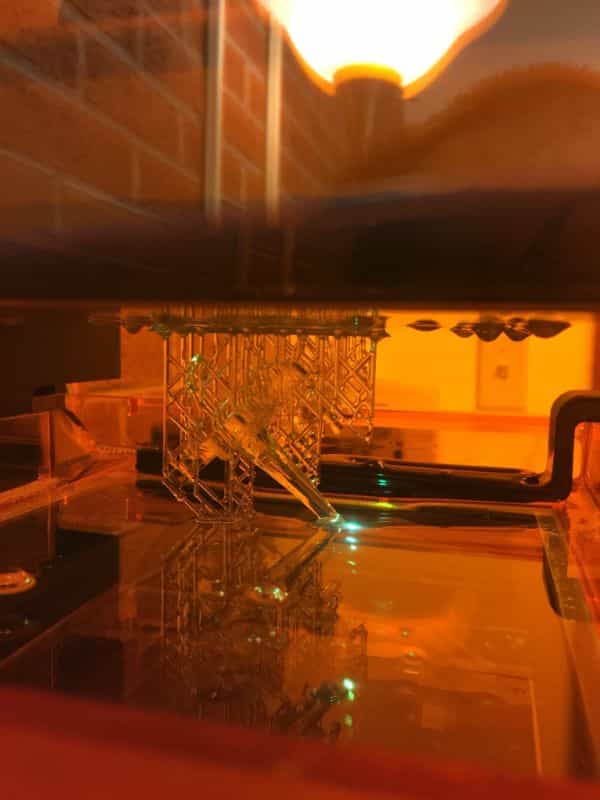
Complex organic structures often feature overhangs and intricate internal geometries. Proper management of supports is essential to maintain structural integrity during printing. Techniques like optimized support placement and dissolvable supports can significantly enhance the outcome. Of course, the software you use determines how easily you can adjust support scaffolding to fit your specific needs.

Layer Resolution and Its Impact
The layer resolution of a 3D printer directly affects the smoothness and detail of the final object. Higher resolutions mean thinner layers, which can capture the subtleties of organic shapes more effectively. However, this also increases print time and requires more precise calibration.
Examples of the Successful application of 3D printing Organic Shapes
Several remarkable projects highlight the capabilities of 3D printing in replicating organic shapes.
Bioprinting of Organic Tissues
Bioprinting is one of the most groundbreaking applications, where 3D printers create complex organic tissues. Breakthroughs include:
- Printing of functional human organs
- Development of custom prosthetics
- Creation of tissue scaffolds for medical research

Architectural Applications
Modern architecture increasingly leverages 3D printing to create structures with organic forms. Examples include:
- The fluid designs of Zaha Hadid Architects
- Innovative façade elements with biomimetic properties
- Custom interior components with natural aesthetics

Advantages of 3D Printing Organic Shapes
The advantages of 3D printing for organic shapes are numerous and significant:
- Customization: Easily create bespoke designs tailored to specific needs
- Complexity: Produce intricate shapes that traditional methods cannot achieve
- Reduced Waste: Additive manufacturing minimizes material wastage compared to subtractive techniques
- Speed: Rapid prototyping accelerates the design and iteration process
- Flexibility: Adaptable to a wide range of materials and applications

- Composite materials combine strength and flexibility
- Advanced post-processing methods like annealing and UV curing
- Research into new printable materials with enhanced properties
Innovations in 3D Print Technology
Recent advancements in 3D printing technology aid in better replication of organic shapes:
- Multi-material printers that allow for complex, hybrid designs
- Higher resolution printers capable of finer details
- AI-driven optimization for support structures and print paths
RELATED: USER-REVIEW OF THE MARS 5 ULTRA 9K RESIN 3D PRINTER FOR MINIATURES
Crash Course: How to Start a 3D Printing Project
Embarking on a 3D printing project for organic shapes requires careful planning and execution. Here’s a step-by-step guide from concept to completion:
Design and Preparation
- Conceptualize the Design: Understand the organic shape you wish to create
- Choose the Right Software: Select modeling software suited for organic designs
- Refine the Model: Use tools to sculpt and perfect the shape
- Select Materials: Decide on the best material based on the shape’s requirements
- Prepare the Printer: Calibrate the printer settings for optimal performance
Printing and Post-Processing
- Slicing the Model: Convert the 3D model into layers using slicing software
- Printing: Start the printing process, monitoring for any issues
- Support Removal: Carefully remove any supports after printing
- Post-Processing: Apply finishing techniques such as sanding, painting, or curing
Future of 3D Printing in Replicating Organic Shapes
The future of 3D printing in replicating organic shapes is bright, with emerging trends and predictions indicating even greater advancements. Innovations like biocompatible materials, more sophisticated AI-driven modeling tools, and higher precision printers promise to push the boundaries further.
As technology continues to evolve, the possibilities for replicating complex organic shapes will expand, opening new horizons in various industries.

Conclusion
Well, what do you think? Sure, we skimmed through this pretty quickly. The world of 3D printing is huge, full of nuances and it’s ever-changing.
For the artist, the hobbyist, or the industry professional, the ability of 3D printers to produce objects with organic form reached a new level. With a bit technical skill and the click of a button, even inexpensive consumer grade printers can create complex and intricate designs.
Of course, there are limitations in this area of the maker space, since many of us have to remain within hardware/software budget constraints. But with some creativity, a few tips and tricks (some shown in this article), the more complex objects we envision aren’t too far from reality.
I hope you found this article helpful. We are always looking for feedback, and happy take questions.
Thanks for reading! Leave a comment below. 😀
Enjoying Your Visit? Join Tangible Day
Free newsletter with monthly updates (no spam)


Tangible Day on YouTube (Miniatures and More!)