Writing by hand is better than typing!
Is this you? You sit down with a plan. Prime the models. Pull paints. Set the water cup where it always goes. Then your brain tries to hold everything at once. A paint recipe. A basing idea. A note to reorder varnish. A half-formed thought that has nothing to do with painting. Another thing I forgot.
When I keep all of that in my head, my hands slow down. The session drags. I can paint for an hour and still feel like I never really started. So I reach for a pen.…
In this article, I share this research study that highlights how writing by hand gives you power over the “over-thinking”. The concepts in the published paper The Pen Is Mightier Than the Keyboard: Advantages of Longhand Over Laptop Note Taking by Pam Mueller and Daniel Oppenheimer (2014) have been debated, repeated, summarized, and argued about for years.
But, it resonated with me and it all makes so much sense for us!
You can also check out this follow-up, supporting paper.
Key findings and takeaways
- Writing longhand forces you to summarize and rephrase, which strengthens learning and smooths out your thinking.
- The real benefit comes from the mind-body link, thinking while you “draw” notes; not storing more words or information.
- Journaling uses the same mechanism to clear mental noise and sharpen focus.
Read on if you want to see how I apply this to all sorts of learning, creative work, and everyday life—I write for a living and for fun.
Why this paper stuck with me
I live on a keyboard; write constantly, and organize projects with lists. I track ideas. Post-its are candy.
I also know exactly what it feels like to type a lot and retain very little. I easily forget the information I write on a screen.

Mueller and Oppenheimer ran three studies where students watched lectures and took notes either by laptop or by hand. Later, the students answered questions that tested both factual recall and deeper understanding.
The consistent signal was this: Students who took notes by hand did better on conceptual (big idea) questions than students who typed notes. Typing was less effective for “thinking” and “remembering”.
The explanation the authors highlight is behavioral. Typing invites verbatim transcription. You zone out. In contrast, writing by hand slows you down and pushes you to process and compress information as you capture it.
It shows up anytime you’re learning a painting technique from a video. Anytime you’re planning a build. Anytime you’re trying to understand why your blends look chalky. When you’re reading a rulebook and you want the rules to actually stick—write by hand.
Your brain learns through meaning-making. Writing by hand makes you do that in real time.
RELATED: MY LEUCHTTURM 1917 NR1 PEN REVIEW — THE MINIMALIST EVERYDAY CARRY FOR THE MASSES
What the published study actually suggests
Here’s the simplest, most usable version of the research—the thing that clicked in my head.
Typing makes it easy to record.
Your fingers can keep up with speech. You can capture a lot. Your notes can look “complete.”
Writing makes it harder to keep up.
That friction forces choices. You decide what matters. You filter and phrase things the way you understand them. There’s a back-and-forth in your head. That “rehearsal” makes that information yours, forever.

You create a personal map of the idea. That map is the point of writing by hand.
In the paper, the authors also explored what happens when students are told not to type verbatim. The “don’t transcribe” instruction helped, and the longhand, writing group still held an advantage on conceptual understanding in their findings.
One detail is worth mentioning for accuracy. The journal later published a correction that updated some reported values and data-file issues in the original paper. It happens.
Even so, the main takeaway—that writing by hand tends to support deeper, conceptual learning. While a single published study doesn’t make the conclusion a fact, it does bring interesting discussion to the topic.
And, personally from experience I agree with this paper. The medium changes what you do while you take notes. When I write, I remember.
I lock-in.
How I use writing for the miniature painting hobby
A lot of what has gone into this website was originally capture as hand-written notes years ago when I was learning how to paint. Back then, there wasn’t a lot of information other than forums—the burgeoning YouTube had not made its big debut, and social media was….not so overwhelming.
When I’m learning something new in miniature painting, I’m usually consuming information fast. Videos. Articles. A comment thread. A single Instagram image with a caption that assumes I already know three steps.
The failure to pick it up happens.I watch a video, then realize I cannot reproduce what I “learned.”
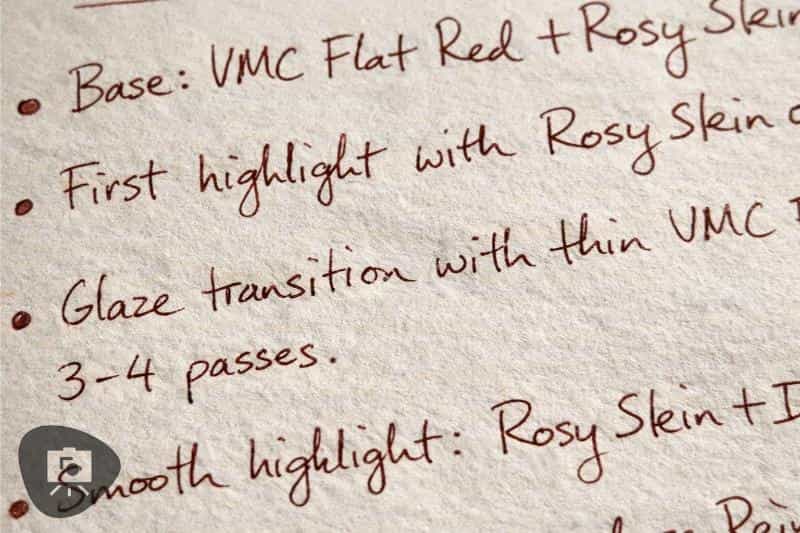
So I started doing something that looks boring and works anyway. I write down the minimum viable recipe. What are the key points? What stuck in my head? That goes on paper. Two words, may be a few sentences.
Here’s what that looks like in real life.
I write recipes—but only for things that I intuitively think I need to know
When I write notes, I don’t write paragraphs. I write things down that tell me what to do and maybe what really matters.
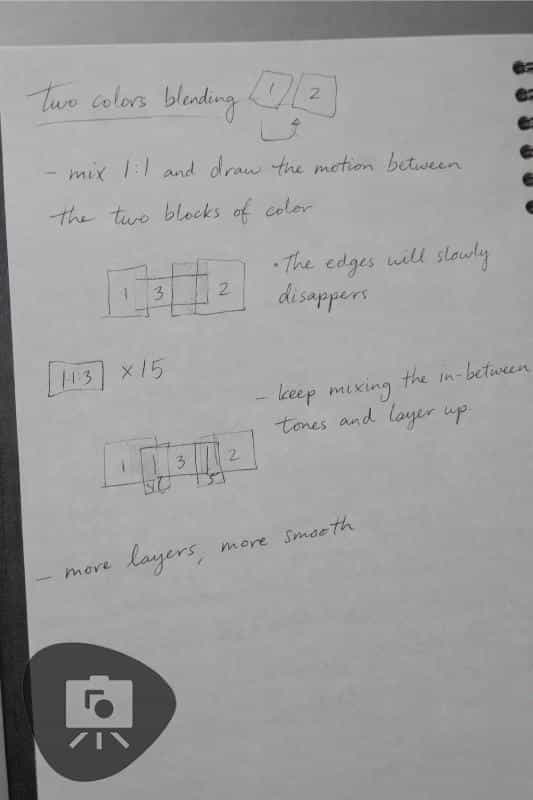
I stop writing once I think I capture the key points that let me understand what I just learned
If I can explain the technique to myself out loud in a minute, I stop. That means I have the shape of the idea. I can always look up the details later.
I leave space for the part that always changes
Your hand pressure changes. Humidity changes. Primer changes. Your mood changes.
So leave space for notes.
Some ideas and things I wrote ended up being a part of fully-written articles:
- “More layers, more smooth” (blending and glazing paint)
- “Side brush for edging” (highlighting)
- “3 values difference for NMM” (how to paint non-metallic metal)
- “Gold + purple ink = copper” (best metallic paints and guide)

Don’t think; write.
Here are some examples. But remember, your notes will likely only make sense to you. This is what made sense to me:
- “Metal NMM, dark gray to white; 3 colors. Block, blend, fix.”
- “Side brush; edge highlights”
- “Gold is brown. Don’t use black to shade”.
When typing works fine
Typing can work well. It just needs rules.
If I take typed notes, I write them like I’m writing by hand. I keep them short.
To keep it simple, I don’t read what I type. I just write. Don’t even look at the screen.
The issue with Voice-to-Text… I hate it.
Sometimes, I use voice-to-text on my phone. But only if I’m desperate. I don’t like dictation, because it’s not accurate and always have to go back and fix things. That ends up taking more time and brain-energy I don’t have. I also don’t like that I have to enunciate…E, NUN, SEE, ATE…every word to make sure my dictation software doesn’t screw up.
Also, it’s like typing for me—It isn’t very good at helping me learn the thing.
Writing by hand…yep. That’s the best.
Bonus: Do the journal thing
Journaling uses the same mechanism as longhand note-taking. It turns vague ideas, some buried deep into something I can “work” with. It really is like digging for treasure; this writing process.
For me, journaling is a practical tool. It keeps me steady. It gives my mind a place to put things so they stop rattling around. I know a lot of creative types who struggle with focus, flow, and the constant pressure to produce.
Journaling slows you down, but speeds you up at the same time because it forces focus and alleviates the pressure to stay “productive”. You are productive when you write.
Tips for writing in a journal
Nope, I’ve got none. No advice except to write something; anything.
Everyone writes rules or best-practices for writing in a journal. I say just tell the truth and pretend nobody is reading it. Actually, nobody is reading what you write unless you share it. And the best default I think is to not share anything until you’ve had sometime to process it.
This isn’t TikTok. Every thought doesn’t need to be curated. Just throw it on the page.
The first entry could be:
“I hate painting miniatures“, which could end up becoming a blog post one day.
Final thoughts
I keep coming back to longhand for one reason.
It slows me down enough to think. Writing by hand forces you to decide what matters instead of copying everything down.
The research gave me a reason to keep doing it on purpose—and to write whenever I want to think clearly, learn faster, or move forward without fear.
Do you find yourself thinking better by writing things by hand? Do you enjoy the process? Let me know in the comments below! Bonus points if you share the brand of your pen!
Enjoying Your Visit? Join Tangible Day
Free newsletter with monthly updates (no spam)


Tangible Day on YouTube (Miniatures and More!)