

What magnifying tools do you actually need for painting fine details? To paint miniatures well, you depend on steady hands and sharp eyesight. Magnification aids — like visors, headsets, or even simple reading glasses — make this work easier and far more comfortable. Whether you’re a scale modeler, painter, or hobbyist working with tiny parts, the right optical help can make a dramatic difference.
Have you ever tried to decouple an N-scale model train in poor light, or check the integrity of an airbrush nozzle without any optical help? I reach for a visor whenever I’m painting miniature faces, eyes, or freehand details. Wearable magnifying “glasses” are everywhere in the hobby world for one simple reason: They work.
When I show my work to other painters and they get close to inspect the tiny details, I almost always get the same question: “Do you use a magnifying glass or something?”
My answer is “sorta”.
The top 3 magnifying visors I recommend for painting miniatures
As you read on below, you’ll see why I choose these three headband visors. They provide ready-to-use optical help for those of us who want to work with fine detail and small parts.
The magnification aid I use for painting miniatures and highly-recommend

Why this magnifier? The best reason to choose a particular type of magnifier is comfort.
You’re going to be leaning in, concentrating for long work-sessions—so the headband should fit securely, the lens shouldn’t force your face into an awkward position, and you should be able to paint without fatigue. If it becomes a hindrance instead of a help, you’ll stop using it.
You’re going to be painting for hours. Do it in comfort.
The other advantages of the Optivisor Headband is the ability to switch out the glass lens inserts for different magnification power (1.5 to 3.75x). This makes the visor incredibly versatile and can adapt to your personal needs and tastes for painting miniatures.
READ MORE: MAGNIFYING LIGHTS FOR MINIATURE PAINTING (TIPS AND RECOMMENDATIONS)
You can even adjust the headband part for your specific head-shape and size. Because it is an open air design, you won’t sweat or overheat from wearing it for long-periods of time. I’ve personally worn one of these headbands comfortably for more than 3 hours (for a big painting commission job).
Notably, the front lens part flips up when you don’t need to use magnification. This allows you to keep going with your task without removing the visor. This is very convenient. Finally, I am able to wear my normal glasses while using this visor. I can jump between normal vision and magnified vision with a flick of the wrist.
The following would be my choice if I wanted a cheaper option, with more bells and whistles:
This visor includes multiple lenses and a small LED light, though you’ll likely rely on your desk lamp for illumination. Unlike the OptiVISOR’s glass plates, these lenses are plastic, which keeps the cost down but reduces optical clarity. Even so, it offers the same basic functionality and gives you more configuration options, including different lenses and a loupe.
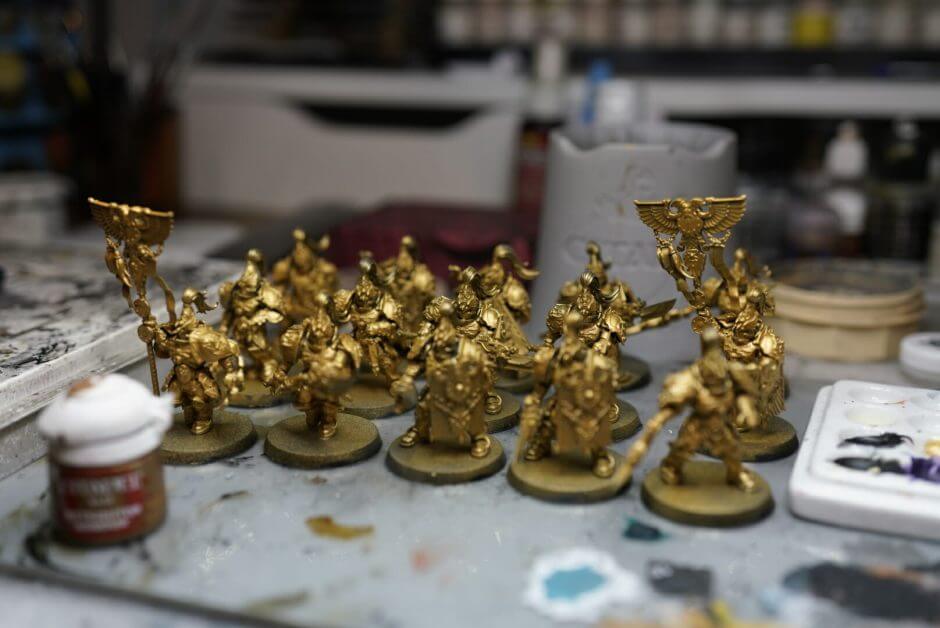
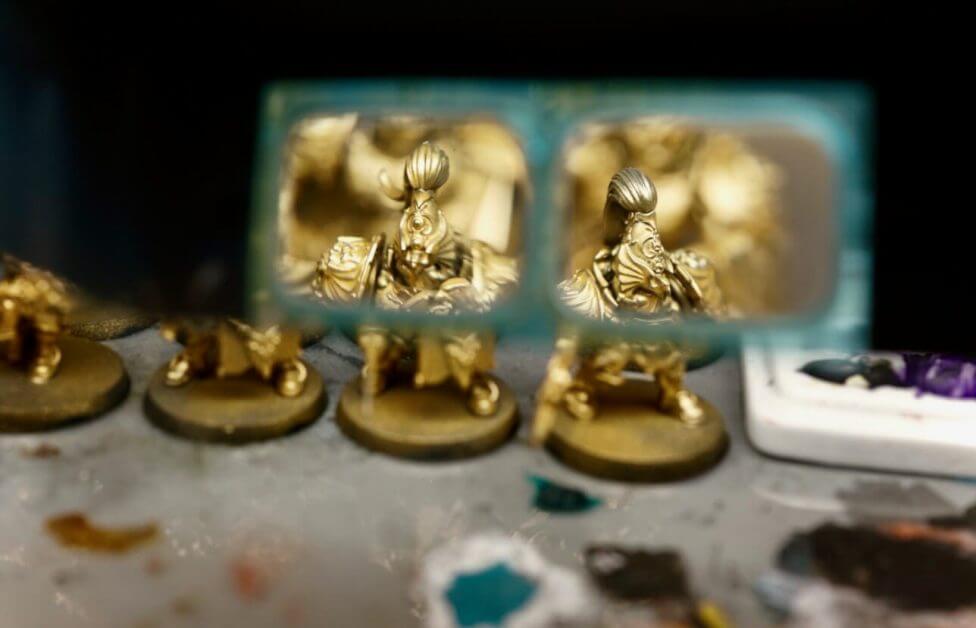
What is the best magnification power for painting minis?
I recommend 2.75x as the default magnification power.
Why?
At 2.75x magnification power you have sufficient improvement in seeing detail while also balancing out the drawbacks of too much or too little power.
In general, magnification power between 1.5 to 3.75x is sufficient for improving the ease of painting details on miniatures. Too much magnification and you lose depth-of-field (see article on how depth of field affects photographing miniatures), which can make painting more difficult. Too little magnification and you might as well not use any vision aids.
Why is focal length important?
Focal length of a magnifying visor is the distance between the lens and the magnified object. Focal length determines how much space you have between your miniature and your face. If your focal length is too short, then your brush will bump into your visor.
Generally, a visor/lens with a shorter focal length has greater optical power (also measured as diopter) than one with a long focal length; that is, it bends the light rays more sharply, bringing them to a focus in a shorter distance.
At 2.75x magnification, the focal length is 6 inches, which is for me is the perfect distance to hold a miniature while I’m painting it for detail.
If you wanted more distance between yourself and the miniature, you would need to decrease the magnification power, e.g., 2x magnification has a focal length of 10 inches (you can buy this lens plate for the Optivisor).
At the end of the day, what magnification strength and focal length you choose is personal. Get what is comfortable and useful for your needs.
3 Recommended Best Magnifying Visor Headbands for Miniatures or Scale Models
This is the most popular headband. I see people using this one often in many aspects of modeling and miniature hobby work.
The best aspect of these pair of visor headbands is the use of real glass lenses. Actual glass in the lens make these the optically best quality pair of visors you can buy (within a reasonable price).
Glass is easy to clean, and resists scratching and damage. More importantly, glass has the highest light transmission index of lens materials. This means a bright, clear magnified image of your working subject.
Also, because of the quality of these lenses, you don’t get the color tint or casts that distort your view. Accurate color representation is important for artists!
There is a reason I’ve used these OptiVISORS for years. I actually own two pairs; one with a 2.75x lens attached, and the other with a 5x lens.
Other notable features:
- Glass prismatic lens for improved focus and reduced eye strain
- Headband size-adjustment knob for custom fit
- Visor tilts out of way when not needed
- Long focal length for an excellent working distance
2. Headband Magnifying Glass with Light

This visor is a good choice if you want an inexpensive option with more flexibility. It costs less because it uses plastic lenses, but the wider range of attachments makes it useful for light-duty miniature or model work.
The built-in LED lights can help brighten your subject, and the lenses flip up or down depending on what you’re doing. For light-duty miniature or scale-model work, this setup is often enough.
These visors may not be ideal for long sessions. The lower optical clarity can lead to eye fatigue or strain, which may slow you down over time.
Ultimately, comfort and the way you like to work will decide which visor feels right for you.
Other notable features:
- Versatile: All lens on the headlamp can be folded when not needed, therefore you can use any single lens or any combination from the three (1 fixed lens, and 2 replaceable lens on the dual slots)
- 3 LED Lights
- Adjustable headband
3. SE Illuminated Dual Lens Flip-In Head Magnifier

This is the least expensive visor on the list. It works and even resembles the OptiVISOR, but it uses acrylic lenses (plastic) instead of glass.
The LED light isn’t very bright, but it can be useful for quick tasks or when you need just a bit more illumination. I included this visor because, at about $10, it’s a good option for casual painters or hobbyists who only need magnification for short, occasional tasks.
I wouldn’t rely on this visor for long sessions, but it’s perfectly fine for occasional tasks that require just a little extra magnification.
Every miniature painter should have some kind of magnification tool in their setup. At some point, you’ll want just a little more clarity to pick out the details that matter.
Other notable features:
- LED light
- 3 plastic lenses (included)
- A 4.5x loupe to increase magnification even further
If you prefer not to “wear” a visor, a magnifying lamp is a great alternative
Brightech LightView PRO – LED 2.25x Magnifying Glass Desk Lamp For Close Work


Final Word
If you’re looking for the best magnification you can buy, the OptiVISOR is the best value. Yes, it is pricier, but for professional level work you’ll be glad to have it with you.

Glass lenses are a big deal. For light duty hobby tasks, the optical quality of the other options are perfectly fine. You’ll have the magnification power to see whatever details you’re working on.
Thanks for reading and happy painting!
Enjoying Your Visit? Join Tangible Day
Free newsletter with monthly updates (no spam)


Tangible Day on YouTube (Miniatures and More!)
I use either reading glasses at 3.0 magnification (I have various strengths from 2.0 up to 3.75) I also have a magnifying headband with clip in lenses (and lights) from 1.0 to 4.0 magnification. You can add two lenses. So magnification up to 6.0 which is way to strong. To be honest I prefer the glasses as they are lighter and I can look over the top to watch TV or underneath to find my paint.
Yep, definitely second the reading glasses. Cheap, easy to store, and comfortable. I think the main one I use is a 1.75 or 2x, and I switch to a 3x pair when doing minute details.
I first got a headband similar to the white one, but it put all the weight on the bridge of my nose. I found that super uncomfortable.
Comfort is way more important than anything else I think, aside from clarity of the lenses
But, I wear glasses….and so hence, the visor. But, the synergy of adding additional lenses hasn’t been something I noticed. I’m going to check it out. Yeah, 6x seems a bit too much for miniature work.
I wear glasses and have two pair, regular for when I drive or ride my bike and reading prescription glasses. I need a third prescription for computer, but that’s going to be a while.
Sounds like somebody needs to come up with one of those visors with several different strengths where you can flip between the strengths as you need a different one.
I found one designed for dental surgery. It’s on amazon but costs $350+ dollars!
I figured there were some expensive options out there for this, but I would like to see somebody do a crowdfunding option for a good pair that didn’t cost anywhere near that much. Although some of the crowdfunding items I see for different things cost way more than they should.
Thanks heaps for this review. I recently bought a pair of magnifying glasses, and as you reference, the magnifications are far too high (x10 – x50) – great for removing spinters, but basically face-worn microscopes.
The other problem with the ones I got is that there is no zone of binocular vision, so depth perception is completely removed. Before I go rushing out to buy one of the sets you recommend, I wanted to ask how they are for seeing with both eyes at once to maintain that depth-of view?
The three sets I recommend all have great depth of field and ideal focal length. The Optivisor (glass lens) is the one I use. The glass is clear, bright and easy to clean if it’s get dusty.
Pingback: Ten reasons why you should hire a Tabletop Wargamer about nerds