You’ve basecoated your model. The paint is opaque and smooth—but it looks flat. That flatness comes from a lack of contrast.
Contrast is the movement from light to dark across a surface. It’s what gives a miniature depth, weight, and presence. Without it, even clean paint jobs feel unfinished.
One of the easiest and fastest ways to add contrast to miniatures is with a shade, often called a wash. To add contrast with shades, load a brush lightly with wash, let it pool naturally in recesses, guide it gently where needed, and leave it untouched until fully dry.
In this article, I’ll show you how to use premade shades (or washes) to add contrast to your model. Premade shades are the simplest and most reliable place to start. Here are 7 simple steps for how to use a shade on miniatures.

Step 1. Choose the Right Shade Color for Your Miniature
Every shade affects the color beneath it. That choice is never neutral. For this simple guide, I’m using a banner that I basecoated earlier to show you how to use a shade.

If you’re unsure where to begin, start with a neutral shade. Agrax Earthshade, an earthy brown, and Nuln Oil, a soft black, are both dependable options. Each shade adds depth while keeping most of the main color of your basecoat.


Citadel shades (washes) work well with a broad range of miniature hobby colors. If follow some simple rules—following below—you can almost never screw up.

Step 2. Shake the Shade Bottle Well
Shades are a mixture of pigment, solvent, and binder. Their performance depends on that balance. See this article if you’re wondering about the difference between shades, inks and washes?

Pro Tip: Don’t dilute or thin your pre-made Citadel hobby shades. Use them straight out of the pot.
If your bottle hasn’t been used recently, heavier pigments will settle at the bottom. Shake thoroughly until the mixture is fully mixed. I use a vortex mixer, but a bit of elbow grease will do. A poorly mixed shade won’t behave well on a model.
Step 3. Load Your Brush Carefully
Washes are thin, and thin media demands control.
Dip your brush only up to the ferrule—the metal part that holds the bristles. The bristles should carry the liquid, not the ferrule. Any wash that reaches the metal will run straight off, often onto model areas you don’t want to touch—or your clothes!
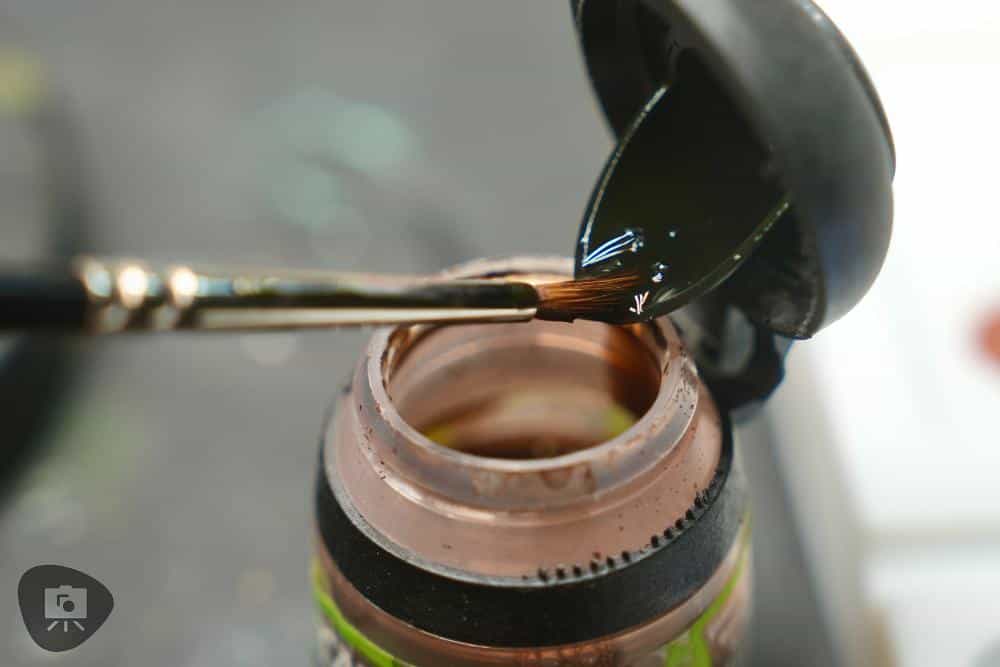
You want enough wash that it stays on the brush without threatening to drip off. Aim for control, control, control.
Step 4. “Roll the Brush” Onto the Model
Rather than “painting” the shade on, think of “rolling” it onto the surface. Roll the bristles onto your model, letting the shade pool.

Use a gentle motion with almost no pressure. Let the shade leave the brush naturally, then guide it into the recesses where shadows belong. The shade should balance within and stick to recesses.

At this stage, you’re placing the wash and not spreading it thin. Deposit a shade; it’s not painting. Continue below to see what I mean.

Step 5. Control the Shade Coat
Drag the brush. Don’t scrub. Don’t paint.
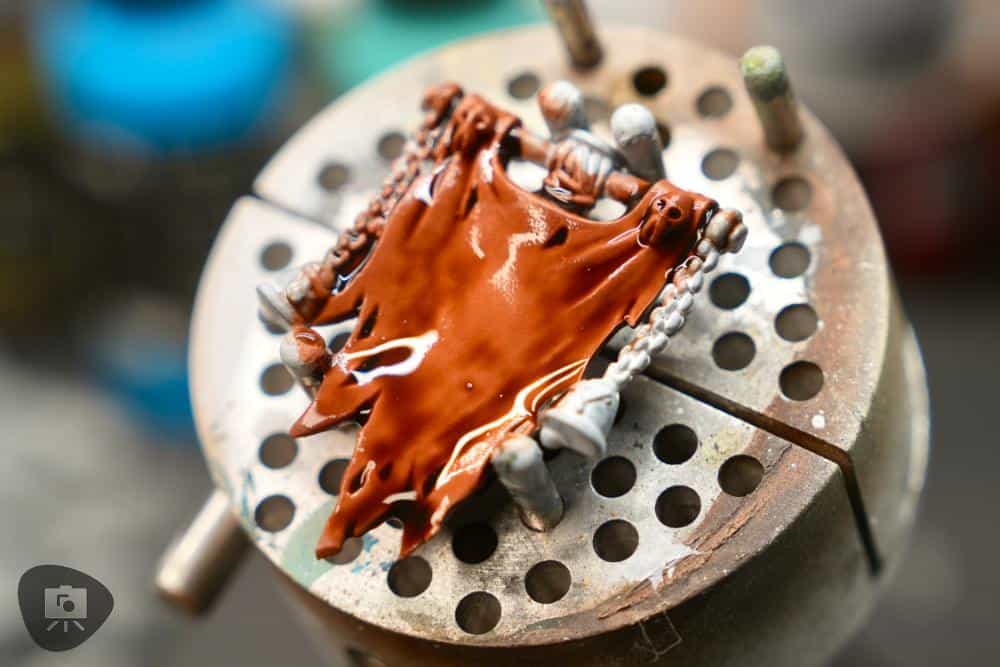
The wash does not need to be thin. It needs to pool. Pooling is where the shade does its real work. Pigment gathers in recesses and low points, darkening them automatically.

This is the key strength of washes. They place shadows for you, creating contrast without careful brushwork. It should be easy and satisfying. No fuss.

Step 6. Let the Shade Dry Completely
The most important part of shading is knowing when to stop.
As the wash dries, you’ll see a thin film form across the surface, similar to the crust on a pie. Once that film starts to form, don’t touch it!
Set the model down and walk away. Most washes dry within 5 to 10 minutes.

Step 7. Done. Inspect the Result
Let air exposure do the work. Disturbing a drying wash is the fastest way to ruin the finish.
Once dry, evaluate the model.

Is the contrast strong enough?
If yes, you’re ready to move on.

If not, apply another layer of wash and let it dry fully again. Multiple controlled passes are better than trying to force results in one go.
This is your call. You’re done when you think the areas of shadow are dark enough for you.
Remember, that the more layers of shade/wash you add, the darker the overall model will become.
Don’t worry, you can bring back the brightness in later steps by painting over a bit of the raised areas with your original basecoat paint color again.

Conclusion
That’s it. This is the simplest and most effective way to add contrast to a miniature.
Shading brings depth and definition to your work. It creates the foundation that makes highlighting meaningful later on.
In the next step, contrast is pushed further through highlights—but that’s a different discussion.
For now, you’ve learned the most impactful and accessible shading method available.
Until next time, happy miniature painting!
Comments, questions? Leave me a message below.
Enjoying Your Visit? Join Tangible Day
Free newsletter with monthly updates (no spam)


Tangible Day on YouTube (Miniatures and More!)