Ever spent an hour perfecting the light reflection on a single gemstone? Or repainting a shoulder pad three times because the edge highlight didn’t “feel right”? If that’s you, you’re not alone—and more importantly, that level of focus reflects something meaningful about how your brain engages with creative work. It reveals a capacity for depth, patience, and craftsmanship that psychologists and researchers increasingly recognize as valuable.
In this article, I share what I’ve learned from the literature about the often, maligned laser-focus you have for detail and getting things just right.

RELATED: Beating Perfectionism: When ‘Done’ Has to Be Enough
Key Points:
- Understand why your attention to detail is a strength, not a flaw, through insights from personality psychology and cognitive science.
- Learn how miniature painting taps into flow, motivation, and emotional resilience, helping you stay focused, calm, and creatively fulfilled.
- Recognize common challenges like perfectionism or burnout—and how to work with them, so your passion stays balanced and rewarding.
You’re Wired for Detail: The Psychology of Precision
When you find yourself totally absorbed in the tiny textures of a base or the subtle blend on a cloak, your brain is exhibiting traits strongly associated with two major personality dimensions: Conscientiousness and Openness to Experience.
- Conscientiousness, one of the Big Five personality traits, reflects diligence, order, and attention to precision. People high in this trait tend to be structured, persistent, and detail-focused—ideal for methodical tasks like miniature painting or scale modeling (Chamorro-Premuzic & Furnham, 2014).
- Openness, on the other hand, drives curiosity, imagination, and aesthetic appreciation. If you find joy in experimenting with colors or textures, or if you chase a certain “look” that only you can see clearly in your mind, that’s your openness at play.
These two traits often work in tandem in the miniature hobbyist. You’re not just interested in how to paint something—you’re fascinated by what could be, and driven to get it just right.

A survey of hobby gamers found that those most engaged in the painting and crafting aspects often score high on both traits, suggesting an ideal personality “fit” for detailed creative expression (Chamorro-Premuzic & Furnham, 2014).
The Cognitive Superpower of Seeing the Small Stuff
You’re not alone in the (sometimes annoying) level of vigilance you have for seeing detail. Many of us are haunted by making sure everything is “in-order”. Yes, certainly there’s some abnormal extremes, but under many circumstances, this instinct is powerful.
What you might think of as “obsessing” is actually a unique form of cognitive focus. At the core of this ability is something called selective attention—your brain’s way of spotlighting a specific visual task and tuning out distractions.

Neurologically, this activates networks across the visual cortex and executive regions that allow you to lock onto details with high accuracy. This is often referred to as local processing—noticing the parts, rather than the whole. Some individuals are naturally inclined toward this style of perception, and artists tend to be particularly flexible in switching between local and global focus (Winner et al., 2024).
Maybe this is you?
If so, remember: it’s more than perception (e.g., seeing things)—it’s a visual-spatial cognition too—a way of thinking with your eyes.
When you position tiny arms on a Warhammer figure or simulate rust patterns on a tank tread, your brain is solving complex 3D puzzles.
Studies show that artists and modelers outperform non-artists in tasks like mental rotation and shape discrimination (Winner et al., 2024). Your ability to imagine how a piece looks from multiple angles? That’s trained visuospatial strength.
Born or Bred? Thinking Different?
The way we think is shaped by both genetics and experience. Maybe, like me, you didn’t get here by following the usual path. You figured things out the hard way—through struggle, curiosity, and making sense of things others overlooked.
Some people walk the trail. Others cut through the brush.
That kind of effort leaves marks. It may have scarred you, too. But it also gives you a way of seeing the world—through structure, texture, and patterns—that others miss. What feels like compulsion is often just persistence dressed in grit.
This detail-focused way of thinking? It’s not something you picked up last week. It’s a mindset you’ve been building for years—one careful step at a time.
Flow State: The Zone Where Everything Clicks
Let’s talk about flow—that magical, fully immersive state where time disappears and the only thing that exists is the model in front of you. Psychologist Mihály Csíkszentmihályi described flow as the ultimate state of engagement, marked by deep focus, high challenge, and intrinsic enjoyment.
When you’re painting fine details, you’re likely hitting every one of those conditions:
- A challenging but achievable task
- Immediate feedback (e.g., visual progress)
- A sense of control and immersion
Neuroscience backs this up. Flow states activate the locus coeruleus-norepinephrine system, which regulates arousal and focus in the brain (van der Linden et al., 2021). This creates a calm-but-alert mental state that’s both relaxing and energizing.
And the best part? You’re probably doing it for its own sake. That’s intrinsic motivation, a cornerstone of sustained creativity. According to Self-Determination Theory, intrinsic pursuits satisfy our needs for mastery and autonomy—and painting miniatures delivers both in spades.
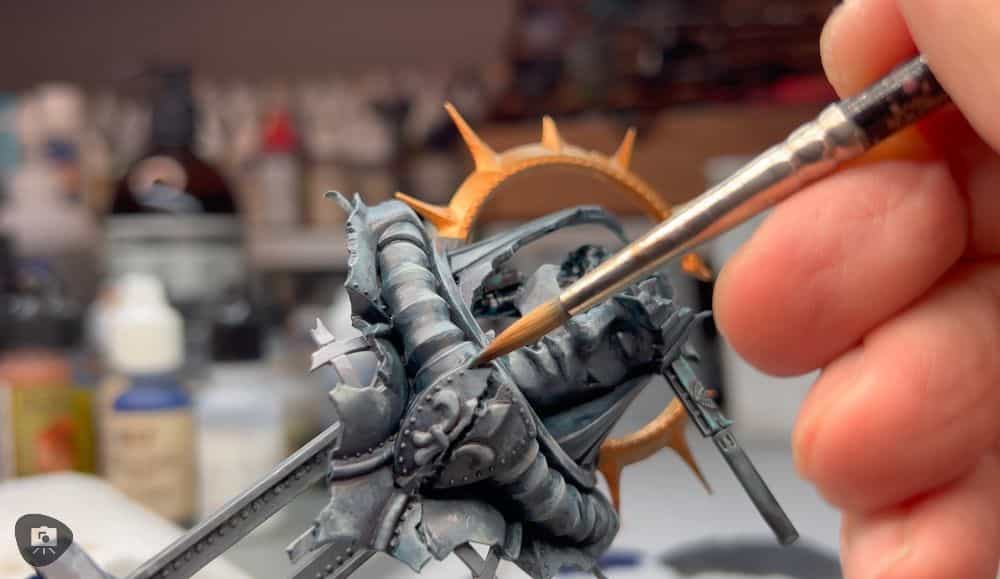
Training Your Brain to Focus: Painting Miniatures
Painting small models engages your mind in ways that go far beyond the surface. Each session builds skills that sharpen your focus, coordination, and creative problem-solving. Here’s what that kind of work develops over time:
- Cognitive Reserve: Engaging in arts and crafts has been shown to reduce age-related memory decline. One major study found that elderly individuals who pursued regular creative hobbies were significantly less likely to develop cognitive impairments (Sifferlin, 2015).
- Fine Motor Skills: Steady brush control and physical precision enhance motor cortex pathways, a kind of neuromuscular mindfulness.
- Pattern Recognition: Identifying micro-patterns in armor plates or fabric folds sharpens your visual analysis and memory.
This is supported by neuroscience. Visual artists show increased neural connectivity in regions responsible for spatial reasoning and attention control (Winner et al., 2024).
Tiny Tasks, Big Rewards: Emotional and Mental Health Benefits
Many detail-oriented painters report a calming, almost meditative effect from their hobby—and there’s data to support this.
- Activities like painting have been shown to reduce cortisol levels, the body’s main stress hormone.
- Flow states increase dopamine activity, providing a sense of pleasure and motivation even without external rewards (van der Linden et al., 2021).
- Arts and crafts are associated with improved life satisfaction and reduced depression symptoms, even when controlled for other lifestyle factors (Keyes et al., 2024).
This kind of focus acts as a powerful buffer against stress, anxiety, and burnout. It engages your mind deeply and creates a calming, restorative effect on your nervous system.
But Be Honest… Ever Got Stuck in the Details?
Here’s where the flip side comes in: perfectionism, burnout, and hyperfocus can creep in.
- Maladaptive perfectionism leads to over-editing, never finishing, and anxiety around “ruining” something that’s not perfect (Dorwart, 2023).
- Burnout happens when hobby time becomes pressure-filled—rushing for contests, comparing to others, or chasing perfection.
- Neurodivergent overlap: People with ADHD may experience hyperfocus, an intense, immersive state that can lead to time blindness (Child Mind Institute, 2021). On the autism spectrum, extraordinary pattern recognition and detail obsession can be both a gift and a struggle (Woods et al., 2023).
These patterns reflect different cognitive styles, each with its own strengths and challenges. Many ADHD or autistic hobbyists thrive in this space, often using structure like timers or checklists to stay balanced and fulfilled.
Detail in Practice: The Miniature Hobbyist’s Mindset
Here’s what this looks like in real life:
- A painter spends 3 hours layering highlights on a cape—not because it’s necessary, but because it matters to them.
- A modeler kitbashes parts until they fit just so, guided by an internal vision no one else sees yet.
- A hobbyist glows when someone notices the tiny scratch they added to a helmet that’s otherwise invisible.
Each act is a meditation. A statement. A form of personal excellence.
This attention to detail forms the core identity of many hobbyists. It’s what drives growth, builds community, and keeps the craft alive.
Conclusion: The Small Things Make the Big Picture
If you’ve ever wondered whether your obsession with detail is a “problem,” let this be your permission slip: It’s not. According to psychology and neuroscience, your ultra-attentiveness is a strength. It reflects a powerful mix of personality, cognitive flexibility, and emotional intelligence.
Every careful brushstroke adds to something meaningful. This kind of focus shows how deeply you care about the process.
I hope you found this article interesting—and that it gave you a new way to appreciate the focus and creativity you bring to your work.
Did I miss anything? I’d love to know what you think! Leave a comment below. 👇
References:
- Chamorro‑Premuzic, T., & Furnham, A. (2014). Personality and artistic creativity. In The Cambridge Handbook of Creativity and Personality Research (pp. ?). Cambridge University Press. URL: https://www.cambridge.org/core/books/cambridge-handbook-of-creativity-and-personality-research
- Winner, E., [et al.]. (2024). Visual arts training and spatial cognition. Scientific Reports. URL: https://www.nature.com/articles/s41598-024-68861-2
- van der Linden, D., Tops, M., & Bakker, A. B. (2021). The neuroscience of the flow state: Involvement of the locus coeruleus–norepinephrine system. Frontiers in Psychology, 12, 645498. URL: https://www.frontiersin.org/articles/10.3389/fpsyg.2021.645498/full
- Sifferlin, A. (2015, April 8). The health perks of arts and crafts for adults. TIME Magazine. URL: https://time.com/3814104/adults-arts-and-crafts/
- Keyes, H., Gradidge, S., Forwood, S. E., et al. (2024). Creating arts and crafting positively predicts subjective wellbeing. Frontiers in Public Health, 12, 1417997. URL: https://www.frontiersin.org/articles/10.3389/fpubh.2024.1417997/full
- Dorwart, L. (2023, June 12). Understanding the psychology behind perfectionism. Verywell Health. URL: https://www.verywellhealth.com/perfectionism-5323816
- Child Mind Institute. (2021). Hyperfocus: The flip side of ADHD? URL: https://childmind.org/article/hyperfocus-the-flip-side-of-adhd/
- Woods, S. E. O., & Estes, A. (2023). Toward a more comprehensive autism assessment: The Survey of Autistic Strengths, Skills, and Interests. Frontiers in Psychiatry, 14, 1264516. URL: https://www.frontiersin.org/articles/10.3389/fpsyt.2023.1264516/full
Enjoying Your Visit? Join Tangible Day
Free newsletter with monthly updates (no spam)



Tangible Day on YouTube (Miniatures and More!)