At some point in your miniature painting journey, you may wonder if you’ve reached a point where you’re considered “good”. Many years ago, I wondered this myself, whether my skills with a brush and paint had reached a level that could be admired and respected by others in the miniature painting community. It sounds vain, thinking that I wanted to know what others thought about my work.
But, for my personality, I felt I needed some objective measure to understand whether I had grown in skill. Art, of course, isn’t a static thing you do. You’re always looking to improve.

Enter money…
—Money is the objective measure we all use to assign value to a product or service. When you pay for a hamburger at your favorite food joint, how much you’re willing to pay is counter-balanced by the quality and service of the product, i.e., the hamburger.
When it comes to judging “things”, money allows a group of people to determine the worth of something.
And, so with money, you can make a case that a product or “widget” is valued to a certain level by an external conglomeration of factors—Here are a few: the demand for the widget; it’s uniqueness in the market place, and whether the consumer places some unknown factor x value on said widget.
The first Reason I started trying to sell my miniature painting service
The first reason I painted miniatures as a commissioned painter was to help my friends get paint on their tabletop wargaming miniatures. At the time, I was a PressGanger (a community organizer) representing Privateer Press for their tabletop wargame, Warmachine-Hordes. I ran events, leagues, and organized tournaments at our local game store.
As anyone knows, painted miniatures are more fun to game with than bare plastic or metal. And, as an avid painter and hobbyist, I loved getting my hands dirty, painting, assembling, and doing all the things that make a wargaming scenario come alive, e.g., making terrain and even writing fan story lore.

A kind of honeymoon period of the miniature painting service life
In the early (super fun) years of painting miniatures for other people, I didn’t charge much. What I was looking for was a group of people who enjoyed my work, thought that it worth a few dollars, and loved receiving my finished painted pieces.

For the most part, my customers were from my local gaming group who I also played games with. The jobs were small, random pieces that challenged my ability to understand what colors worked together, and how to meet the expectations, the vision that my customers expressed to me.
Painting miniatures as an amateur commissioned painter was a rollercoaster of challenges with few risks other than investing a bit of my time and subtle fear of not meeting my friends’ expectations (although they were very low at the time….).

I loved it. Low expectations, great fun for all, and the challenge for a budding miniature painter/artist (me) to hone their skill across a huge range of miniatures, of all complexity, types, and colors schemes. I learned so much and I was able to pocket a bit of side change. Commissioned miniature painting funded both my hobby and personal growth.
Then…commissioned miniature painting became work, but I learned something really important
As I got better a painting minis, faster and notably improving the way I created the finished models, I started charging a bit more money. And, it actually became a pretty good sum that I ended up being able to use a lot of it to experiment with fancier tools and equipment, e.g., better airbrushes, quality paint brushes, and such. Much of this went into this site’s expansion in sharing what I learned about what works and doesn’t.

Expectations leads to disappointment if left unchecked
But, as demand grew, so did expectations—mine and the people I painted for. And, because there’s a limited supply—there’s only one me—I started to really pick and choose what projects to accept. While this was nice for a while, as I worked on things that I felt showed off my skill or held a particular personal interest (like I wanted to paint purple Warhammer 40k Orks, and had that opportunity for a client), I slowly burnt out. I even wrote about why I stopped painting for money for a while.

Long story short, I discovered that I had fallen into the common painting service trap of putting external expectations and tying my finished outcome to monetary gain. Inside, I was painting not for personal enjoyment or a sense of growth in the art, but for the pay day and the grateful accolades for a customer well satisfied. My hobby, the art, had become “just a job”.
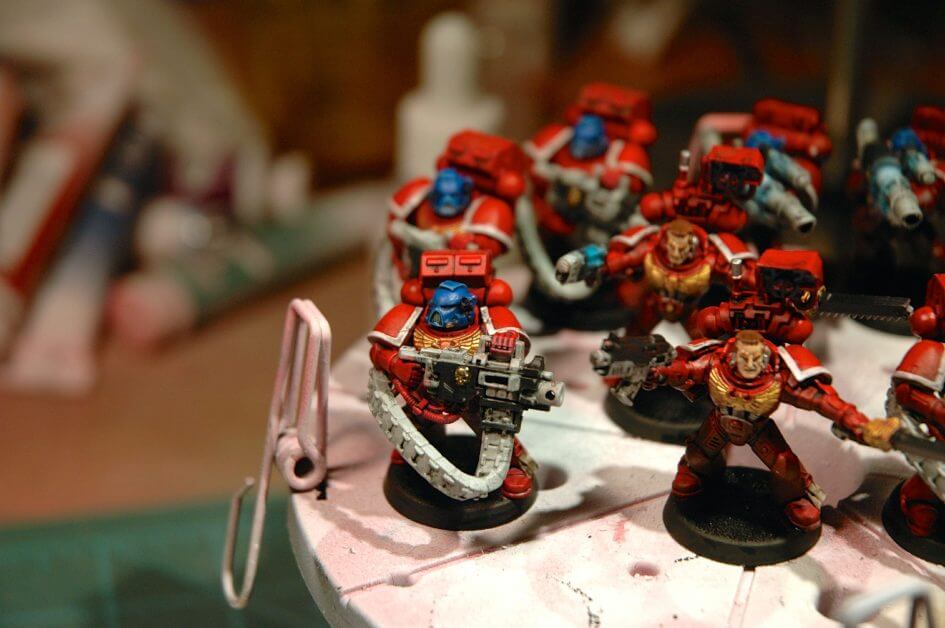
Painting miniatures for money dampens the artistic freedom that comes with the art.
And, so I took a prolonged break from painting anything. Just stopped cold. It hurt, and maybe there was a depression in there. Just too much pressure and not enough spark to ignite the thing that makes us feel good about the hobby itself. I kind of withdrew for a bit.
Eventually I came out of it, painting much more now, but here’s the lesson learned: Be wary of turning your hobby into a business, unless you’re prepared to endure it as a business.
The Best Reason to Paint Miniatures for Money (IMHO)
With the exception for those of you who may be painting for a company or studio, or need the side-income, and it is actually your way of living, I think the best reason to paint miniatures for money is to measure your skill against an established point of reference—what someone else is willing to pay you for your services.

In other words, I think painting miniatures is a good way to understand your progress in the hobby. When you try to sell your service, your effort, you see your outcome from an different perspective. You have to view your work through the lens of another person. And the more people you do work for, the more varied the perspectives you have.

Painting miniature for money helps you grow in skill. It pushes your boundaries of what you think you’re capable of, because you’re forced to meet an expectation. Painting miniatures on commission also places a deadline on your work. You won’t have the luxury of procrastination.
Learning to paint well ultimately requires you to finish the project to the best of your ability, or at least match someone else’s desired outcome. In either case, agreed upon transaction between service provider and client serves as a bridge to creates a relationship you can use to gauge your artistic character—the part of you that fears, loves, and endures to create (and finish) whatever final painted miniature you’re working on.
Deep down, with discipline—avoiding the trap of making it a job—I think painting miniatures for money makes you a better artist.
Conclusion
So, what do you think? Do other people pay you to paint miniatures? I hope you’re enjoying the process. Anyway, this was just my two cents into how I’m coming around to how I would like to approach commissioned miniature painting moving forward. The entire hobby has been a journey into understanding who I am as a person, a creator, and how much I enjoy sharing what I learn along the way.
Until next time, happy miniature painting! Let me know what you think with a comment below or write to me directly!
Enjoying Your Visit? Join Tangible Day
Free newsletter with monthly updates (no spam)


Tangible Day on YouTube (Miniatures and More!)