
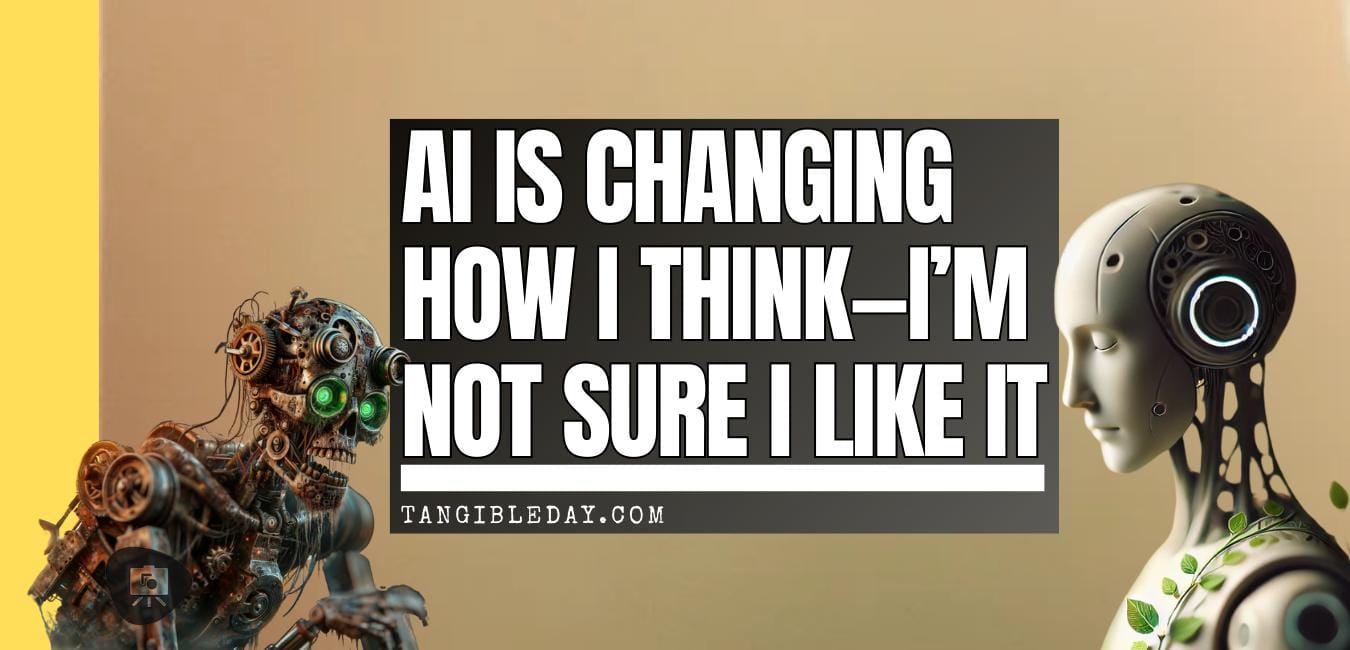
Have you ever caught yourself relying a little too much on AI? Maybe it started small—using a tool to rewrite a sentence, generate an idea, or find the perfect phrasing. Before you knew it, though, you started wondering: am I still thinking as deeply as I used to? AI is everywhere, and while it’s an incredible tool, I can’t shake the feeling that it’s changing how I interact with my own thoughts. It’s convenient, yes, but does that come at a cost?
I’ve been sitting with this question for a while now, and the more I think about it, the more I see it creeping into everything—how I write, how I problem-solve, even how I search for answers. Maybe you’ve felt it too. Let’s talk about it.
The Slow Erosion in Thinking
I’ve been using AI for a while now. For writing, for brainstorming, for problem-solving. It’s a tool. A useful one. But lately, something’s been gnawing at me, this feeling—this sense—that something is slipping. Not all at once, not in a way I can easily point to, but a slow erosion. My ability to sit with a complicated thought and really work through it, like kneading dough, stretching and folding until something takes form. Writing especially.

It’s like I can feel it happening in real-time. I sit at my computer, fingers hovering, waiting for that deep pull of thinking, and instead—this hesitation. Because there’s always that option now. That easy way to offload the hard part, to take a shortcut. I’ve explored this more deeply in my reflections on how AI tools impact creativity.
I catch myself second-guessing. Not just the words I put down, but whether they’re even mine. I know I wrote them, but AI shapes the way I think. If a thought is fed back to me in a slightly more polished way, do I start to accept that version as better? As mine?
And if everything starts getting filtered through an algorithm—whether it’s a sentence, an idea, or just some piece of information I was trying to look up—how much of what I know is actually something I came to on my own?
The Hollowing Out of Deep Thought
It’s the uncertainty. The small, creeping question that sneaks into everything I do. Every search, every response. Was that the answer I was looking for? Or was it just the most likely answer, pulled from some vast, averaged-out database of human knowledge?
And then there’s the deeper fear: what if this shapes how I think in ways I don’t even notice? What if, slowly, without realizing, I start to rely on it too much? AI changes how much effort I put into figuring things out. AI is already reshaping creativity in miniature painting and tabletop gaming.

A study published in Science Advances titled “Generative AI enhances individual creativity but reduces the collective diversity of novel content” explores the impact of generative AI on human creativity. Researchers found that while AI-generated story ideas helped individuals produce more creative and enjoyable writing, these AI-assisted stories tended to be more similar to each other. This suggests that while AI can boost individual creativity, it may also lead to a reduction in the overall diversity of creative content. The authors describe this as a social dilemma—AI offers individual advantages, but at the potential cost of collective novelty.

At the same time, AI is advancing at an unprecedented pace. Companies like DeepSeek and Open AI are pushing boundaries in AI efficiency, using models that optimize computing resources and challenge the dominance of established tech giants. These developments promise innovation but also raise concerns about dependence and the potential impact on human creativity.
Writing, the kind that requires sitting with an idea until it fully unspools, is more than just getting words on a page. It’s a process, a wrestling match. AI provides convenience, but sometimes, convenience can come at the cost of depth.
The Question of Value
I think about this a lot. What makes something we create valuable? Is it the struggle? The process? The fact that we wrestled with something and came out the other side with something that wasn’t there before?
And if AI makes that struggle optional, does it also make the final product mean less?

I don’t have a neat answer for this. Maybe no one does. But I keep coming back to this feeling, this unease, that if I let AI smooth out all the rough edges, I’ll lose something I didn’t even realize I was holding onto.
Touching the World Again
Maybe the answer is to step away more often.
Less scrolling. Less tapping. Less feeding prompts into a machine to see what comes back. More time in places where things don’t happen instantly. Where there’s no autocomplete, no predictive text, no algorithm trying to nudge me in one direction or another.

A walk in the woods, where the only thing dictating the pace is my own legs. The weight of a pen scratching across real paper. The smell of ink. The way sunlight catches on the surface of a creek, moving in a way that no amount of pixels could ever really replicate. There’s something grounding about returning to analog experiences, like writing with a fountain pen.
We spend so much time looking at representations of the world—photos, videos, words—that sometimes we forget to actually be in it. AI can mimic a lot of things, but it can’t replace what it feels like to exist in a moment that no one else can replicate.
RELATED: AI CAN’T REPLACE FEAR
The Choice We Have
Every generation sees the ground shift beneath them. There was a time before microwaves, before the internet, before any of the things we now take for granted. People worried about what would be lost.
But the truth is, it’s about how much control we keep over how we engage with it.

So I’m not afraid of AI. I’m not fighting against it. But I also know that I don’t want to lose the things that make me feel present, connected. The things that remind me that I’m not just reacting to the world, but actually living in it.
That’s what matters.
Final Thoughts: What Do You Think?
I’m up late and no ruminating pipeline leads to rest like getting thoughts on page. Thanks for reading!
This is the twilight zone and we haven’t seen the ending yet. The twist is yet to come.
Leave a comment below. I’d love to know what you think. Is AI messing with your ability to think properly or creatively for yourself? Like it, or love it?
ABOUT THE AUTHOR

Andrew Tan is a writer, commissioned miniature painter, and longtime hobbyist with over 15 years of experience in the miniature painting and tabletop gaming community. A father of three, he lives in Connecticut, USA, where he balances family life with his passion for creativity—and more hobbies than he can count. As the founder of Tangible Day, he blends storytelling and artistry, offering insights, tutorials, and reflections on the miniature painting hobby. Whether he’s making discoveries in his studio, experimenting with new techniques, or sharing his journey through words, Andrew is always exploring ways to make art more accessible and enjoyable.
Enjoying Your Visit? Join Tangible Day
Free newsletter with monthly updates (no spam)


Tangible Day on YouTube (Miniatures and More!)
Great post Andrew. A lot of tough questions. I definitely get what you are saying. I sometimes find myself wanting to pull up AI to help me think, or feel out a idea completely which is helpful because sometimes it is able to bring up things you didn’t think about. When we come to the question: What makes something we create valuable? We have to try and remember, not everything has to be a struggle to be valuable. What if I was just out with my camera and grabbed a spontaneous once in a lifetime shot because I was in the right place, right time. I did no planning, setting up lights, etc but still, this is one of the best photos I’ve taken. A lot of time, we here people say: “I could do that” about art, OR, “anyone could do that”
But, did they?
No, so the struggle isn’t always in the process, sometimes it is the act of intent. How do we use these tools? How do we create something that still feel inherently ours?
I don’t know, I’m still struggling with all these things because I too get caught up in the idea that it should be hard. I’ve messed around with a lot of AI tools, creating images on Midjourney etc, but none of the work feels inherently mine. Countless hours spent, changing words, trying again to get it look just like I want and still. Even if I take it into Lightroom and PS and sort of put my touch on it. It still don’t feel like my photography or I don’t have that same connection to the work. I don’t feel ownership, no matter what. So, I talked in a circle and basically came out at the same place, no answers lol Just a head full of spinning thoughts
Ohh each of your questions could be an entire post … I have to think about this some more. Yeah, I kind of forgot what it was like NOT to have AI to fall back on. Like how did I feel making things before it??? I’m going to follow up.
Pingback: AI Can't Replicate This Essential Human Power - Tangible Day